Goldfield, Nevada: The Last Gold Rush, a Labor War, and the Hotel That Never Reopened
Goldfield sits along U.S. Route 95 in Esmeralda County, Nevada, at 5,689 feet, about 26 miles south of Tonopah and 247 miles southeast of Carson City. It is the seat of one of Nevada’s least-populated counties, and today only a few hundred people live there. That’s a hard fact to square with what this town was in 1907: briefly the largest city in Nevada, with more people than Reno, a downtown of brick banks and a four-story luxury hotel, and enough gold coming out of the ground to draw the attention of the President of the United States.
Few Western boomtowns packed as much into five years as Goldfield did. In less than a decade it produced one of the richest gold strikes in American history, one of the most bitter labor conflicts of the Progressive Era, a heavyweight-caliber prizefight staged purely as a publicity stunt, and a hotel so thoroughly associated with its own ghost stories that it has outlived almost everything else in town. All of it happened within about a five-year window before the boom went the way of every other Nevada gold camp.
In December 1907, mine owners convinced President Theodore Roosevelt to send federal troops into an American town where no significant violence had actually occurred — and it worked exactly as intended.
Discovery and the rush to the desert, 1902–1904
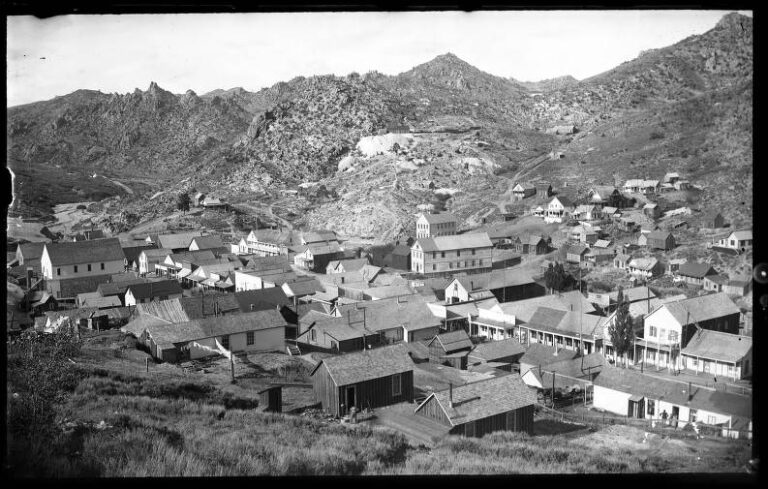
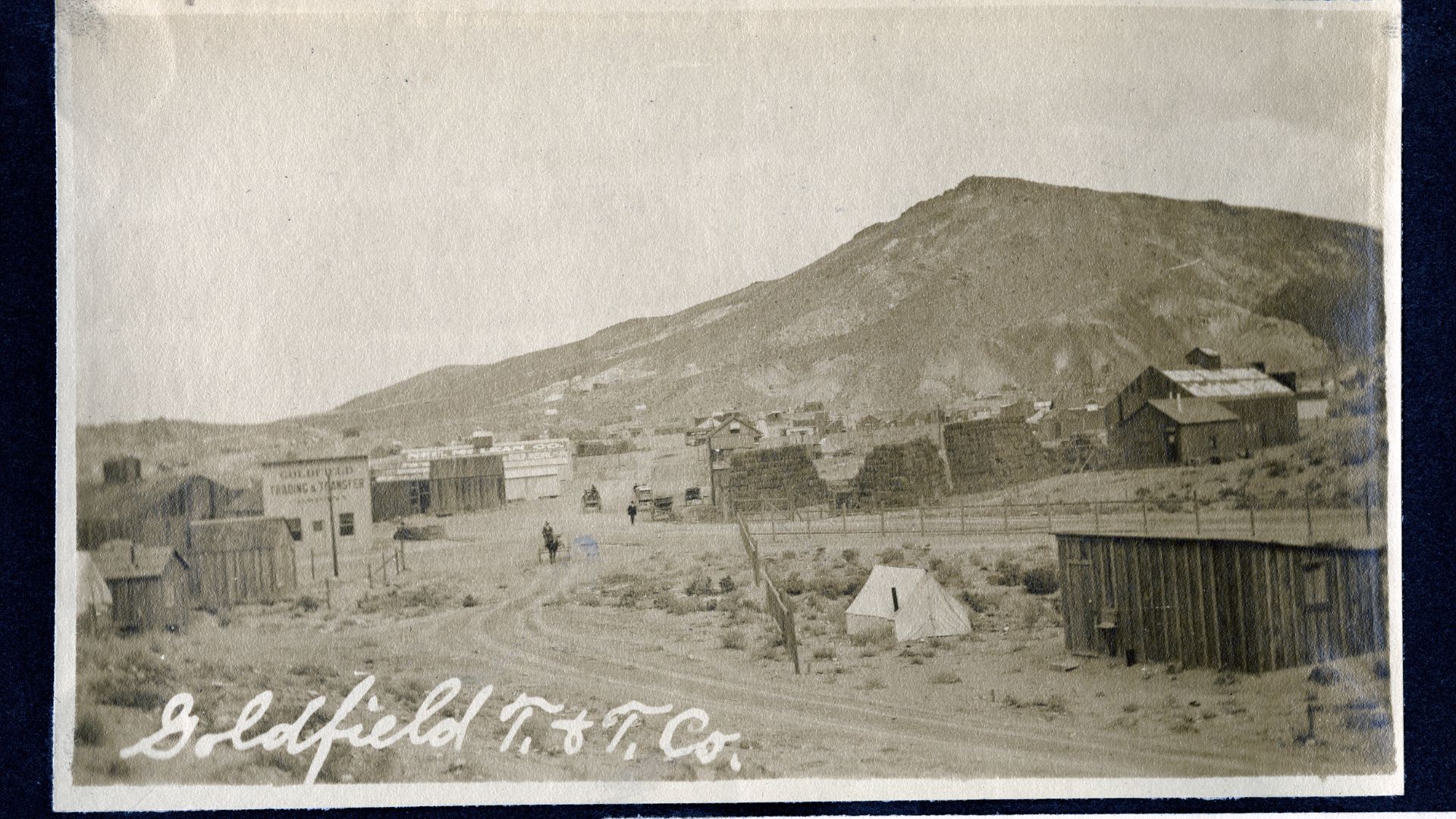
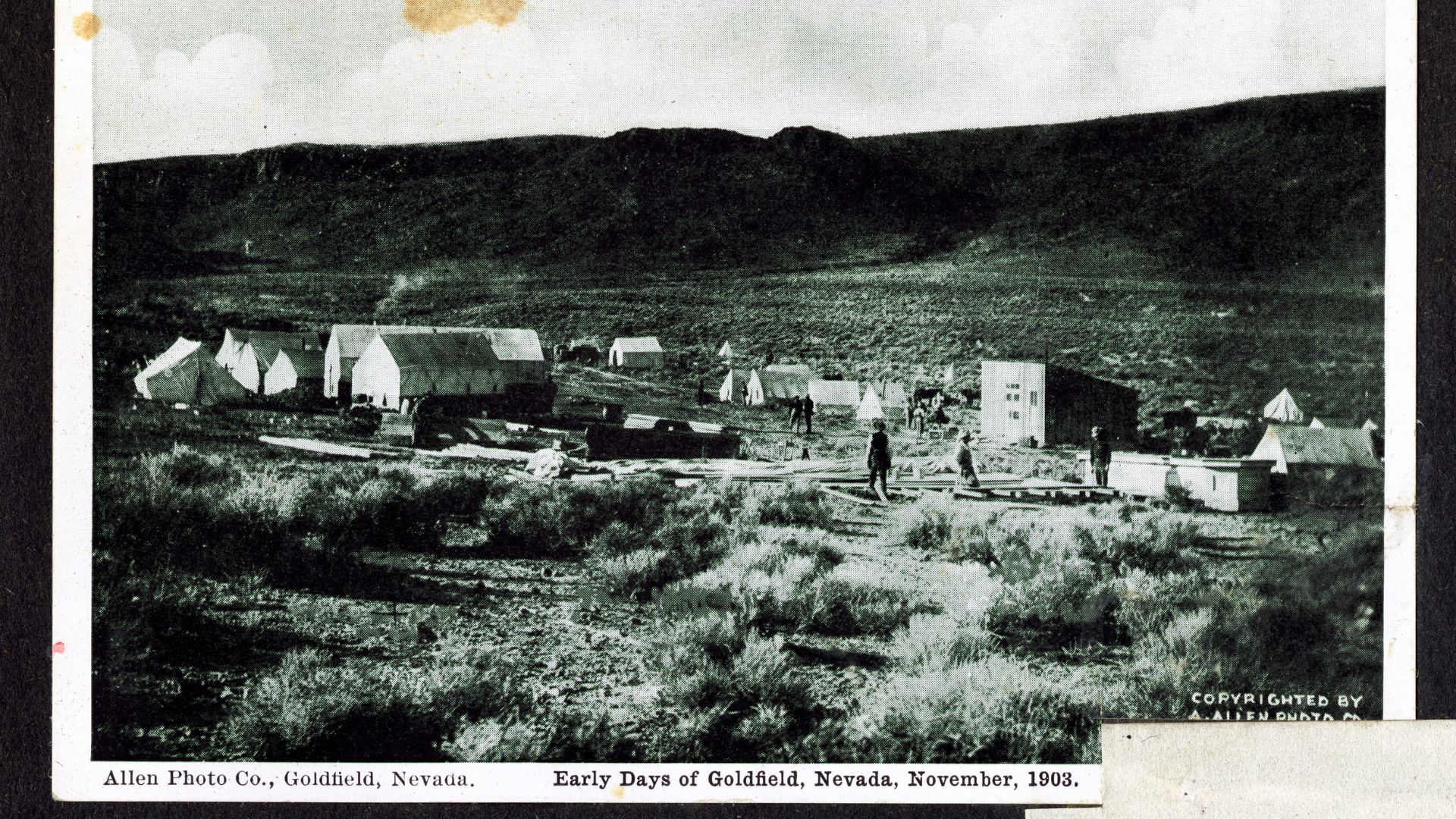
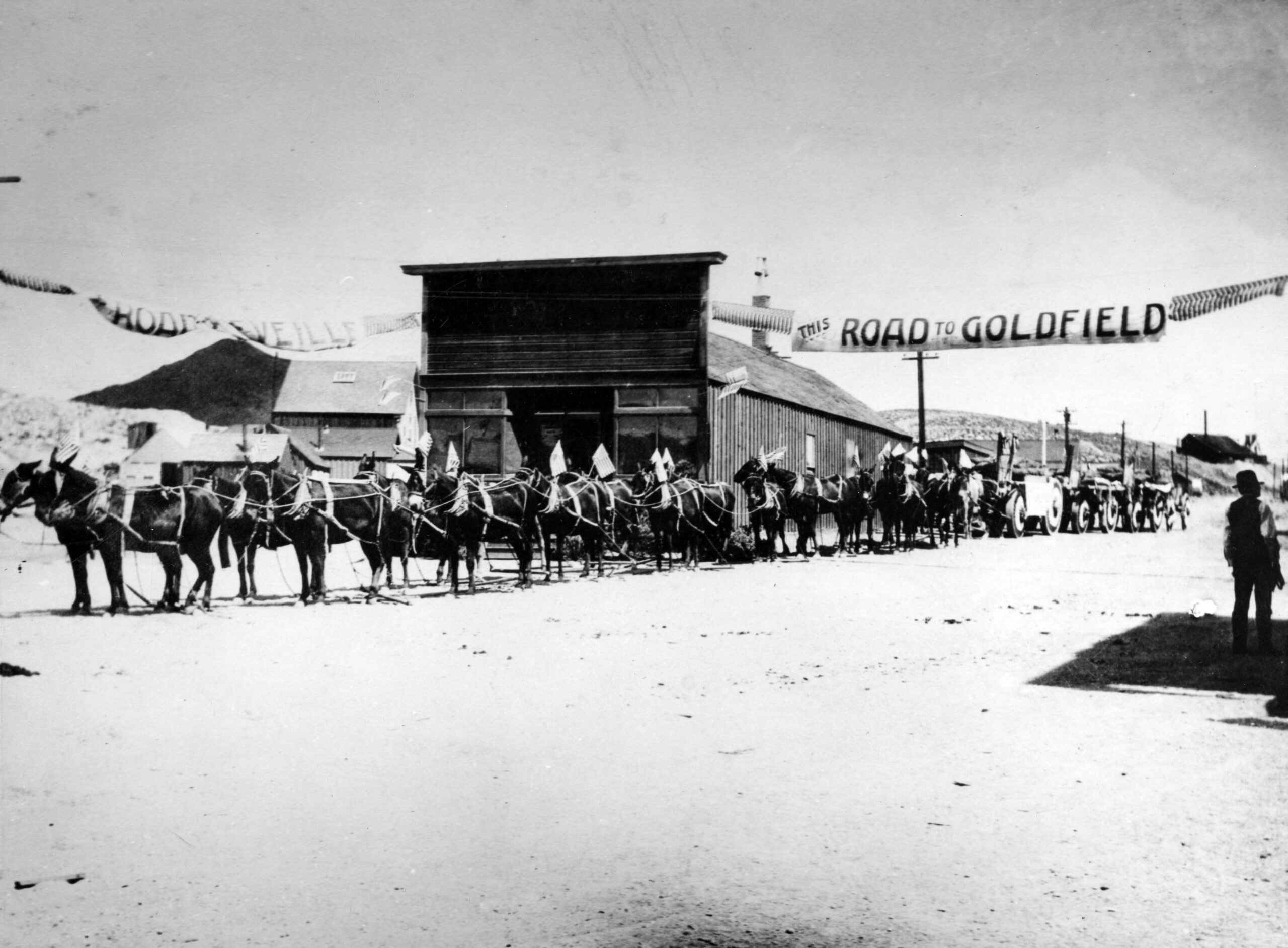
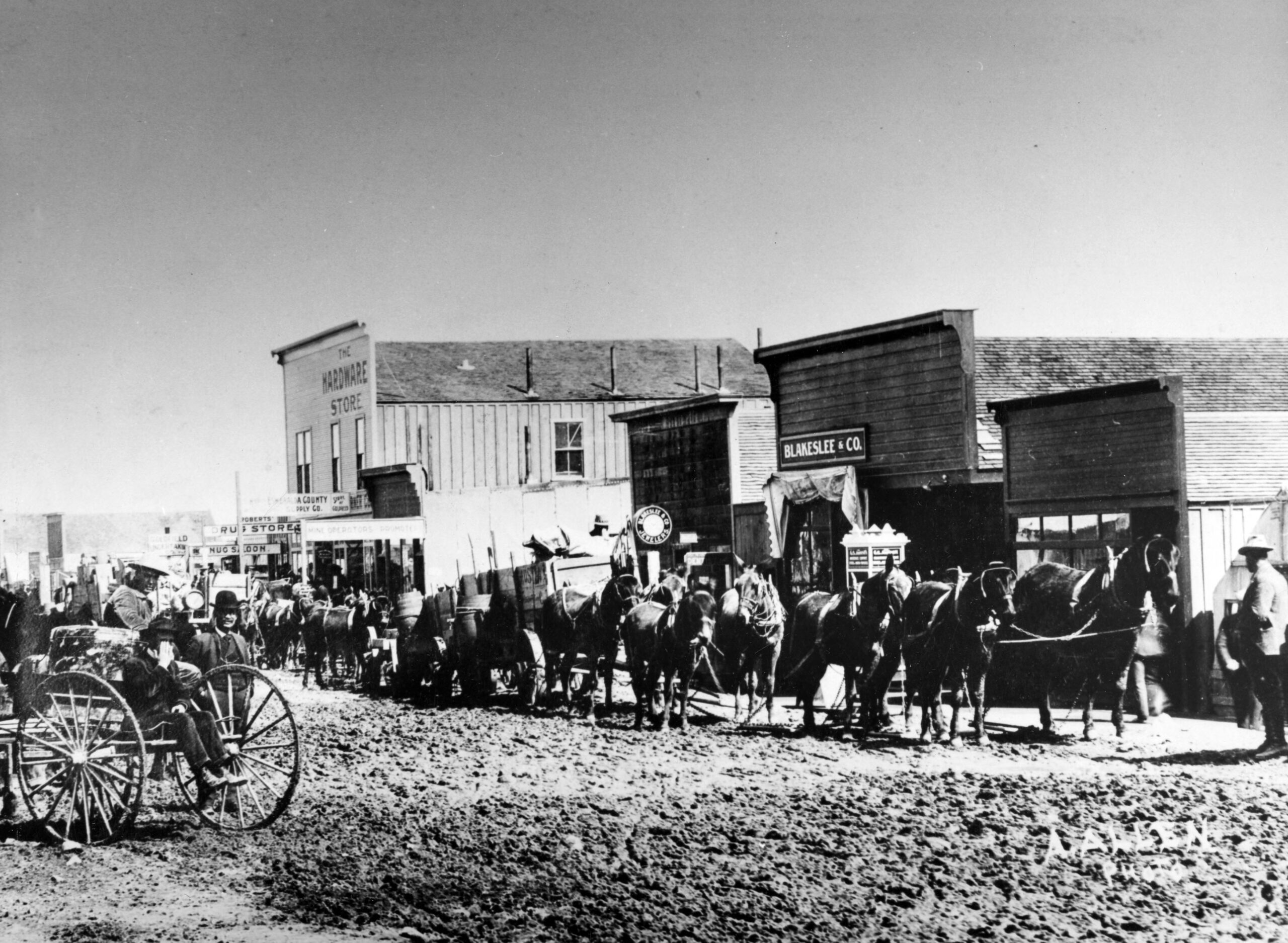
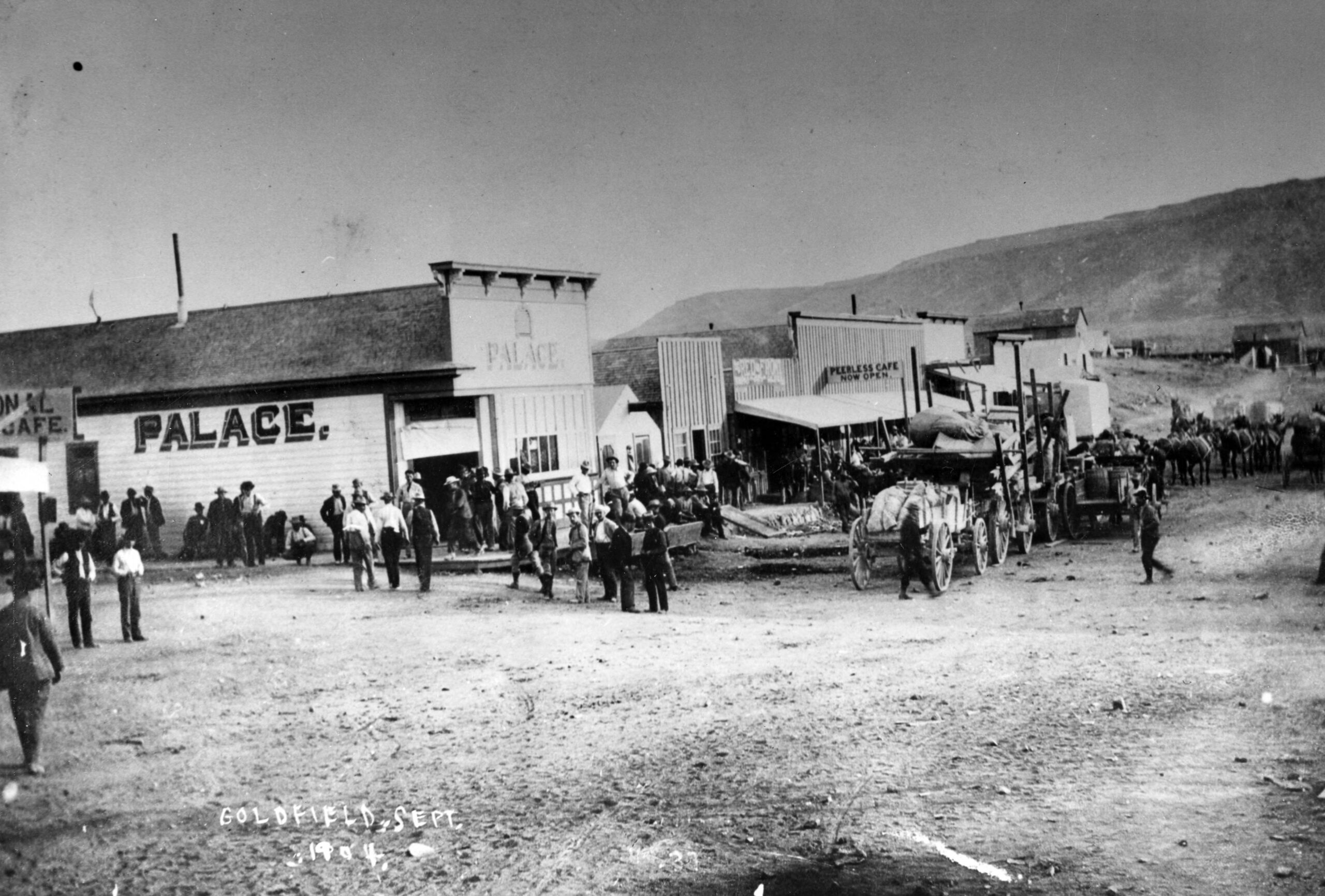
Prospectors Harry Stimler and Billy Marsh found gold-bearing rock in the hills of Esmeralda County in December 1902, and by 1903 word had spread far enough to pull people out of Tonopah — itself only two years into its own silver boom — and across the desert to the new strike. What started as a tent camp grew with startling speed. Within a few years Goldfield had its own railroad connection, the Tonopah and Goldfield Railroad, and a downtown solid enough to support brick banks, a hotel under construction, and a courthouse. By 1907 estimates put the population as high as 20,000, briefly making Goldfield the largest town in Nevada.
High-grading, change rooms, and a labor war
Goldfield’s mines became one of the country’s fiercest battlegrounds for radical labor unionism. Miners organized jointly under the Western Federation of Miners and the Industrial Workers of the World, pushing for control not just over wages but over conditions and, to some degree, the town itself. At the center of the fight was “high-grading” — miners quietly pocketing rich ore specimens in their clothes, lunch pails, and boots. Workers treated it as an informal profit-sharing arrangement in a dangerous industry; mine owners, led by George Wingfield’s Goldfield Consolidated Mines Company, estimated it was costing them as much as 40 percent of total production.
Wingfield’s answer was the “change room” — a mandatory building where miners stripped naked and were inspected each time they moved between work clothes and street clothes. It triggered wildcat strikes and, on the other side, increasingly inventive smuggling: miners took to hollowing out the wooden handles of their copper candlesticks, the one piece of personal equipment allowed out of the mine, and packing them with gold dust.
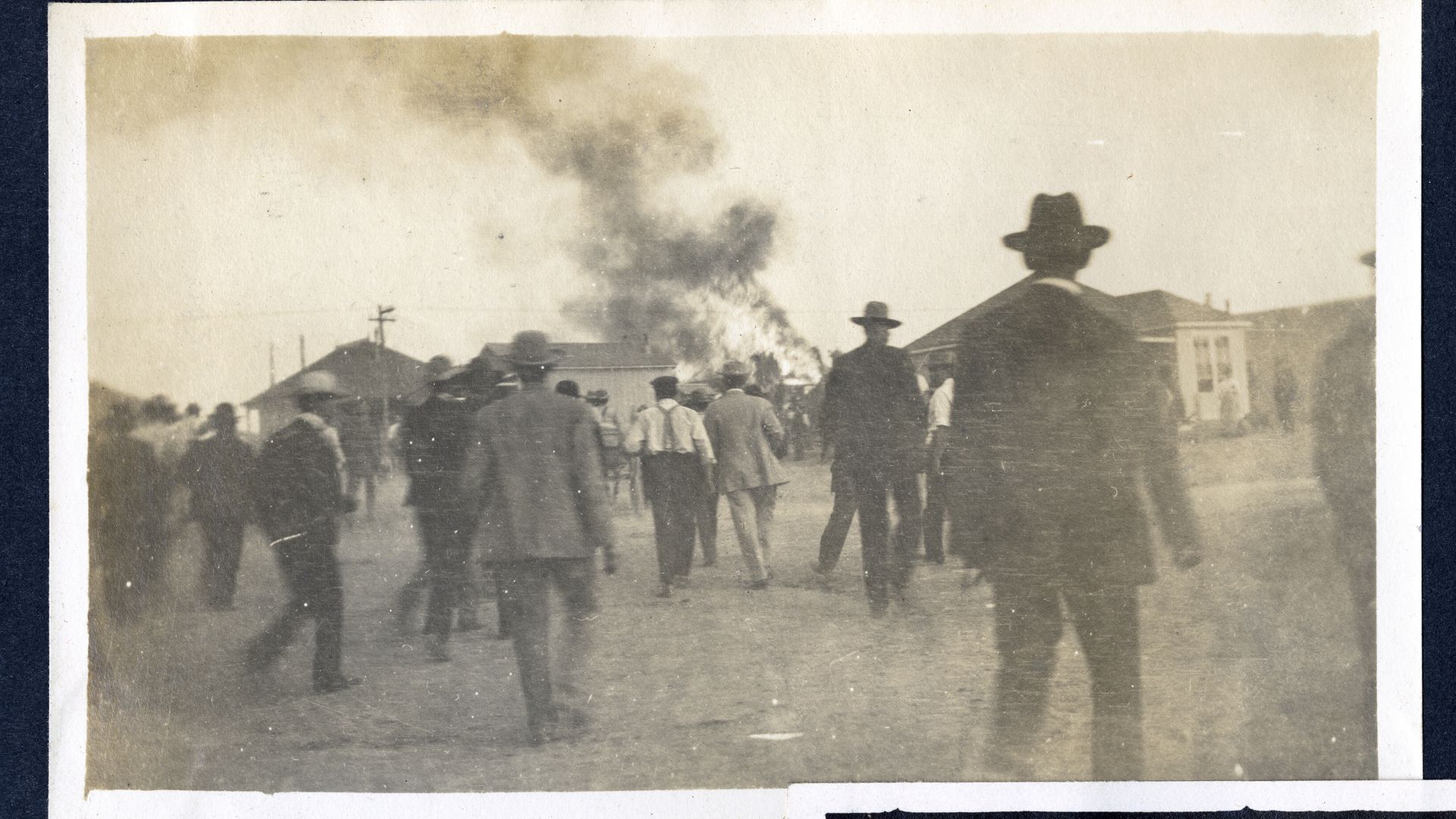
By December 1907, after more than a year of strikes, Wingfield and Nevada Governor John Sparks appealed directly to President Theodore Roosevelt, warning of an armed insurrection that, by most accounts, was not actually underway. Roosevelt sent 300 federal troops from the 22nd Infantry Regiment, who arrived on December 6, 1907. Mine owners moved immediately: wages were cut and WFM and IWW members were locked out of the mines entirely. The troops stayed until March 1908, by which point organized labor’s power in the district had been broken for good.
A championship fight, a transcontinental race, and the Earp brothers
Goldfield’s promoters were as ambitious as its mine owners. On September 3, 1906, boxing promoter Tex Rickard staged the World Lightweight Championship between Joe Gans and Oscar “Battling” Nelson in Goldfield purely to put the town on the map — he stacked $30,000 in gold coin in the town square to advertise the purse. Gans won in the 42nd round when Nelson was disqualified for a low blow. Rickard’s own house in Goldfield still stands and is part of the town’s walking tour.
Two years later, in 1908, the Great New York to Paris Auto Race — billed as the longest automobile race in the world — routed straight through Goldfield. The American-built Thomas Flyer, which went on to win the race, stopped at the Western Union office to check in and had lunch at the Goldfield Hotel before continuing west.
The Earp brothers were in town for the earlier boom years as well. Virgil Earp was appointed deputy sheriff of Esmeralda County in 1904 and served until he died of pneumonia in Goldfield in late 1905. His brother Wyatt Earp lived in town during the same stretch, working as a pit boss and guard for local saloons rather than as a lawman.
Diamondfield Jack Davis
Jackson Lee “Diamondfield Jack” Davis brought one of the more colorful résumés of anyone in Goldfield. In the late 1890s he worked as a hired gunman for Idaho cattle barons, enforcing range boundaries against sheep ranchers. In 1896 he was convicted of murdering two sheepherders and sentenced to hang; he sat on death row even after two other men confessed to the killings, and wasn’t fully pardoned until 1902.
Davis headed straight for the central Nevada gold rush after his release, staking claims five miles northeast of Goldfield in 1903 and laying out his own townsite, Diamondfield, complete with a toll road. He built a fortune in mining stocks, opposed the radical unions as a guard for mine owners, survived an assassination attempt in which he was shot in the jaw by an IWW operative, and was a fixture in the district’s armed disputes. He lost his fortune in the Great Depression and lived quietly until 1949, when he was struck and killed by a taxicab in Las Vegas.
The Goldfield Hotel
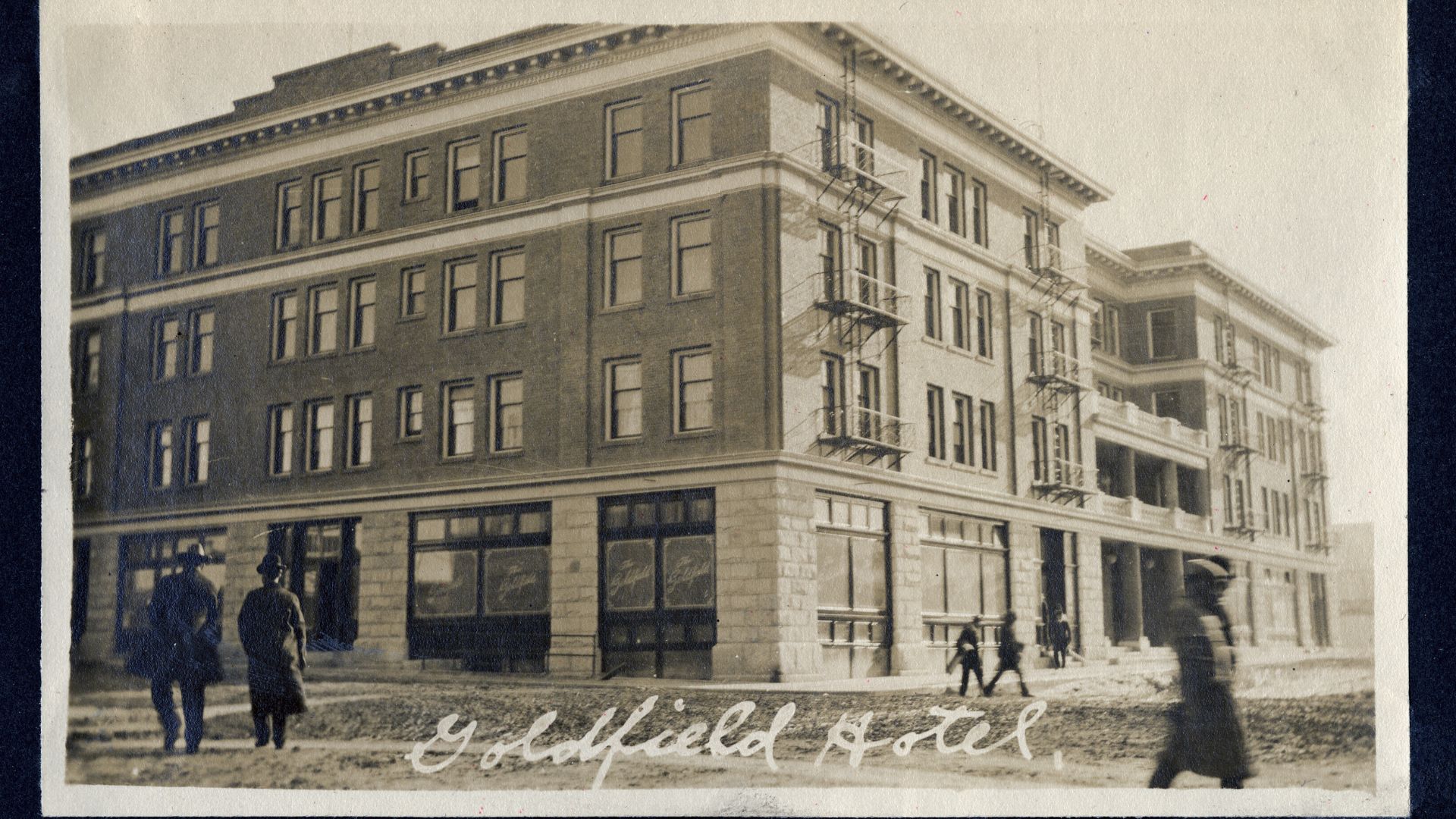
The Goldfield Hotel is the architectural centerpiece of the historic district. Designed by architects George E. Holesworth and Curtis and built in 1907–1908 by the Hayes-Monette Syndicate together with George Wingfield, the four-story brick and stone building cost over $300,000 — a staggering sum for the place and period. Its 154 to 200 rooms opened with mahogany paneling, crystal chandeliers, black leather furnishings, gold-leaf ceilings, European chefs, and an Otis electric elevator, one of the first operating west of the Mississippi.
The hotel’s fortunes tracked the town’s. As Goldfield’s economy contracted through the 1920s and 1930s, it slid into use as a low-cost boarding house. During World War II the U.S. government leased the building to quarter officers stationed at the Tonopah Army Airfield a few miles north. When the troops left at the war’s end, the hotel closed for good in 1946. It has changed hands several times since, but the building remains unrestored and unoccupied.
Fire, decline, and what survives today
A devastating fire tore through downtown Goldfield in 1923, taking a heavy toll on a town whose population and mining output had already been sliding for over a decade. Even so, Goldfield never became a true abandoned ghost town. Roughly 120 historic structures spanning about 35 city blocks survive within the Goldfield Historic District, and a few hundred residents still call it home today, making it a living community rather than a ruin.
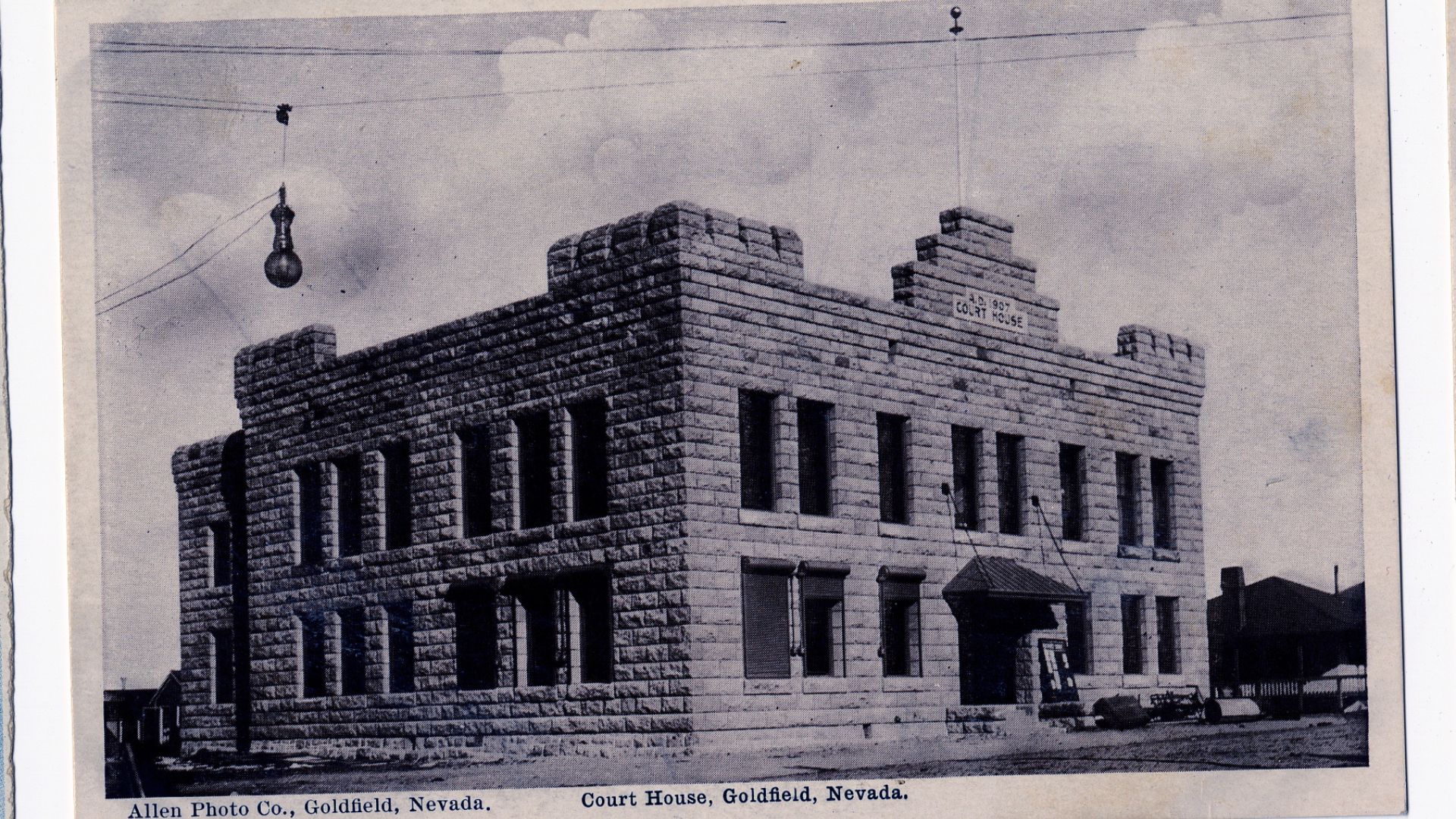
The Esmeralda County Courthouse, built in 1907–1908, is a two-story stone building with an attached historic jail that remains in continuous official use as an active civic courthouse. The Goldfield Historic High School, built in 1907, is a 12-room, 20,000-square-foot, three-story stone and brick building currently undergoing preservation and open by appointment. Other survivors include the Santa Fe Saloon, one of Nevada’s oldest continuously operating saloons; the old Tonopah and Goldfield Railroad Office and John S. Cook & Co. Bank building; and several preserved residences, including Tex Rickard’s house.
Goldfield timeline
Ghost towns nearby
Further reading
Sources
Western Mining History — Goldfield Nevada — production figures, labor conflict, and mine ownership history
NoeHill Travels — National Register #82003213: Goldfield Historic District — historic district boundaries and surviving structure count
Legends of America — Goldfield, Nevada — Queen of the Mining Camps — general history, Earp brothers, Diamondfield Jack
Nevada Expeditions — Goldfield — geographic and settlement details
Travel Nevada — Goldfield Historic Walking Tour, Goldfield Historic High School & Goldfield Visitor’s Center — current visitor hours, fees, and access details
Nevada SHPO — Diamondfield Jack Davis — biography and Idaho murder trial background
Wikipedia — Goldfield, Nevada — population figures and general timeline
More ghost towns in Nevada: Rhyolite