Skidoo, California: Death Valley’s Gold Camp in the Clouds
CaliforniaGold & Silver MiningRuins · High-clearance road·~10 min read
Part of Death Valley ghost towns, with drive times and road notes for every town near the park.
Quick facts
What it is1906 gold camp in the Panamint Range, now a townsite marker, foundations and a stabilized stamp mill
Gold strikeJanuary 1906, by John Ramsey and John “One-Eye” Thompson
Peak populationAbout 500 to 700, in 1907
Post office1906 (as Hoveck) to 1917
Gold producedAbout 75,000 ounces, worth $1.5 to $1.6 million at the time
National RegisterListed 1974 as a historic district
Elevation5,689 feet
Coordinates36.4355, -117.1476
State / CountyCalifornia / Inyo County, in Death Valley National Park
⚠ High-clearance vehicle recommended · Day use only · No services or water · Open mine shafts · Stay out of the mill
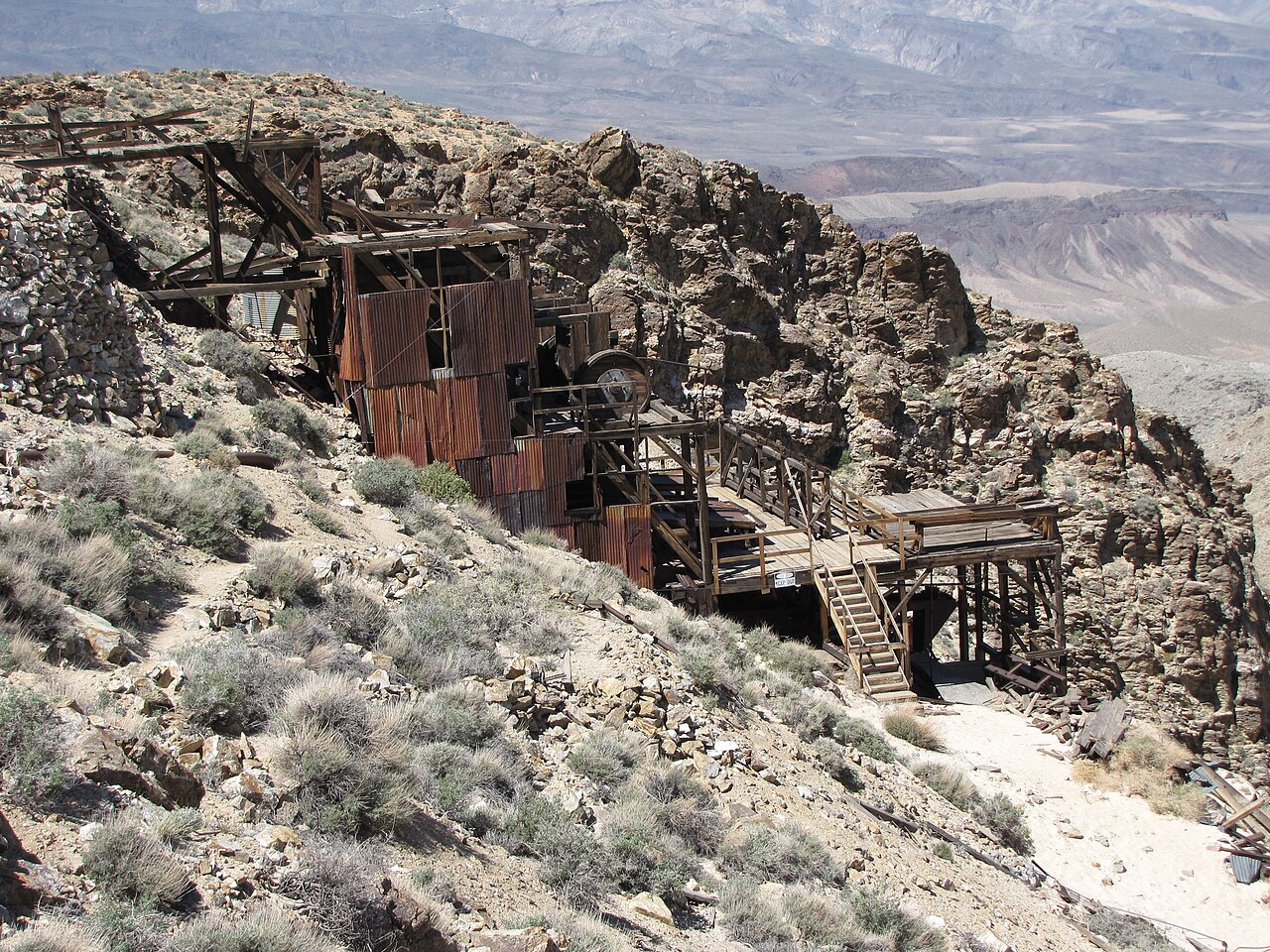
The Skidoo stamp mill on its hillside in the Panamint Range, 2009. Photo: Norm Kresge, CC BY 3.0, via Wikimedia Commons.
Skidoo was a gold camp built more than a mile above sea level in the Panamint Range, on the west side of what is now Death Valley National Park. Two prospectors found gold ledges here in January 1906 while waiting out a fog, and within a year the camp had a newspaper, a bank, a telephone line to Rhyolite and several hundred people. Its owners piped water from the slopes of Telescope Peak more than 20 miles across the mountains to run a stamp mill, and the mines turned out about $1.5 million in gold before closing in 1917. Skidoo is also remembered for Death Valley’s only lynching, in April 1908. Little of the town survives, but the mill still hangs on its hillside at the end of a rough dirt road.
Found in a fog
In January 1906, John Ramsey and John “One-Eye” Thompson were on their way to the new gold strike at Harrisburg, a few miles to the south, when fog forced them to camp near Emigrant Spring. According to the usual telling, when the fog lifted they spotted gold-bearing ledges on the hillside. The rock assayed at about $82 a ton, and the claims became the Gold Eagle group.
The claims were soon sold to E. A. “Bob” Montgomery, the mining promoter already famous for the Montgomery-Shoshone mine at Rhyolite. One account puts the price at $100,000. A townsite was laid out in the summer of 1906, and its post office opened that October under the name Hoveck, after Matt Hoveck, who managed the mine. Some accounts say the camp was also briefly called Montgomery.
On the discovery story: The fog-bound camp is how every history tells the find, but it rests on later retellings rather than records from 1906. Sources also disagree on Ramsey’s first name: most say John, one says Harry.
Twenty-three skidoo
The town took its lasting name from “23 skidoo,” a popular slang phrase of the day that meant roughly “scram” or “get out while you can.” The post office would not accept a number in a place name, so the 23 was dropped, and Hoveck became Skidoo in February 1907.
On the name: Many explanations are offered for why the miners chose a slang phrase built on the number 23: a pipeline 23 miles long, 23 original claims, or a claim staked on January 23. None of these can be confirmed, and the park’s own sign simply credits the slang.
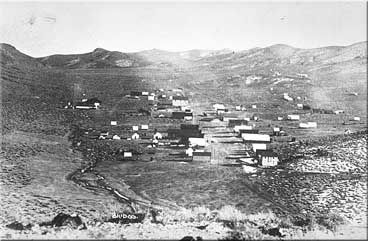
Skidoo in its first year, 1906.Photo: National Park Service archives, public domain
A town on the mountain
Skidoo grew fast through 1906 and 1907. One history counts about 130 buildings by April 1907. The camp had saloons, stores, a school, a telephone line to Rhyolite and the Skidoo News, a weekly paper that ran from November 1906 until about the summer of 1908. A branch of the Bank of Southern California opened in May 1907.
The boom was short. The financial panic of late 1907 dried up investment across the desert camps, the bank failed in 1908, and one account says only about 150 people were left by that summer. Unlike most Death Valley camps, though, Skidoo had real ore, and a smaller mining town carried on for almost another decade.
On the population: The National Park Service puts Skidoo’s peak at about 700 people, while the National Register nomination says “over 500” and other histories give 400 to 500 in 1907. This post gives the range.
Water from Telescope Peak
Gold was only half the problem at Skidoo. The mill needed water and power, and the hills around the camp had little of either. The Skidoo Mines Company built an 8-inch pipeline that carried water by gravity from Birch Spring in Jail Canyon, high on the slopes of Telescope Peak, across the mountains to the mill. The work cost somewhere between $200,000 and $250,000, a huge sum for the time, and water reached Skidoo near the end of 1907.
The water did double duty. Besides supplying the mill, it was dropped down the hillside to turn the machinery, which made the Skidoo mill the only water-powered mill in Death Valley.
On the pipeline’s length: The park’s signs call it a 23-mile pipeline, which may have helped the “23 skidoo” story along. The National Register nomination and a state mining report from 1915 to 1916 give 21 miles, and other accounts say 18 to 22.
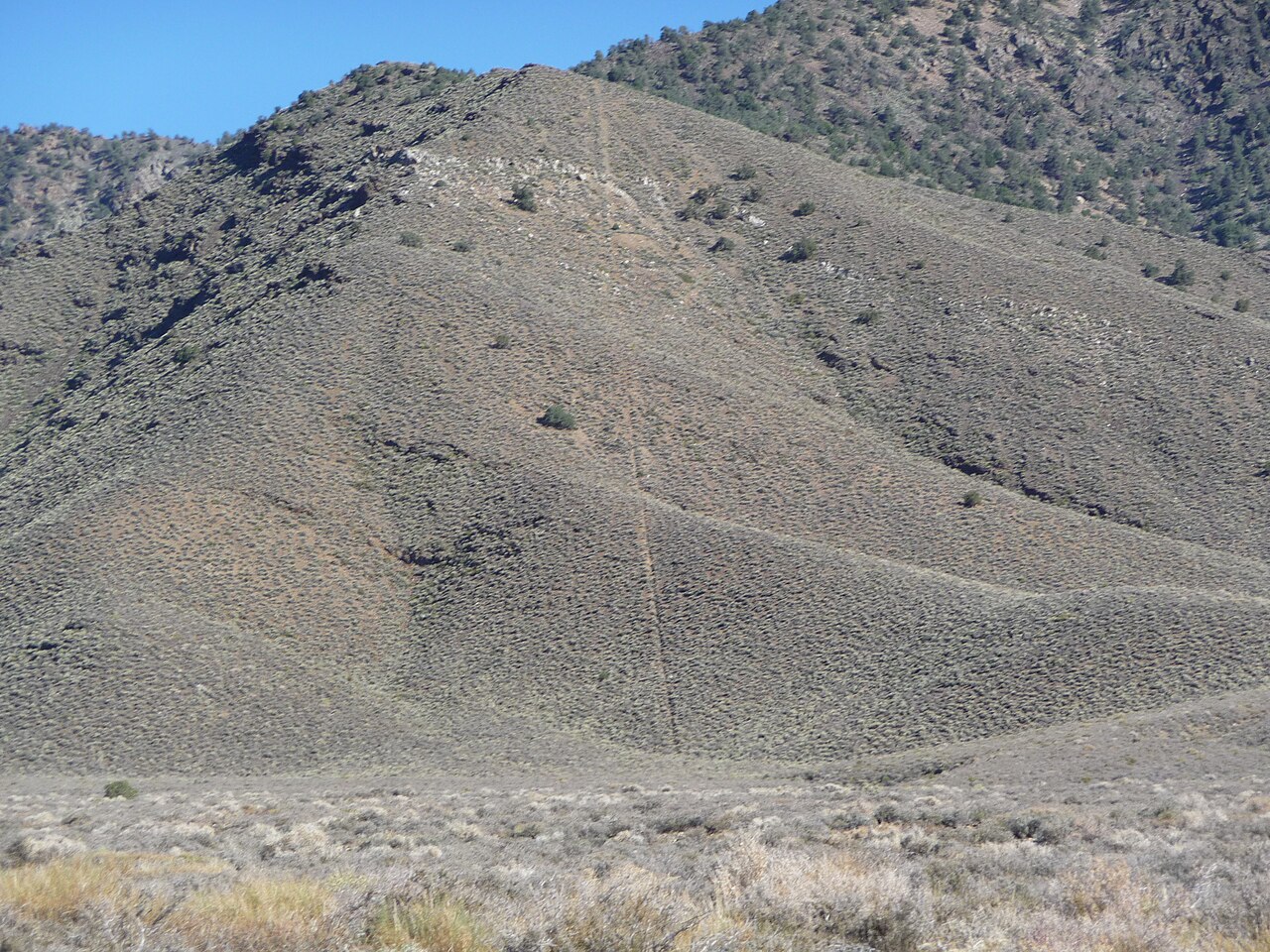
The line of the old water pipeline still shows on the hillsides.Photo: Daniel Mayer, CC BY-SA 3.0, via Wikimedia Commons
The mill
The company’s mill started with 10 stamps, which were running by June 1908. The stamps crushed the ore, mercury caught the free gold, and a cyanide process recovered more from what was left. The company paid its first dividend in 1909.
According to one history, the mill had a hard year in 1913. The pipeline froze that January, and in June a fire destroyed most of the mill, a loss put at $50,000. It was rebuilt with 10 stamps by October, and five more were added in 1915, bringing it to the 15 stamps that stand today. By the time the main mine closed in 1917, Skidoo had produced about 75,000 ounces of gold, worth roughly $1.5 to $1.6 million then. The post office closed on October 31, 1917.
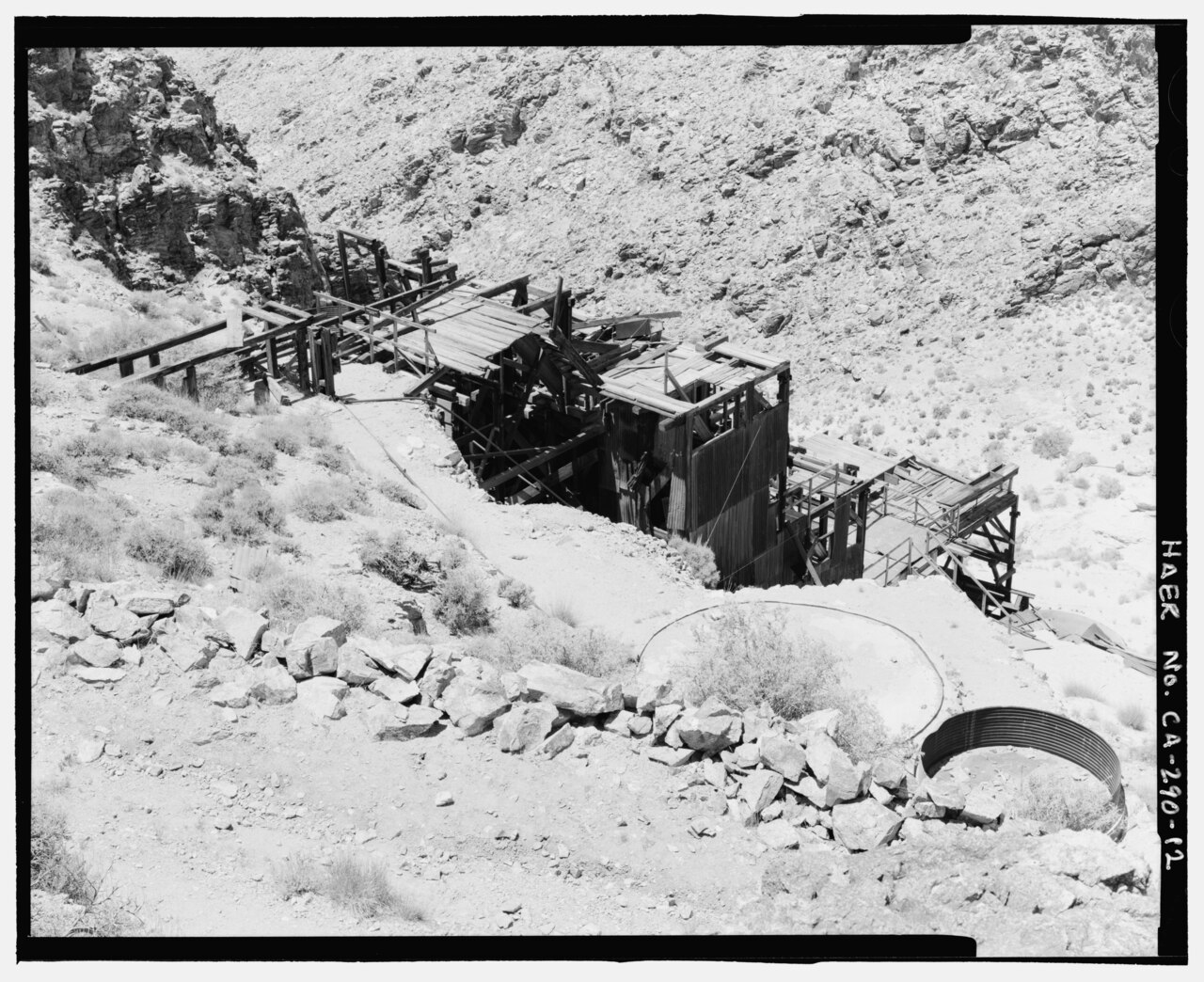
The east and south sides of the mill, with its conveyor and collapsed upper level, recorded in 2000.Photo: Gianfranco Archimede, Historic American Engineering Record, Library of Congress, public domain
Death Valley’s only hanging
On April 19, 1908, a Skidoo man named Joe “Hooch” (also spelled “Hootch”) Simpson shot and killed Jim Arnold, a well-known local businessman. The National Park Service says Arnold owned the store that housed the bank, and that Simpson had tried to rob the bank earlier. A crowd took Simpson from the deputy holding him and hanged him from a telephone pole. No one was ever arrested for it, and it is the only hanging on record in Death Valley.
On the details: Accounts differ on Arnold’s trade, calling him a butcher, a storekeeper or the owner of the Skidoo Trading Company. They also differ on timing: the park says Simpson was hanged the same night, while other histories date it April 22, and the Los Angeles Times reported it on April 24.
Legend: The best-known part of the story is that Simpson was hanged twice, the second time so newspaper photographers could get their picture. The park itself only says he “is said to” have been hanged twice, and the version that is told today comes from later retellings, not from reports in 1908. A grislier tale about what became of his skull is local folklore.
After the boom
Skidoo did not die all at once. Small operators reworked the mines and mill from the 1920s into the early 1940s, including a lease by Gray and Worcester from 1935 to 1937, and one account mentions tungsten claims in the 1950s. The site was listed on the National Register of Historic Places in 1974, and in 1993 the estate of Roy C. Troeger donated the mill to the National Park Service.
In 2023 the park set aside $1.6 million, shared with the nearby Gem mill, to stabilize the old structures. The same year, Hurricane Hilary damaged the roads in this part of the park, and Skidoo Road did not reopen until March 2024.
What remains
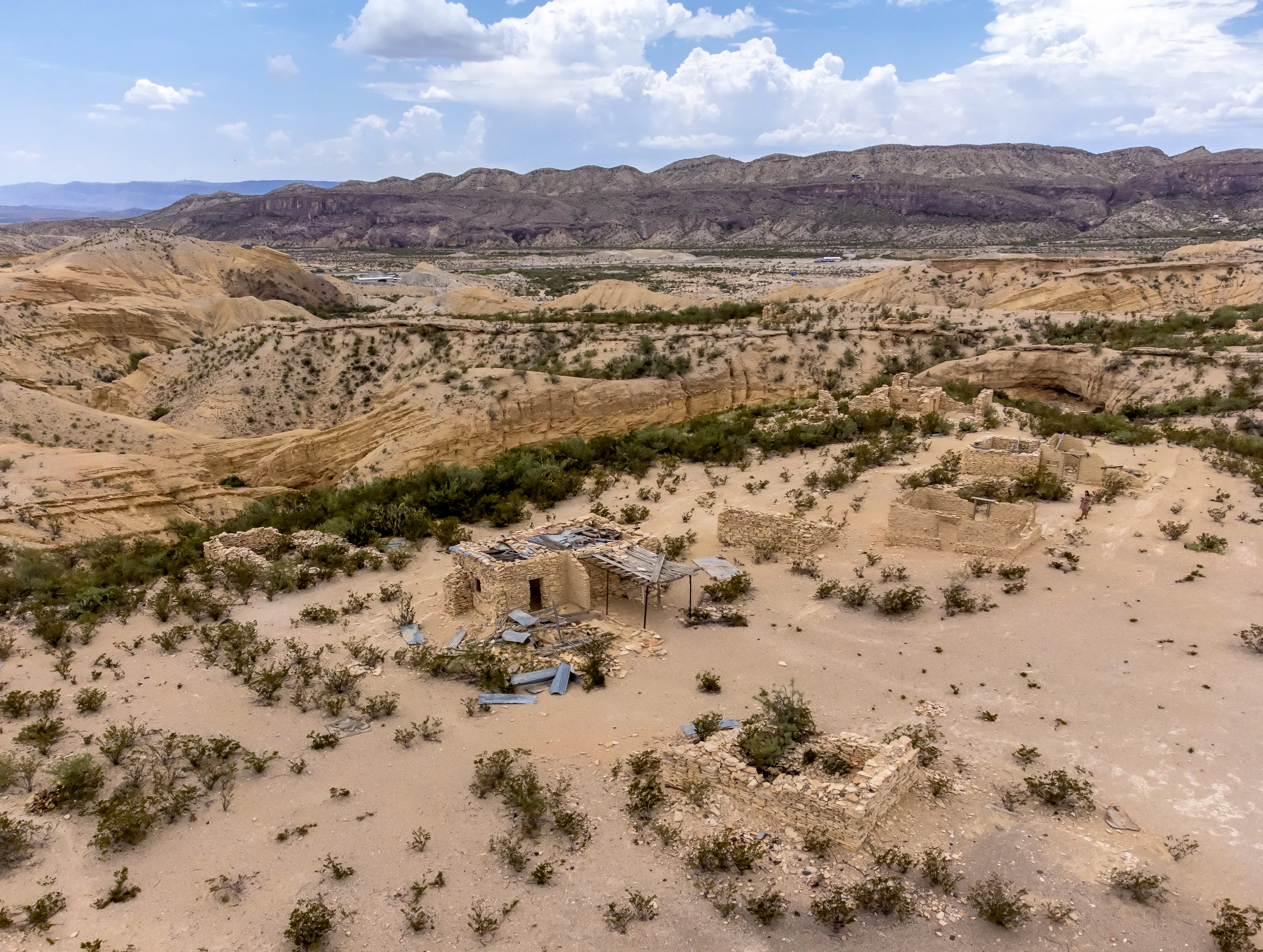
Almost nothing of the town itself is left standing. A park sign marks the townsite, and the hillsides around it hold stone foundations, debris, mine openings, a loading chute and the long scar of the pipeline. The real draw is the 15-stamp mill, which still clings to a steep slope above the road with its stamps, conveyor and timber frame in place. It can be seen from the outside after a short walk from the end of the road.
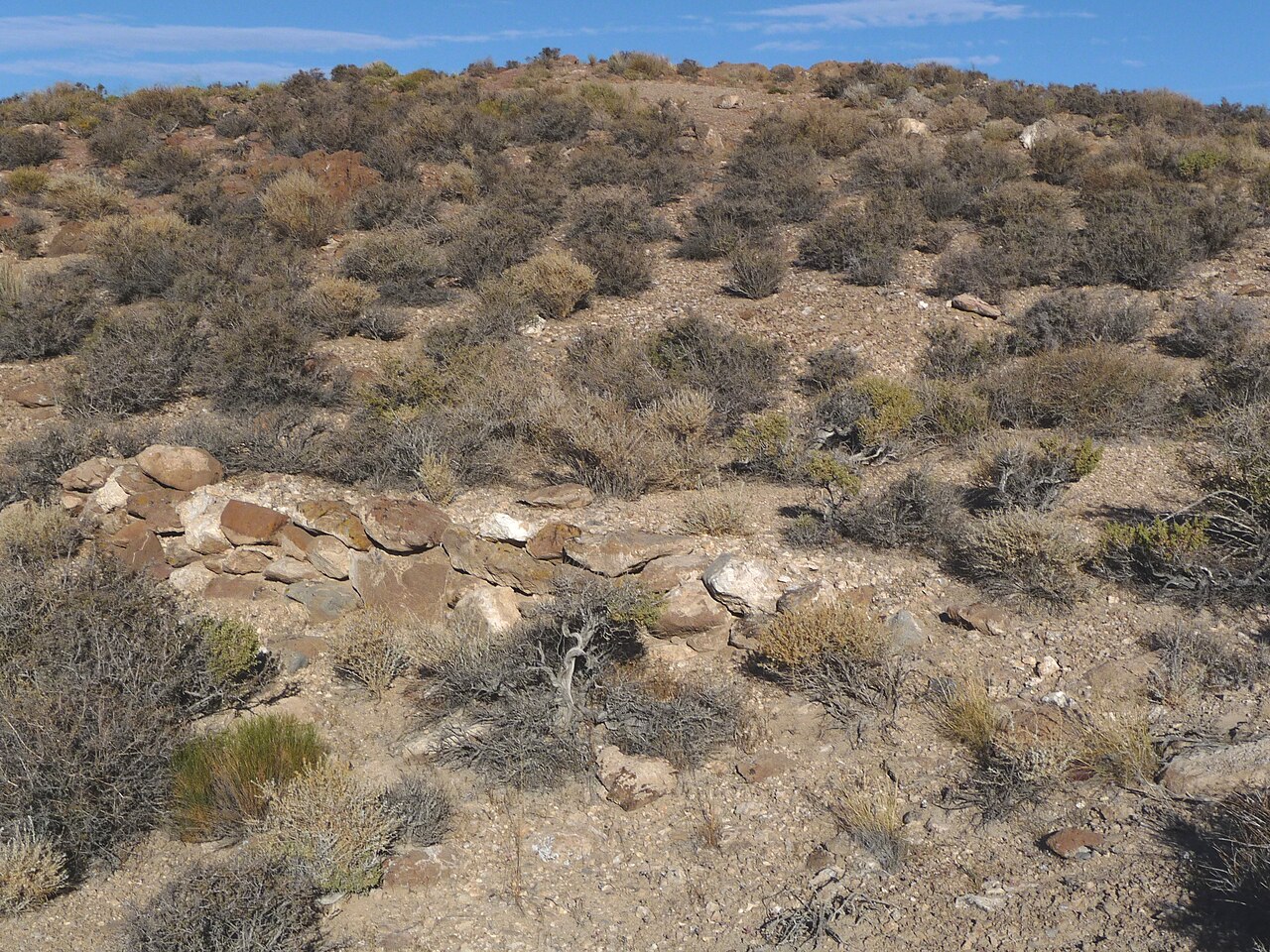
A stone house foundation at the townsite.Photo: Daniel Mayer, CC BY-SA 3.0, via Wikimedia Commons
Timeline
Jan 1906
John Ramsey and John “One-Eye” Thompson find gold ledges while camped near Emigrant Spring.
Summer 1906
Bob Montgomery’s interests buy the claims, and a townsite is laid out.
Oct 1906
The post office opens as Hoveck. The Skidoo News starts in November.
Feb 1907
Hoveck is renamed Skidoo. The town peaks at several hundred people that year.
Late 1907
Water arrives through the pipeline from Birch Spring on Telescope Peak.
Apr 1908
Joe “Hooch” Simpson kills Jim Arnold and is lynched by a crowd.
Jun 1908
Ten stamps are running in the new water-powered mill.
1913
Fire destroys most of the mill in June; it is rebuilt by October.
1915
Five more stamps bring the mill to 15.
1917
The main mine closes, and the post office shuts on October 31.
1935–37
Gray and Worcester lease and work the property.
1974
Skidoo is listed on the National Register of Historic Places.
1993
The Troeger estate donates the mill to the National Park Service.
2023–24
The park funds work to stabilize the mill; Skidoo Road reopens in March 2024 after storm damage.
Visit guide — Skidoo, California
Can you visit?Yes. Skidoo is inside Death Valley National Park, so a park entrance pass is needed. Skidoo Road is for day use only, with no camping along it.
Getting thereFrom Highway 190 at Emigrant, about 9 miles west of Stovepipe Wells, drive south on paved Emigrant Canyon Road for about 9.4 miles to the Skidoo Road turnoff. The townsite sign is about 7 miles up Skidoo Road; the mill is about a mile farther, then a walk of roughly 600 feet.
Coordinates36.4355, -117.1476 (townsite)
Road conditionsUnpaved and rocky. The park says high clearance is needed, with a steep, rocky stretch around mile 3.5 where sedans risk damage. The last mile to the mill is narrow and rough. Snow and mud are possible in winter. Check the park’s road conditions page before you go.
What to seeThe 15-stamp mill, the townsite sign, stone foundations, mine dumps and the pipeline scar across the hills.
ServicesNone. The nearest gas, food and water are at Stovepipe Wells, about 25 miles by road.
Land statusNational Park Service land in Death Valley National Park, within a National Register historic district. The ruins are protected by federal law.
Mine and desert hazards: The hills around Skidoo are full of open shafts and tunnels. Never enter a mine or walk up to the edge of a shaft. Stay out of the mill, whose machinery and timbers are unstable. Carry plenty of water and a spare tire, expect no cell service, and remember that summer heat in Death Valley can kill.
Respect the ground: Everything at Skidoo is protected by federal law. Do not dig, metal detect, climb on the mill or collect anything, including bottles, nails and pieces of pipe. Stay on the road with your vehicle and leave the site as you found it.
Approximate location of the Skidoo townsite off Emigrant Canyon Road in Death Valley National Park.
Historic sites nearby
Harrisburg & Aguereberry Camp, CA
~6 miles southeast
The 1905 strike the Skidoo prospectors were headed for · cabins at Aguereberry Camp
Wildrose Charcoal Kilns, CA
~13 miles south
Ten beehive kilns built in 1877 for the Modoc mine smelters
Panamint City, CA
~22 miles south, also on this site
1870s silver camp reached by a long canyon hike · smelter stack
Ballarat, CA
~27 miles south, also on this site
Supply town for the Panamint camps · adobe ruins and a cemetery
Leadfield, CA
~29 miles north
Rhyolite, NV
~37 miles northeast, also on this site
Bob Montgomery’s other boomtown · bank ruins, depot, bottle house
Distances are straight-line estimates. Driving distances in the park are much longer.
Further reading
Books and records about Skidoo and Death Valley mining
Death Valley and the Amargosa: A Land of Illusion
Richard E. Lingenfelter · University of California Press, 1986 — the standard history of the region’s mining camps
Historic Resource Study: A History of Mining in Death Valley National Monument
Linda W. Greene · National Park Service, Denver Service Center, 1981
National Register of Historic Places Nomination: Skidoo
F. Ross Holland Jr. · National Park Service, 1973 (listed 1974, reference 74000349)
Death Valley Ghost Towns
Stanley W. Paher · Nevada Publications, 1973
Ghost Towns and Mining Camps of California
Remi A. Nadeau · Ward Ritchie Press, 1965
Skidoo CaliforniaCaliforniaCalifornia Ghost TownsGhost TownGold MiningInyo CountyDeath ValleyPanamint RangeStamp MillBob Montgomery
Sources
Wikipedia — Skidoo, California
National Park Service — Death Valley Ghost Towns, funding to stabilize historic mines, road reopening, March 2024 and current conditions
National Register of Historic Places — Skidoo nomination
Historical Marker Database — park markers for the townsite, the mill and the pipeline
Legends of America — Skidoo; Digital-Desert — Skidoo history; NV Expeditions — Skidoo; True West — Hooch Simpson
Photos: Norm Kresge, CC BY 3.0; National Park Service, public domain; Gianfranco Archimede, Historic American Engineering Record, public domain; Daniel Mayer, CC BY-SA 3.0 and CC BY-SA 3.0