Silver Reef, Utah
Utah
Gold & Silver Mining
Boom 1876–1891
13 min read
Founded
Town platted 1876 (silver discovered 1866)
Peak Population
~1,048 in the 1880 census; ~1,500–2,000 at the peak
County / Region
Washington County · near Leeds, ~18 mi NE of St. George
The Anomaly
Commercial silver mined from sandstone — essentially unique in North America
Production
7+ million oz of silver (200+ tons); later uranium, too
Status
Historic district & museum; ruins amid a modern residential area
Museum & open-air site
Admission $5
Paved access off I-15
Open Mon/Thu/Fri/Sat
Interpretive trails

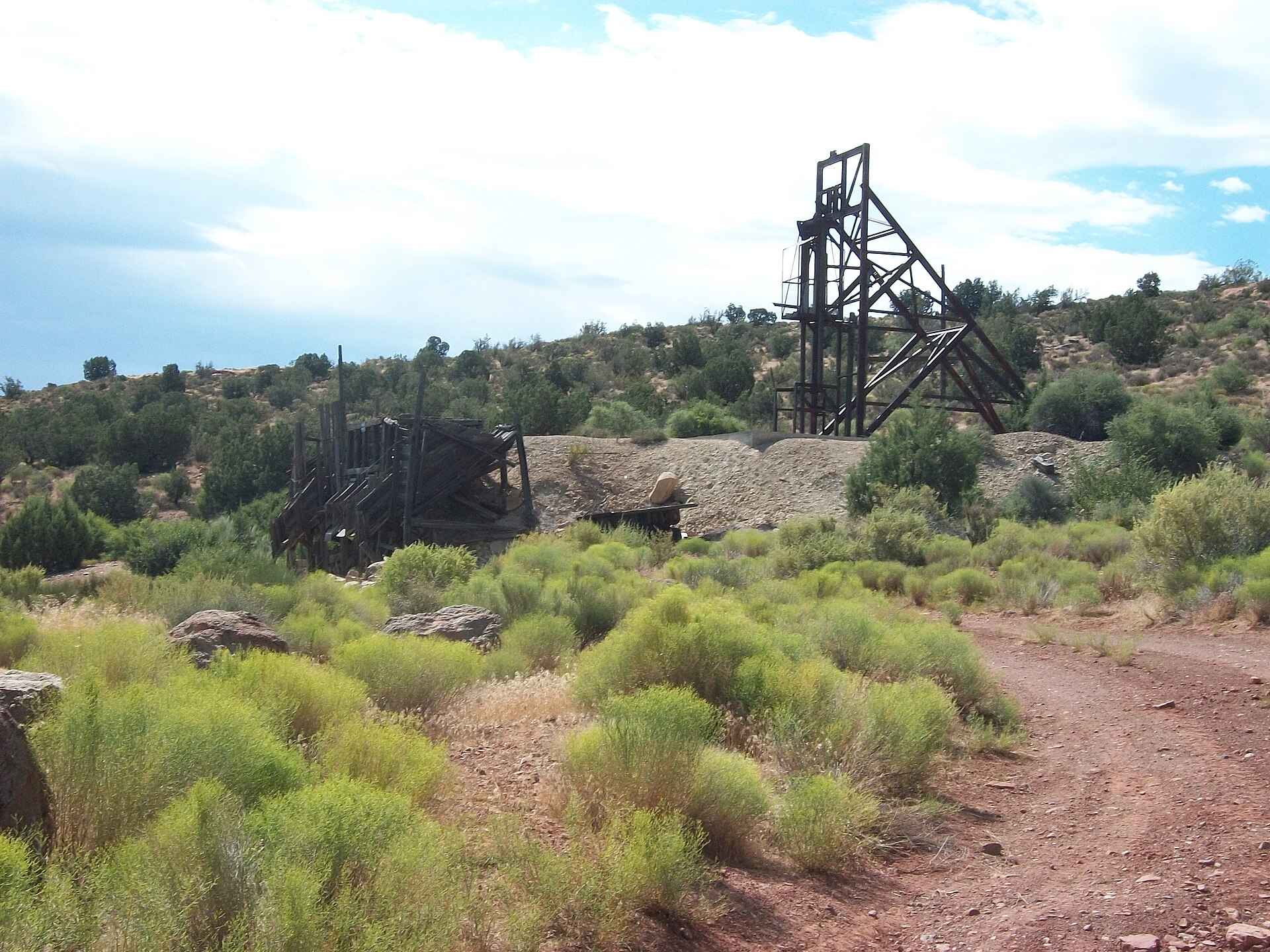
The red-sandstone benches of Silver Reef — the improbable ground where miners pulled silver from sand rock. Photo: The Utahraptor, CC BY-SA 3.0, via Wikimedia Commons.
Silver Reef is the ghost town that, by the science of its day, should never have existed. Everyone in nineteenth-century mining knew that silver belonged in quartz veins and igneous rock — not scattered through ordinary red sandstone. Yet here, on a bench of eroded sandstone in Utah’s Dixie, miners pulled fortunes in silver out of the rock, and even dug petrified logs that had been turned, cell by cell, into pure metal. For about fifteen years it was the loud, cosmopolitan, hard-drinking exception to the quiet Latter-day Saint farm country around it — and then it emptied out, was carried away for lumber and stone, and nearly vanished.
This is the documented history of Silver Reef, the geology that baffled the experts, and the legends worth separating from the record — a town whose story has been embellished almost as often as its ore was doubted.
“Miners extracted single petrified trees that yielded thousands of ounces of pure silver — crushing priceless fossils in the stamp mills to make commercial bullion.”
— on the horn-silver replacement of fossil wood at Silver Reef
Silver where silver shouldn’t be
The find traces to prospector John Kemple, who around 1866 noticed silver “float” in the eroded sandstone near the Latter-day Saint farm settlement of Harrisburg. Because the mining science of the era held that precious metals could not occur in sedimentary sandstone, Kemple couldn’t trace the silver to a conventional quartz lode, grew discouraged, and never realized the scale of the wealth around him. He organized a rudimentary district in 1871 and the Harrisburg Mining District in 1874, then sold his claims for modest sums. The deposit sat doubted for nearly a decade.
The grindstone assay — folklore, not discovery history. The town’s most famous origin story tells of an assayer in Pioche, Nevada — “Metalliferous” Murphy — whom distrustful miners tried to embarrass by submitting a crushed sandstone grindstone as a quartz sample; it supposedly assayed at 200 ounces of silver per ton, unmasking the fact that common sand rock held silver. It’s a great yarn, but historians introduce Murphy with “it is said” for good reason: no assayer named Murphy is recorded with a claim in the district, and the documentary trail runs through Kemple, Barbee, and the mining-district records. The legend preserves a real kernel — settlers really did quarry local sandstone for hearthstones and grindstones, and those beds really did carry silver — but it shouldn’t replace Kemple in a factual account.
What rock actually holds the silver? This is genuinely debated, and sources differ. The ore sits in a cross-bedded fluvial sandstone; older literature (Paul Dean Proctor’s foundational 1953 survey) tied it to a “Silver Reef Sandstone” within the Triassic Chinle Formation, while modern Utah Geological Survey mapping assigns the ore-bearing beds to the Springdale Sandstone Member. What’s not in dispute: the silver occurs chiefly as chlorargyrite (horn silver, AgCl), the metals were most likely leached from volcanic ash in the Chinle Formation and re-precipitated where fossil organic matter created chemical traps, and the resistant ore-bearing ridges — the White, Buckeye, Butte, and East “Reefs” — are sandstone hogbacks, not coral. The Buckeye Reef alone yielded roughly 70% of the district’s silver.
From Bonanza City to boomtown, 1875–1879
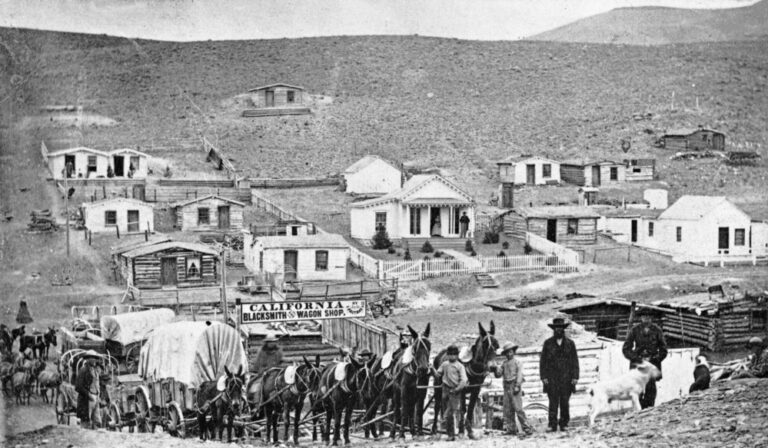
The man who turned a doubted outcrop into a rush was William Tecumseh Barbee, dispatched in 1875 by the Walker brothers, Salt Lake City merchant-bankers looking to diversify into mining. Barbee quickly staked 21 claims, centered on the rich Tecumseh ground, and promoted the district hard in The Salt Lake Tribune. In February 1876 he platted a speculative townsite called Bonanza City; when its lots grew too dear, miners clustered just north in a rough camp nicknamed the “Rockpile,” and the combined community became Silver Reef. Growth accelerated when the mines of Pioche, Nevada faltered and displaced miners streamed east in what’s remembered as the Pioche Stampede.
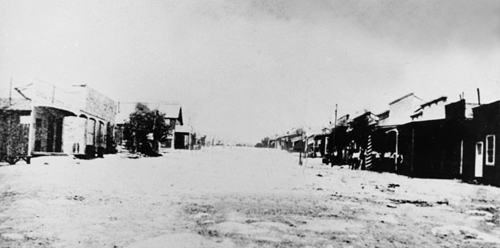
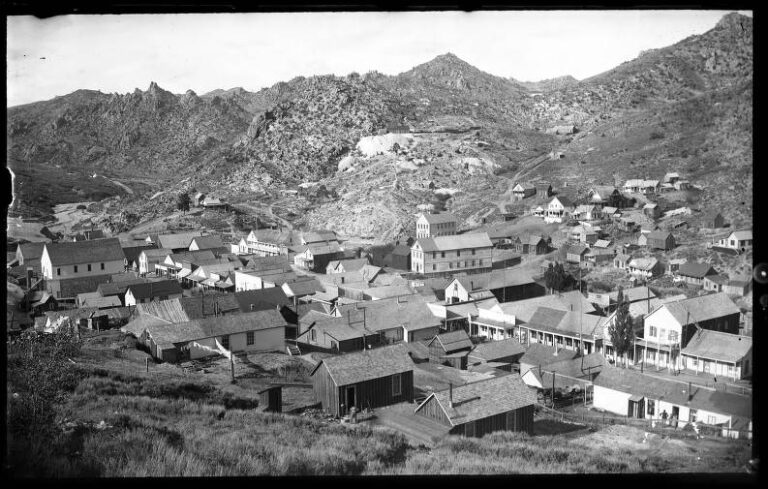
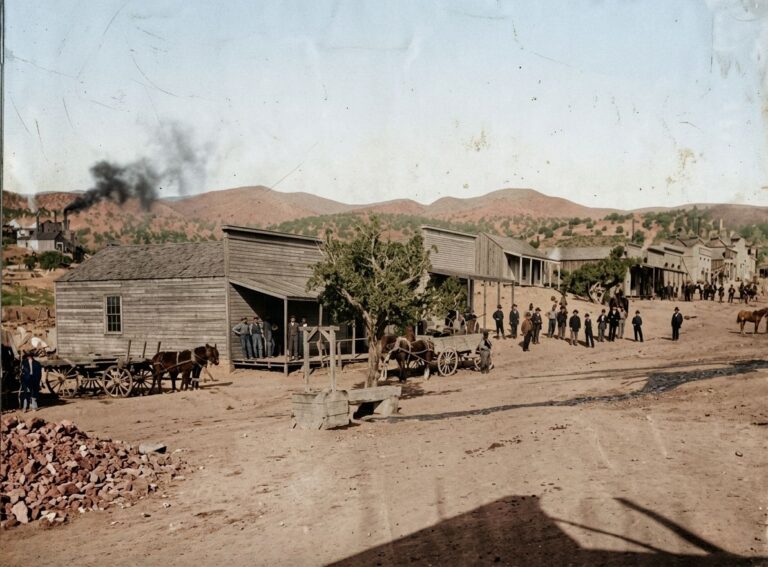
By 1879 Silver Reef was the commercial center of Washington County — a mile-long red-sand Main Street of cut-stone, brick, and lumber buildings. It had two banks (the Leeds Banking Company and a Wells Fargo & Co. express office), a telegraph, mercantile warehouses, boarding houses, a hospital, a brewery, an iron foundry, dance halls, and its own newspaper, The Silver Reef Miner. Depending on who counted, there were somewhere between twenty and thirty-seven saloons and gambling houses. Five principal stamp mills — the Christy, Stormont, Leeds, Buckeye, and Barbee & Walker — crushed the ore. It was, in the words of later researchers, a conspicuously secular, cosmopolitan island set down in the heart of Utah’s ecclesiastical Dixie.
That island was never as isolated as the “Mormons versus Gentiles” shorthand suggests. The surrounding farm towns of Leeds, Harrisburg, and Washington supplied the camp with food, cotton, lumber, and hauling; when the St. George Temple neared completion in 1877, regional Latter-day Saint artisans and freighters took wage work at the reef. The mining town and the farm communities grew increasingly interdependent.
Silver Reef in the boom years — a mile of stone and timber on the sandstone bench. Photo: George Ottinger, public domain, via Wikimedia Commons.
A cosmopolitan camp: Catholics, Cornishmen, and Chinatown
Silver Reef’s miners were largely Irish and Cornish, its merchants Anglo-American and European, and the camp drew one of southern Utah’s most remarkable episodes of interfaith goodwill. The Catholic priest Father Lawrence Scanlan — later the first Bishop of Salt Lake City — ministered to hundreds of miners and founded St. John’s Catholic Church, a school, and a miners’ hospital. When his congregation outgrew the little chapel, his friend John Menzies Macfarlane, an LDS surveyor and director of the St. George Tabernacle Choir, arranged something extraordinary: with Apostle Erastus Snow’s blessing, Scanlan celebrated a Catholic High Mass inside the St. George LDS Tabernacle on May 25, 1879, with Macfarlane’s all-Mormon choir singing the Latin mass to an overflow crowd of roughly 3,000 Latter-day Saints and Catholic miners.
The camp also had a substantial Chinatown on its southeastern edge — laundries, herbal dispensaries, butcher shops, rooming houses, and vegetable gardens that fed the town’s restaurants, plus timber-hauling contracts. Its community was led by the merchant-apothecary Yee Sam Wing, known locally as the “Mayor of Chinatown.” When the mines failed, Wing performed a last service with his own savings: he built wooden exhumation caskets, disinterred the Chinese dead from the camp’s cemetery, and paid the freight to return their remains to their ancestral villages in China.
How big was Chinatown? The figures differ. University of Pennsylvania researchers working from the 1880 census counted about 100 Chinese residents within the town’s total of ~1,048, while a more recent BLM archaeological account cites nearly 250 Chinese residents and documents the physical remains of the quarter. Both efforts are reputable, so the honest reading is that Silver Reef had a significant, archaeologically confirmed Chinese community whose exact size depends on which records and boundaries you count.
Strikes, a lynching, and the long decline
As the easily milled surface ores gave out, conflict sharpened. In early 1880 management cut underground wages from about $4.00 to $3.50 a day; miners organized the Silver Reef Miners’ Union and struck in 1881, a dispute serious enough to produce arrests and the territorial criminal case People v. O’Loughlin. It’s sometimes billed as “Utah’s first organized labor strike” — safer to call it one of territorial Utah’s earliest important mining-labor confrontations — and by the time it broke, much of the experienced workforce had left.
That tension framed the camp’s most notorious violence. In October 1880 the Cornish shift boss Michael Carbis, having fired the contentious miner Thomas Forrest on orders, was ambushed and stabbed to death. Forrest was jailed and moved to St. George for safekeeping — but on the night of October 5, 1880, a masked mob of more than a hundred armed miners rode from Silver Reef, overpowered the sheriff, seized Forrest, and hanged him from a cottonwood. Though many in the mob were recognized, no one was ever indicted. Carbis’s carved sandstone headstone still stands in the Protestant cemetery.
The decline that followed was gradual, not a single dramatic abandonment. Below the water table, the oxidized horn silver gave way to refractory sulfides and copper carbonates that milled poorly; groundwater forced expensive steam pumping in an arid, treeless landscape; and every ton of machinery and bullion had to be teamed a hundred miles to the railhead at Milford. When silver prices fell after the Coinage Act of 1873, margins evaporated. The primary mines closed by 1891, with brief revival attempts in 1898, 1909, and 1916. Much of the town was then dismantled for building materials — St. John’s Catholic Church was bought in 1895 and its stone hauled to Leeds to build a social hall; the schoolhouse was moved; homes were reassembled on valley farms. One last chapter came mid-century, when Western Gold & Uranium worked the old stopes and tailings from 1948 into the late 1950s, recovering more than 5,000 pounds of uranium oxide — making Silver Reef one of the very few districts anywhere to commercially yield both silver and uranium from the same sandstone.
“A fire destroyed the town” — not quite. A spectacular fire swept part of the commercial district in May 1879 (a separate fire hit Chinatown that July), and it’s sometimes cast as the town’s death blow. It wasn’t: businesses rebuilt, archaeology has identified the burn-and-rebuild layer at the Cosmopolitan Restaurant, and mining continued for years. Likewise, “1891” is a convenient end date, but lease mining and revivals ran well into the twentieth century. Silver Reef contracted over decades rather than dying in a single event.
What survives
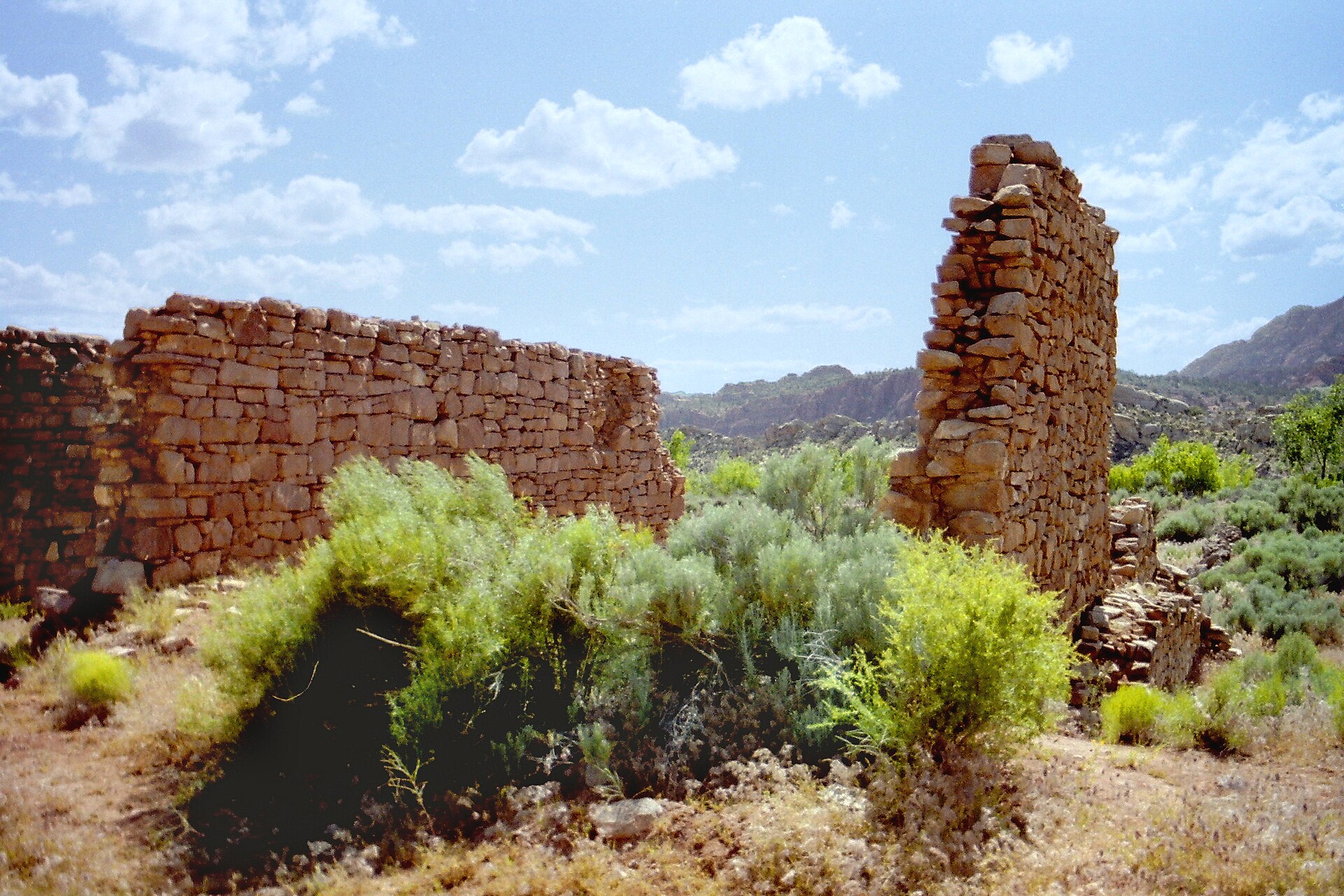
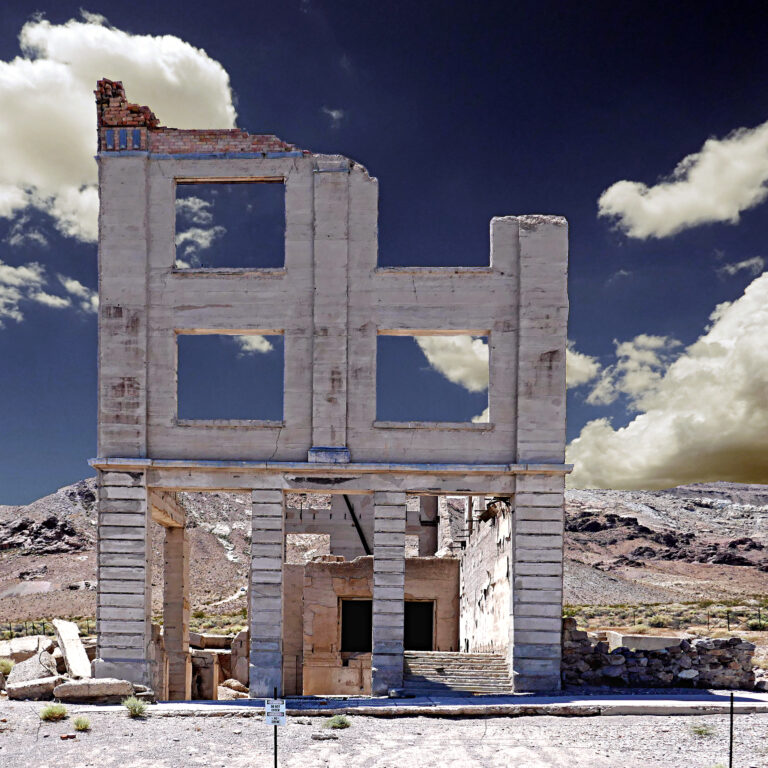
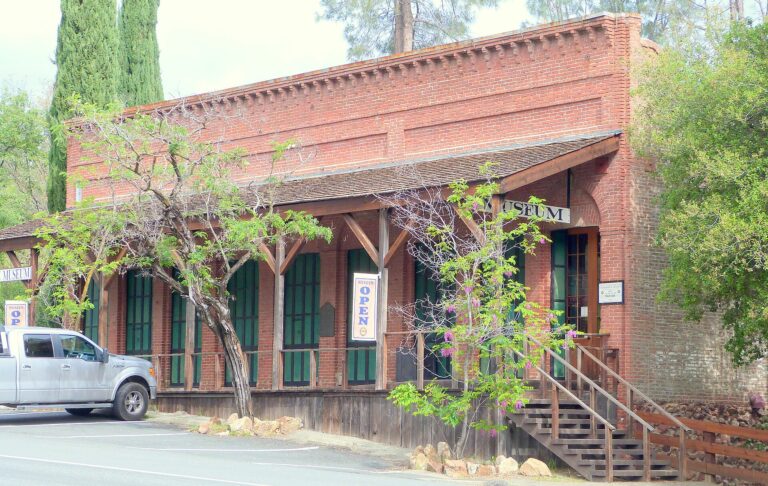
What remains is a mix of authentic nineteenth-century fabric, careful reconstructions, archaeological landscape, and — today — a modern neighborhood. The centerpiece is the restored Wells Fargo & Co. Express Building (1877), which survived the salvage years and now houses the Silver Reef Museum. Around it are stone walls and foundations, mill ruins and tailings, mine dumps, roads, town-site alignments, a beehive charcoal kiln, and the Catholic, Protestant, and Chinese pioneer cemeteries.
Mill walls, foundations, and stone footings trace the old works across the bench. Photo: Nikater, public domain, via Wikimedia Commons.
Authentic vs. rebuilt. Not every prominent “building” at Silver Reef is untouched boom-era fabric. The Wells Fargo office is genuine, restored. But the John H. Rice Bank was rebuilt after a 1982 fire, and the Cosmopolitan Restaurant was reconstructed on its original footprint to evoke its 1870s look. It’s a distinction worth knowing when you read a photo captioned “Silver Reef ghost town.”
Timeline
1866
John Kemple finds silver float in the sandstone near Harrisburg.
1874
The Harrisburg Mining District is organized, with Orson B. Adams as president.
1875
The Walker brothers send W. T. Barbee; the Pioche Stampede brings displaced Nevada miners east.
1876
Barbee plats Bonanza City; the camp coalesces as Silver Reef.
1877
The Wells Fargo and Rice Bank buildings go up; St. George Temple work draws regional labor.
1879
Peak years; Father Scanlan’s Catholic Mass in the St. George LDS Tabernacle (May 25); a major fire hits the district but the town rebuilds.
1880
The Carbis–Forrest affair: Forrest is lynched by a vigilante mob; 1880 census counts ~1,048.
1881
Miners’ strike over a wage cut; the case People v. O’Loughlin follows.
1891
Primary silver mining ends; the town is dismantled for building materials.
1898–1916
Brief, unsuccessful revival attempts.
1948–50s
Western Gold & Uranium works the old stopes and tailings for uranium.
1996–2000
Hundreds of mine openings are reclaimed; some gated to preserve bat habitat.
Today
The Silver Reef Museum and interpretive trails operate amid a modern residential area.
Visiting Silver Reef now
Unlike many ghost towns, Silver Reef is easy to reach on paved roads just off I-15, and it’s anchored by a real museum. It’s also a living historic district — a residential subdivision now overlies part of the old town, and ownership is a patchwork of federal, state, museum, and private land — so treat it as a historic neighborhood, not an open-air free-for-all.
Plan your visit
Silver Reef Museum
1903 Wells Fargo Road, Leeds / Silver Reef, UT 84746 (in the Wells Fargo Express Building)
Museum Hours (2026)
Mon, Thu, Fri, Sat 10 a.m.–3 p.m.; closed Tue, Wed, Sun. Last tour 2:15 p.m.
Admission
$5 individual; $16 family of four; $4 each extra family member; under 6 free; groups of 10+ $4/person
Special Exhibits
Underground mine exhibit usually open Saturdays; Rice Building shown on request (call ahead)
Interpretive Trails
Two self-guided trails, 23 stops, ~30 min total; daylight hours
Getting There
From St. George: I-15 Exit 22; from Cedar City: I-15 Exit 23; follow Silver Reef Road (brown historic signs). Museum road is paved.
Contact
Silver Reef Museum, 435-879-2254
Managed By
Silver Reef Foundation, Washington County Historical Society & the Town of Leeds
⚠ Desert & mine hazards. Summer temperatures regularly top 100°F (38°C) — carry water and sun protection. The broader district has unmarked prospect pits, vertical shafts, unstable adits, and scree, plus Mojave rattlesnakes and scorpions. Do not enter abandoned mines — they’re unstable, dangerous, and illegal to enter; stay outside gates and grates. Secondary roads toward the East Reef / Babylon workings can require high clearance or 4WD and turn impassable when wet.
It’s a protected historic district on mixed ownership. Don’t climb on, sit on, lean against, or dislodge stone from the historic walls, arches, or footings — the ruins are unstable and protected under Utah antiquities law. Collecting or metal-detecting artifacts (square-cut nails, amethyst glass, ceramics, ore) is illegal. Obey no-trespassing signs — much of the district is private property — stay on designated routes, leave relics in place, and follow Leave No Trace. Pets on leash (≤ 6 ft); no pets inside the museum buildings.
Silver Reef, just northwest of Leeds and about 18 miles northeast of St. George.
Nearby ghost towns & historic sites
Harrisburg
~4 mi S
The Mormon cotton mission where Kemple lodged with Orson B. Adams while prospecting — Silver Reef’s origin site. Preserves the restored 1860s Adams home and a cemetery.
Babylon
~4 mi SE
An 1878 stamp-milling settlement on the Virgin River built to power the 10-stamp Stormont Mill; visible stone foundations, retaining walls, and tailings.
Grafton
~30–40 mi E · near Zion
The region’s most intact ghost town — a flood-plagued 1859 Mormon farm settlement with an 1886 brick schoolhouse, pioneer homes, and a cemetery. A striking farm-vs-mining contrast.
Apex Mine / Tutsagubet
~30 mi SW
A base- and precious-metal district that later became the world’s first primary source of gallium and germanium. Visible open stopes and ruins.
Old Irontown (Iron City)
~45 mi NW
An 1868 pig-iron smelting center with a fully preserved beehive charcoal kiln, blast-furnace chimney ruins, and an arrastra.
Goldstrike
~45 mi WNW
A high-desert gold camp that boomed 1910–1915 after an epithermal lode strike; collapsed timber shafts, waste dumps, and foundations remain.
Also within the broad 50-mile radius: Duncan’s Retreat, Shunesburg, Fort Harmony, and Tonaquint — flood- and hardship-abandoned pioneer settlements, several on private land. For more mining ghost towns on the archive, see Tonopah, Belmont, and St. Elmo.
Further reading
Books, reports & scholarship on Silver Reef
Silver, Sinners & Saints: A History of Old Silver Reef, Utah (1991)
Paul Dean Proctor & Morris A. Shirts · Paulmar — the definitive district history, pairing Proctor’s geology with Shirts’s archival demography.
Geology of the Silver Reef (Harrisburg) Mining District (1953)
Paul Dean Proctor · Utah Geological & Mineralogical Survey, Bulletin 44 — the foundational technical report on the stratigraphy and ore genesis.
A Historical Study of Silver Reef, Southern Utah Mining Town (1966)
Alfred Bleak Stucki · M.A. thesis, Brigham Young University — mining deeds, court records, and oral histories.
“Memories of Silver Reef” (1930) & “Silver Reef” (1961)
Mark A. Pendleton and Juanita Brooks · Utah Historical Quarterly — an early-resident retrospective and a classic analysis of the Mormon–Gentile divide.
The Carbis-Forrest Affair: Vigilante Justice in Frontier Utah (2014)
Jonathan Alvey · Washington County Historical Society — a legal and historical investigation of the 1880 killing and lynching.
From the Ground Up: The History of Mining in Utah (2006)
Colleen K. Whitley, ed. · Utah State University Press — includes assessment of Silver Reef’s role in the regional economy.
The Historical Guide to Utah Ghost Towns
Stephen L. Carr · Western Epics — plat maps, architectural inventories, and site photography.
Sources:
Utah Geological Survey, Silver Reef (Harrisburg) Mining District — Bulletin 44 and related publications, geology.utah.gov.
Bureau of Land Management & Washington County Historical Society, Silver Reef town and people histories — wchsutah.org.
Silver Reef Museum (Silver Reef Foundation) — history, places, and 2026 visitor information, silverreef.org.
“Silver Reef, Utah” and “Wells Fargo and Company Express Building” — en.wikipedia.org; Historic American Buildings Survey (HABS), Library of Congress — loc.gov.
“A History of the Establishment of Silver Reef, Utah,” Greater Zion; Utah Historical Quarterly (Pendleton 1930; Brooks 1961; Dwyer 1952); Proctor & Shirts, Silver, Sinners & Saints (1991).
Photo credits: Hero (red-sandstone head-frame): The Utahraptor — CC BY-SA 3.0, via Wikimedia Commons. Stone ruins: Nikater — public domain, via Wikimedia Commons. Historic view of Silver Reef: George Ottinger — public domain, via Wikimedia Commons.
← More Utah ghost towns