Virginia City, Nevada: The Comstock Lode and the West’s Great Silver Boomtown
Nevada
Gold & Silver Mining
By Darrel Bishop · Ghost Town Archive
Location
Storey County, western Nevada
Elevation
6,200 ft (1,890 m), Mount Davidson
Founded
1859 (incorporated Feb 1861)
Peak Population
~25,000 (mid-1870s)
Total Output
~$400 million in gold & silver
Status
National Historic Landmark (1961); pop. 787 (2020)
Fully open to the public year-round as an active municipality and historic district on the slopes of Mount Davidson, 24 miles south of Reno via the Geiger Grade (SR 341).

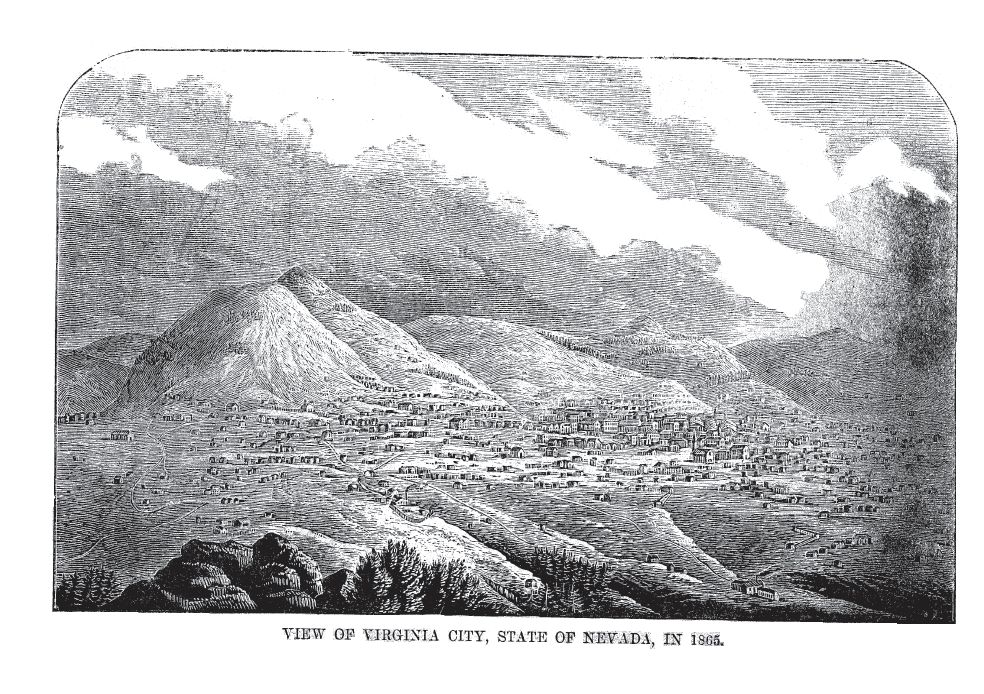
An 1868 engraved view of Virginia City on the eastern slope of Mount Davidson. Photo: John Barber & Henry Howe, Public Domain, via Wikimedia Commons.
Silver Beneath the Blue Mud
Virginia City owes its existence to the 1859 discovery of the Comstock Lode, the first major silver strike in the United States. For years, prospectors panning Gold Canyon on the eastern flank of the Sierra had cursed a heavy blue-gray mud that fouled their equipment. That “troublesome” clay turned out to be extraordinarily rich silver sulfide laced with gold. When miners Peter O’Riley and Patrick McLaughlin hit rich outcrops at the head of Six-Mile Canyon, a local prospector named Henry “Pancake” Comstock talked his way onto the claim by bluster alone — and lent his name to the entire district.
Word of the strike triggered a reverse rush back across the mountains from the California diggings. A canvas tent camp on the barren slope of Mount Davidson swelled within a few short years into a fully built city of banks, assay offices, print shops, and mansions, incorporated in 1861 at an elevation of 6,200 feet. The Comstock’s fame also sent prospectors fanning out across Nevada in search of the next big strike, seeding satellite silver camps such as Unionville in the Humboldt Range to the northeast.
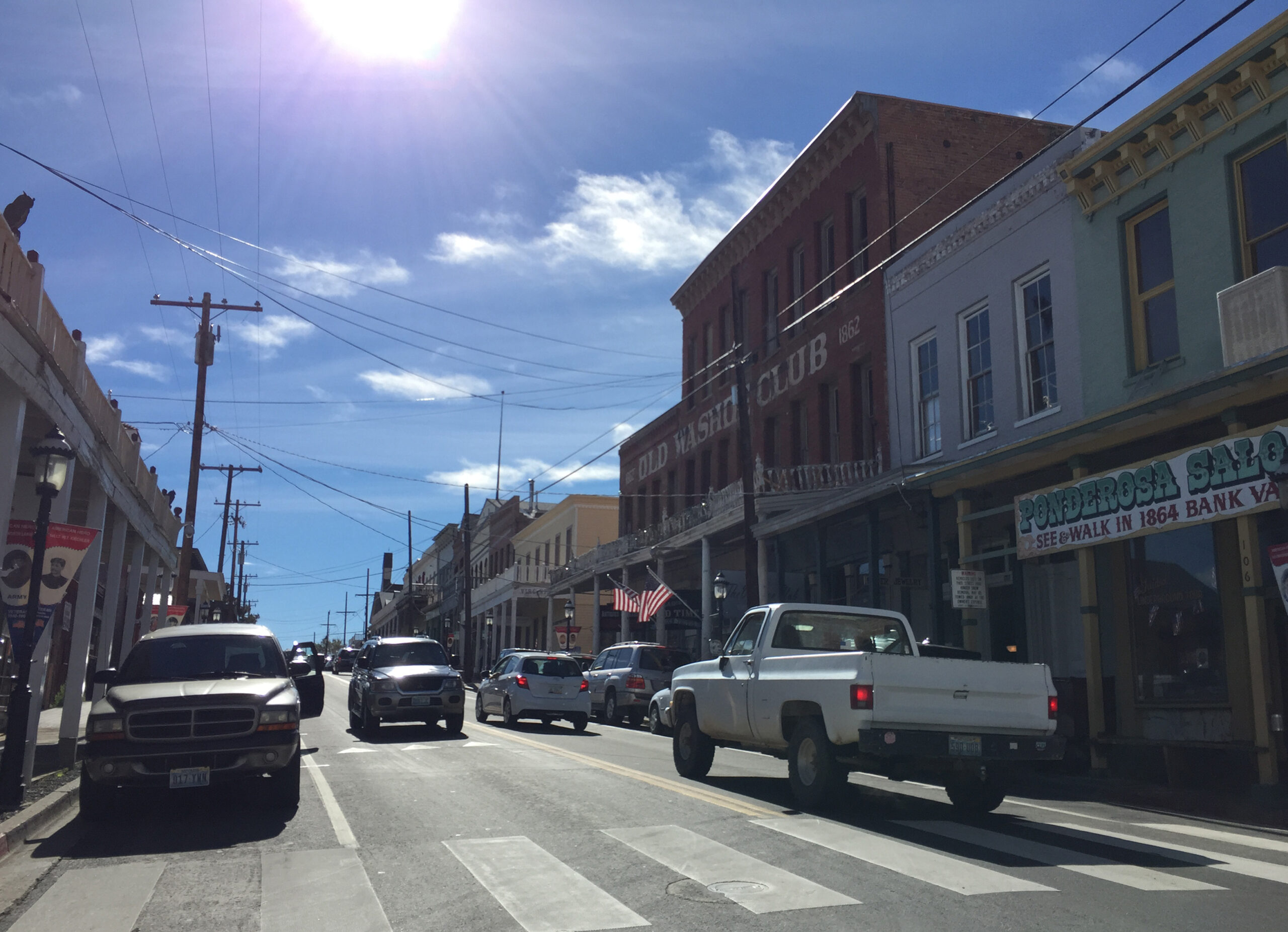
Historic C Street (SR 341), the main commercial thoroughfare of Virginia City. Photo: Famartin, CC BY-SA 4.0, via Wikimedia Commons.
An Underground City of Timber and Steam
The Comstock’s ore bodies were unlike anything California miners had faced: colossal, shattered masses of rock under immense pressure that would collapse the moment they were opened. In 1860 the German engineer Philip Deidesheimer solved the problem with square-set timbering — interlocking cubes of heavy timber that could be stacked to fill any void, letting shafts expand safely to great depth. Alongside it came the Washoe pan-amalgamation process, pneumatic Burleigh drills, wire-rope hoists, and safety cages.
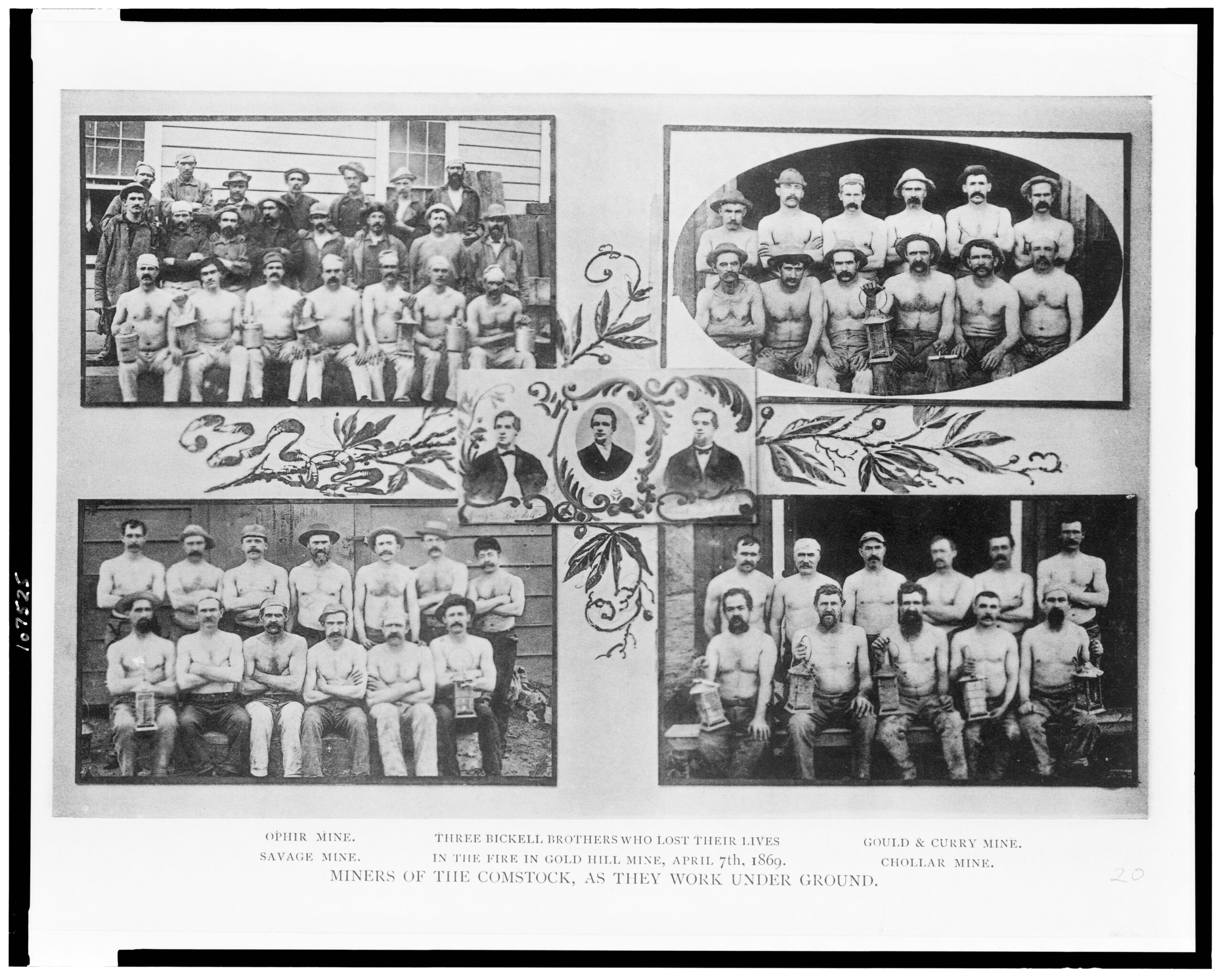
Depth brought new enemies: flooding and geothermal heat. Shafts routinely struck scalding water that pushed temperatures past 120°F, and miners who trudged through winter snow on the surface descended into a furnace, earning the grim nickname “hot water plugs.” Massive Cornish pumps drained millions of gallons a day, and engineer Adolph Sutro eventually bored a six-mile drainage adit through the mountain to relieve them.
Miners of the Comstock as they worked underground, from the Ophir, Savage, Gould & Curry, and Chollar mines. Photo: Library of Congress, Public Domain, via Wikimedia Commons.
In 1876 alone, at the height of the “Big Bonanza,” the district produced roughly $36 million in gold and silver — wealth that helped build San Francisco and finance the Union during the Civil War.
Total output across the mining era reached an estimated $400 million. That fortune bankrolled San Francisco’s industrial rise, funded a transcontinental telegraph, and gave Nevada the political weight to enter the Union on October 31, 1864. At its mid-1870s peak, Virginia City was the largest industrial city between Denver and San Francisco, with perhaps 25,000 residents drawn from Irish, Cornish, German, Chinese, and African American communities.
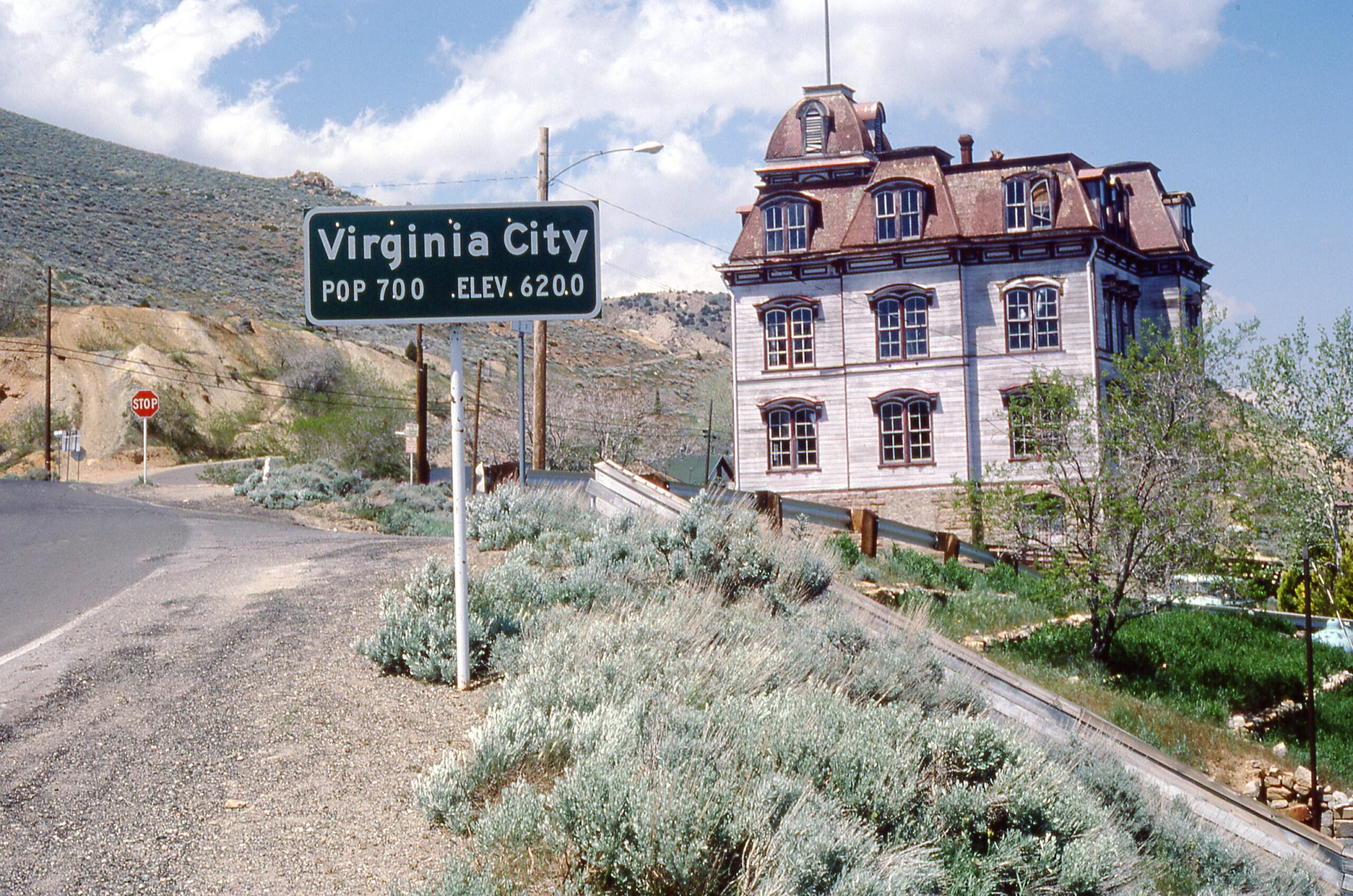
The 1876 Fourth Ward School, now a museum, near the Virginia City welcome sign (elevation 6,200 ft). Photo: Bill Golladay, CC BY-SA 4.0, via Wikimedia Commons.
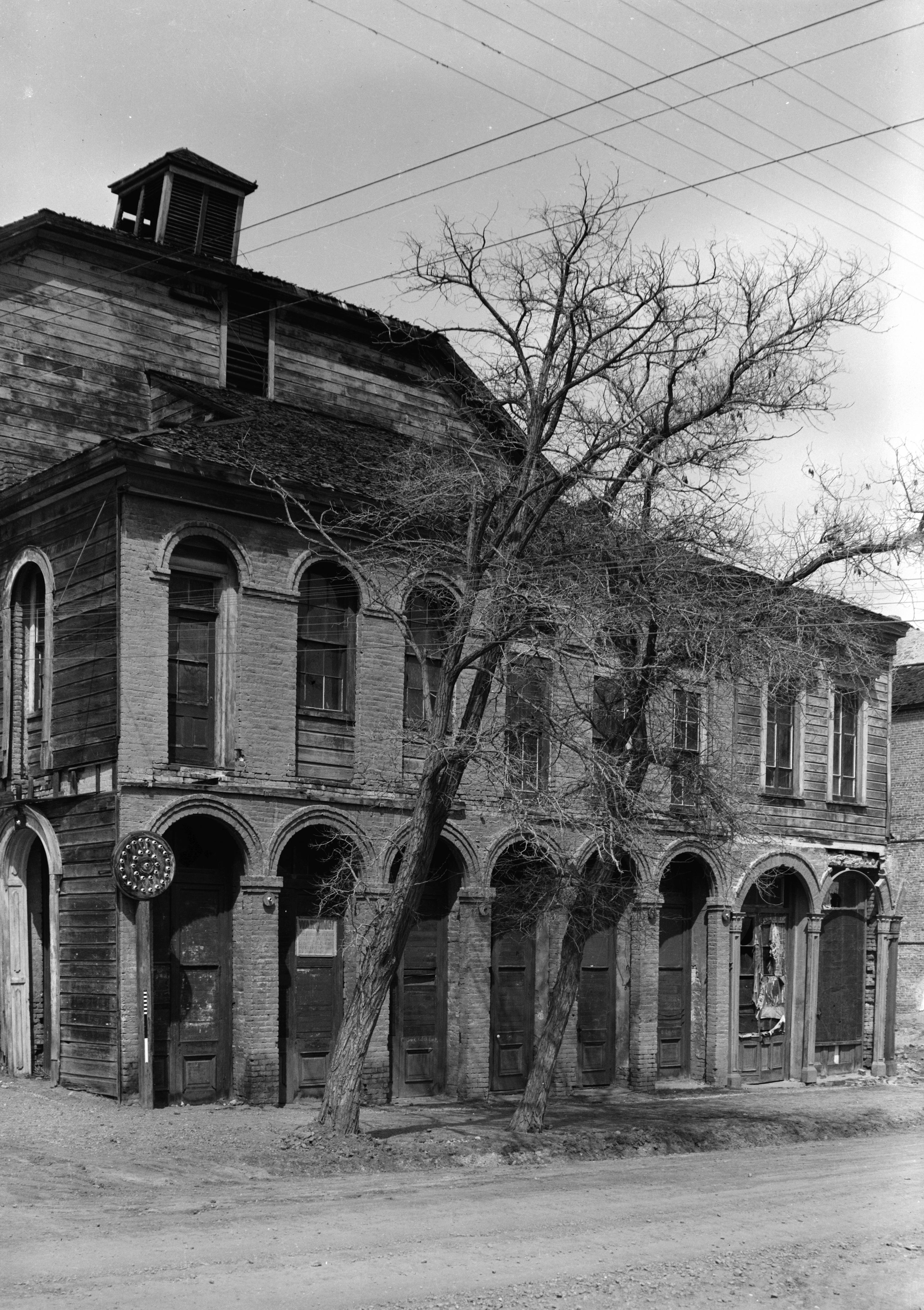
Piper’s Opera House, a landmark of the Comstock era. Photo: Robert W. Kerrigan (HABS), Public Domain, via Wikimedia Commons.
Note on the folklore: popular tradition credits James “Old Virginny” Finney with naming the town after drunkenly breaking a whiskey bottle. Historians treat the broken-bottle tale as a frontier origin myth rather than documented fact.
Fire, Decline, and Survival
On October 26, 1875, a saloon fire driven by gale-force wind swept through the wooden town, destroying the business district and leaving thousands homeless in the “Great Fire of 1875.” Because the Bonanza mines were still paying, the city rebuilt quickly in brick and Victorian style, raising landmarks like Piper’s Opera House and the Fourth Ward School. But when the high-grade ore gave out around 1878, the dividends stopped, stock values collapsed, and the population drained away — from tens of thousands to a few thousand by 1900.
Unlike camps that simply burned or emptied, Virginia City never fully died. A small resident population and the Storey County government kept it alive until, in the 1930s, artists and tourists rediscovered its preserved Victorian streetscape. In 1961 the entire town and its mining environs were designated a National Historic Landmark District. Today about 787 people call it home, and its wooden boardwalks along C Street remain one of the West’s most authentic mining-era townscapes.
A modern panorama of Virginia City in the high desert of the Comstock. Photo: Nick Ares, CC BY-SA 2.0, via Wikimedia Commons.
1857
Grosh brothers identify silver in Gold Canyon ore
1859
O’Riley & McLaughlin strike rich ore at Six-Mile Canyon; Comstock Lode named
1860
Deidesheimer invents square-set timbering
1861
Virginia City incorporated; Nevada Territory organized
1863
Samuel Clemens first signs a column “Mark Twain” at the Territorial Enterprise
1864
Nevada admitted to the Union, Oct 31
1869
Sutro Tunnel begun; Gold Hill mine fire kills the Rickell brothers
1873
Discovery of the “Big Bonanza” in the Consolidated Virginia mine
1875
Great Fire of 1875 destroys the business district
1876
Peak year: ~$36 million produced; Fourth Ward School built
1878
High-grade ore exhausted; rapid decline begins
1961
Designated a National Historic Landmark District
Safety note: Virginia City is a living town, but the surrounding Comstock hills are riddled with abandoned shafts, adits, and unstable mine workings. Never enter or approach unsecured openings — vertical shafts can be hundreds of feet deep and hidden by brush. Underground mine tours (Chollar, Ponderosa) are guided and safe; freelance exploration of old workings is not. The Geiger Grade (SR 341) is steep, with 10% grades, hairpins, and drop-offs; drive it slowly.
Visitor Information
Getting There
24 mi south of Reno via I-580 to SR 341 (Geiger Grade); RVs use SR 342 through Gold Hill
Visitor Center
86 South C Street; Mon–Sat 9–5, Sun 10–4
Free to Do
Walk the C Street boardwalks and view historic exteriors
Paid Attractions
Chollar & Ponderosa mine tours, Fourth Ward School Museum, V&T Railroad, Washoe Club
Ghost Towns & Historic Sites Nearby
Gold Hill
1 mile South
Sister Comstock town with historic hotel, V&T depot, and mine headframes.
Silver City
3 miles South
1859 mill camp; historic cemetery and early stone structures.
Sutro
10 miles East
Townsite at the Sutro Tunnel portal; guided tours only.
Dayton
12 miles Southeast
1850 placer site and major Comstock ore-milling town.
Empire City
12 miles Southwest
1860s Carson River quartz-milling and timber depot.
Genoa
32 miles Southwest
Founded 1850 as Mormon Station; Nevada’s oldest settlement.
Further Reading
The Roar and the Silence: A History of Virginia City and the Comstock Lode (1998)
Ronald M. James
Comstock Women: The Making of a Mining Community (1998)
Ronald M. James & C. Elizabeth Raymond
The History of the Comstock Lode, 1850–1997 (1998)
Grant H. Smith & Joseph V. Tingley
Comstock Mining and Miners (1883)
Eliot Lord
The Big Bonanza (1876)
Dan DeQuille (William Wright)
Ghost Town Archive documents historic sites for educational and heritage-travel purposes. Conditions, hours, and access can change; verify current information and respect all private property, closures, and safety signage before visiting. Abandoned mine workings are dangerous — observe from a safe distance.
Darrel Bishop
Darrel is a historian and field researcher who documents the ghost towns, mining camps, and industrial ruins of the American West, combining archival sources with on-the-ground visits. Sources for this article are listed below.
Virginia CityComstock LodeStorey Countysilver miningMark TwainFourth Ward SchoolPiper’s Opera HouseMount DavidsonSutro TunnelV&T RailroadNevadaTerritorial Enterprise
Sources & photo credits: Ronald M. James, The Roar and the Silence (1998); Eliot Lord, Comstock Mining and Miners (1883); Wikipedia (Virginia City, Nevada; Comstock Lode; Mark Twain in Nevada); Travel Nevada; Visit Virginia City NV. Photos via Wikimedia Commons: John Barber & Henry Howe (PD); Famartin (CC BY-SA 4.0); Bill Golladay (CC BY-SA 4.0); Robert W. Kerrigan / HABS (PD); Library of Congress (PD); Nick Ares (CC BY-SA 2.0).
← Back to Nevada Ghost Towns