Tonopah, Nevada: The Queen of the Silver Camps
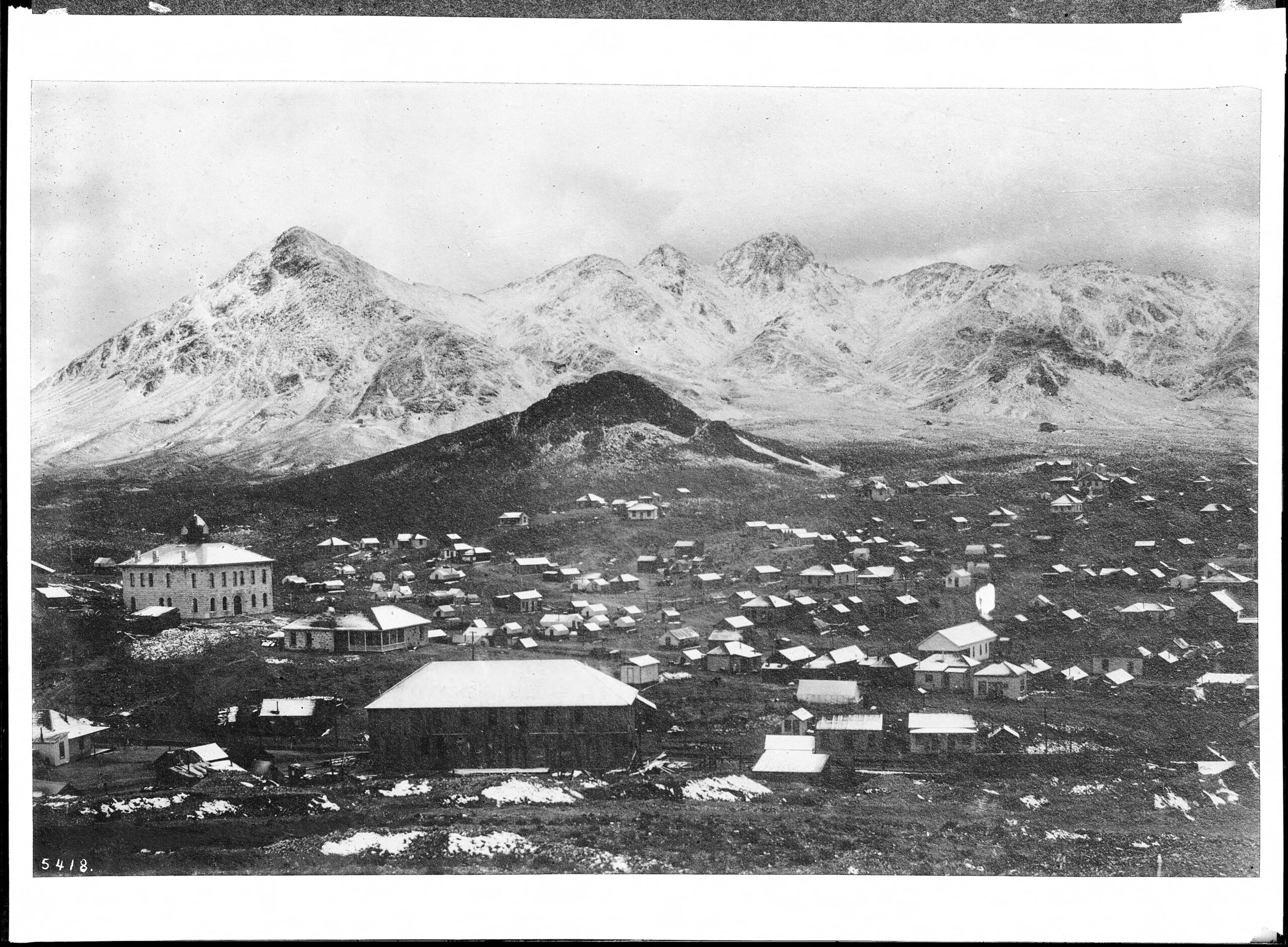
Most Nevada boomtowns share the same arc: a lucky strike, a frantic rush, a few golden years, and then the slow surrender to wind and rust. Tonopah began exactly that way — but it never finished the story. More than a century after Jim Butler stubbed his boots on a ledge of silver ore, the “Queen of the Silver Camps” is still very much alive, straddling the lonely junction of U.S. Routes 6 and 95 in the geographic center of Nevada. It is at once a working county seat and a vast open-air museum of the mining era that built it.
What makes Tonopah worth the long drive is precisely this doubleness. The headframes on the hillside above town are not reconstructions; they are the real machinery of the strike that pulled Nevada out of a twenty-year depression. The 1907 Mizpah Hotel still rents rooms. The cemetery still holds the plague victims and the mine-fire dead. Here the ghost-town experience is not about absence but about continuity — a place where the boom never entirely let go.
A State in the Doldrums
To understand why Tonopah mattered so much, you have to picture the Nevada of the late 1890s. The legendary Comstock Lode — the silver bonanza that had bankrolled Virginia City and, indirectly, the Union war effort — was played out. Silver prices had collapsed on the world market. For roughly two decades the state had shed population and capital, its mining economy limping along on the memory of past glory. Nevada needed a new strike badly, and in the spring of 1900 it got one in the last place anyone was looking: the barren San Antonio Mountains of Nye County.
Jim Butler and the Ledge of Silver
The man at the center of the story was James L. “Jim” Butler, the district attorney of Nye County and a part-time prospector with a rancher’s patience. In May 1900 he set out overland from his ranch near Belmont, bound for the small camp of Klondike. Passing through the mountains, he made camp at a desert spring the Shoshone called Tonopah — a word joining the roots for greasewood and water. Inspecting the dark rock outcrops near his camp on May 19, he gathered several heavy, mineralized samples.
An informal look in Klondike dismissed the rock as worthless iron. But Butler held onto more fragments, and that summer his associate Tasker L. Oddie paid to have them properly assayed by a chemist in Austin. The results were electrifying: the samples ran from $50 to more than $600 per ton in silver and gold. Butler returned to the site with his wife, Belle, on August 25, 1900, and together they filed the district’s founding claims. It was Belle who named the first three — the Mizpah, the Desert Queen, and the Burro. The Mizpah would go on to become the single richest silver producer in Nevada for the next forty years.
The Leasing System and the Rush
Butler could have hoarded his ground and waited for big capital. Instead, in December 1900, he did something unusual that supercharged the district’s growth: he opened it up. Under his flexible leasing arrangement, independent miners could work a specified block of a claim in exchange for handing back a quarter of everything they pulled out. The policy cost Butler nothing up front and turned the whole basin into a magnet. Prospectors, laborers, and merchants poured in.
By early 1901 the informal encampment — first called simply Butler, or Butler City — held about sixty people living in tents and rough board shacks. The Post Office Department opened an office under the name Butler that April, changing it to Tonopah only in 1905. Growth was ferocious. By the middle of 1901 the camp counted more than 650 residents, stage lines running in from Sodaville, and its own newspaper, the Tonopah Bonanza. Within a year that figure had tripled.
From Leaseholders to Corporations
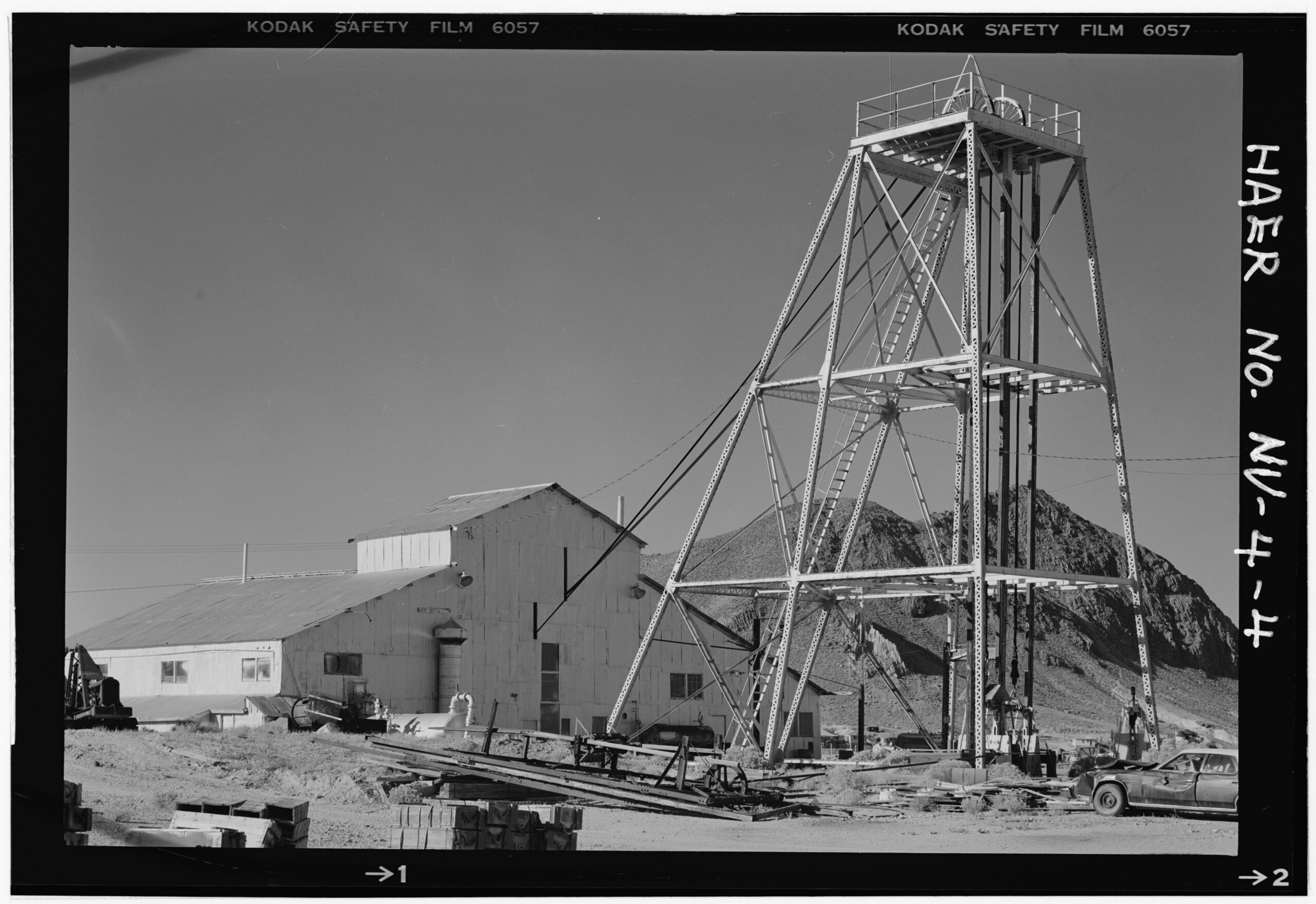
As word of the bonanza reached financial markets, individual leaseholders gave way to well-funded corporations. Between 1901 and 1902 the district’s major enterprises were incorporated — the Tonopah Mining Company, the Tonopah Belmont Development Company, the West End Consolidated, and the Tonopah Extension. Corporate money meant electricity, deep shafts, and reduction mills, and it meant an end to the freight-wagon bottleneck that had strangled the camp. In 1903 crews began building a sixty-mile narrow-gauge line to connect Tonopah with the Carson and Colorado Railroad at Sodaville. Cheap rail transport transformed the district’s economics overnight.
The town’s rising status was formalized in May 1905, when Tonopah displaced the fading community of Belmont as the seat of Nye County. Newspapers began calling it the “Queen of the Silver Camps,” and for once the boosterism was earned.
Peak Years
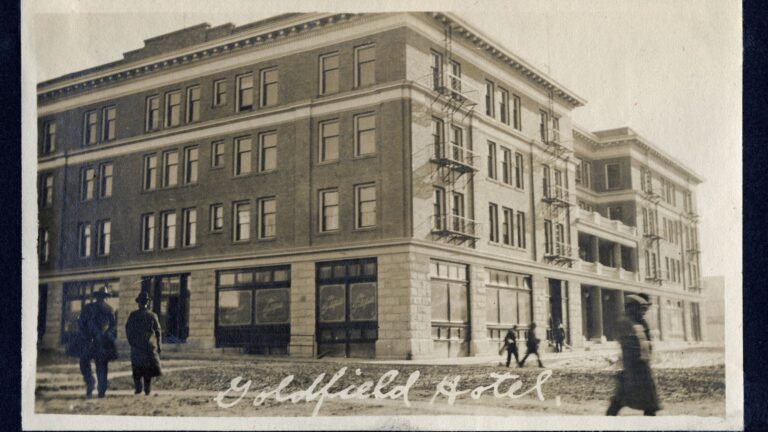
Tonopah reached its zenith between 1910 and 1914. In those years the district’s mines routinely produced eight to ten million dollars in silver and gold annually, and the town swelled to roughly ten thousand people. It had electric light, water mains, banks, theaters, fraternal halls, and a rail connection to the outside world. Over the full life of the district, the Tonopah mines yielded an estimated total of more than $150 million in precious metal — a staggering sum that reverberated across the whole state, helping to touch off further rushes at Goldfield, Rhyolite, and Manhattan.
The Long Decline
Tonopah did not die in a single stroke; it wound down over decades. Gold output began slipping as early as 1910, and by 1920 the population had fallen to less than half its peak. The easy surface veins were gone, forcing crews to chase lower-grade ore into ever-deeper and wetter ground, where pumping and hoisting costs mounted. The Great Depression of the 1930s knocked metal prices down further and dried up investment, until only four major companies were still working the district by the start of World War II.
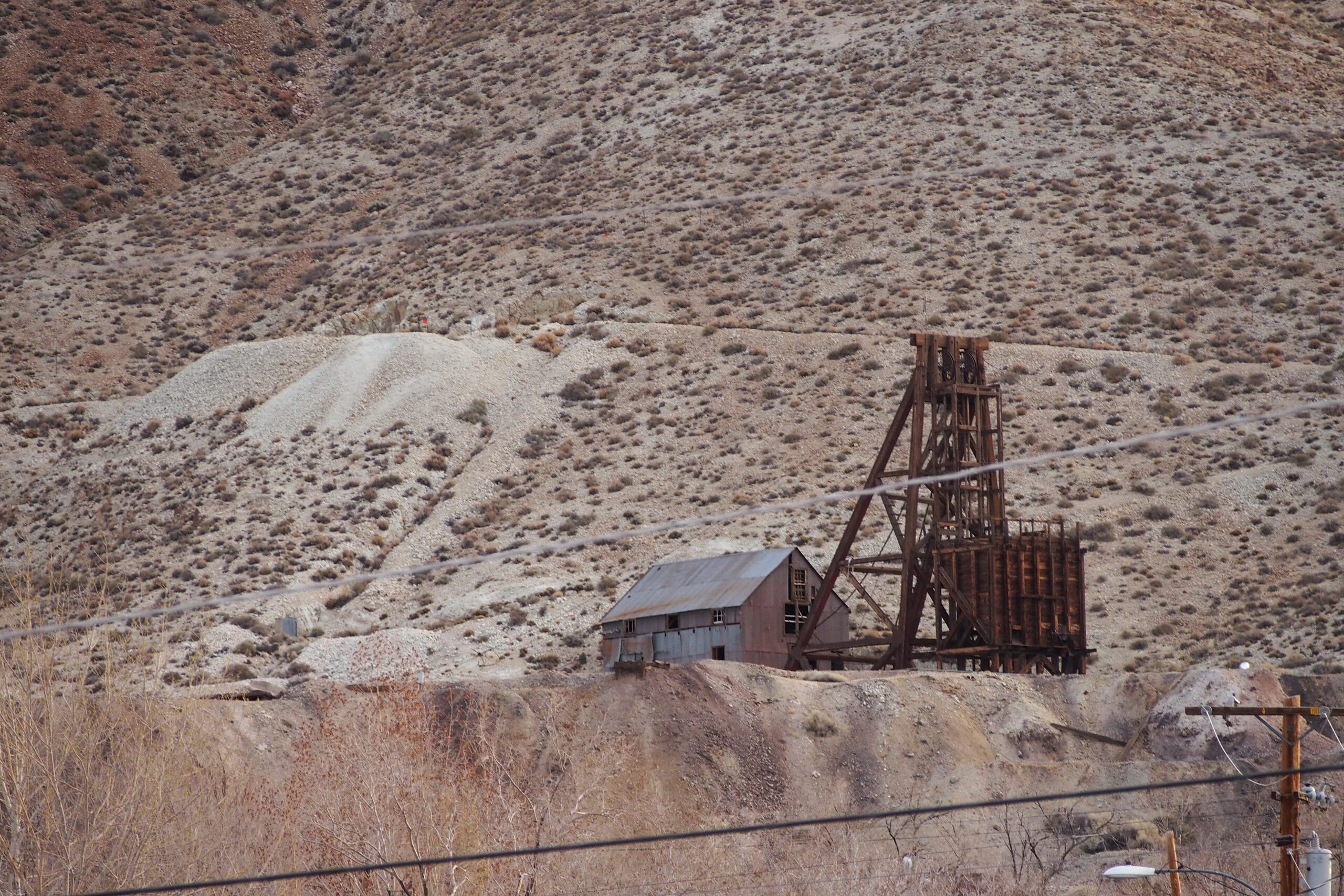
Fire finished much of what economics began. On the night of October 31, 1939, flames tore through the Belmont Mine, burning shaft timbers and warping the great steel headframe; the damage permanently closed the district’s second-richest mine. In October 1942 another fire destroyed the Tonopah Extension mill, inflicting more than $100,000 in damage and ending commercial milling in that sector. After the war the surviving companies liquidated for good, and in October 1947 the Tonopah & Goldfield Railroad ran its last train and pulled up its track — the final severing of the industrial lifeline. Howard Hughes bought up patented claims across the district in 1968 through his Summa Corporation, but the underground mines never reopened.
Disaster and Sacrifice
Two catastrophes bracket Tonopah’s early years. The first was the so-called “Tonopah Plague” of 1902. Between January and April of that year the raw camp suffered a sudden, terrifying spike in deaths — fifty-six in four months — and rumors flew of poison ground-gas or some exotic tropical fever. State health authorities eventually identified the killer as an epidemic of virulent pneumonia, driven by bitter high-altitude winter cold, filthy conditions in the canvas shelters, and unsanitary slaughterhouses near the town center.
The second was the Belmont Mine fire of February 23, 1911, Tonopah’s worst industrial tragedy. A miner left a lit candle against dry timber near the 1,200-foot level, and carbon-monoxide fumes rolled through the connected drifts where men were working. A twenty-eight-year-old miner named William “Big Bill” Murphy volunteered to ride the hoist cage down into the poison to pull out trapped workers. He made two successful trips, hauling exhausted men to the surface, and then — already sick from the gas — went down a third time. He never returned, dying with seventeen others. Murphy was buried in the Old Tonopah Cemetery, and a stone monument outside the Tonopah post office still shows him lifting a fallen comrade.
Lawmen, Senators, and Legends
For a remote desert camp, Tonopah drew a remarkable cast. The gunfighter-turned-lawman Wyatt Earp arrived in 1902 and ran the Northern Saloon before drifting south to Goldfield. Tasker Oddie, who had funded that first assay, parlayed his mining fortune into the governorship of Nevada and a U.S. Senate seat. The brothers Key and Vail Pittman both settled here; Key became a long-serving senator and chairman of the Foreign Relations Committee, while Vail became governor. And George “Devil” Davis, remembered as Tonopah’s first African American civic leader, was known across town as an influential figure and irrepressible prankster.
Ghosts of the Queen
A town this old collects its share of ghost stories. The 1907 Mizpah Hotel is said to be haunted by a “Lady in Red,” a 1920s guest supposedly murdered on the fifth floor. The Old Tonopah Cemetery, opened in 1901 and holding roughly 300 graves — plague victims, the Belmont fire dead, and a sheriff killed in a bordello shootout — sits, fittingly, right beside the famous Clown Motel, a pairing that has done wonders for the town’s spooky reputation. And regulars at the Tonopah Liquor Company still blame the mischievous spirit of “Devil” Davis whenever something goes missing behind the bar.
The Town That Refused to Vanish
Here Tonopah’s story diverges from nearly every other Nevada silver camp. When the mines closed, the town did not empty out. Its position on U.S. 95, roughly midway between Las Vegas (220 miles south) and Reno (240 miles northwest), gave it a second economic life as a highway waypoint. Its role as Nye County seat kept government payrolls in place. And in the decades since, the Department of Defense’s Tonopah Test Range, the nearly billion-dollar Crescent Dunes solar project, and a steady trickle of heritage tourism have kept the lights on. Today about 2,400 to 2,500 people call it home.
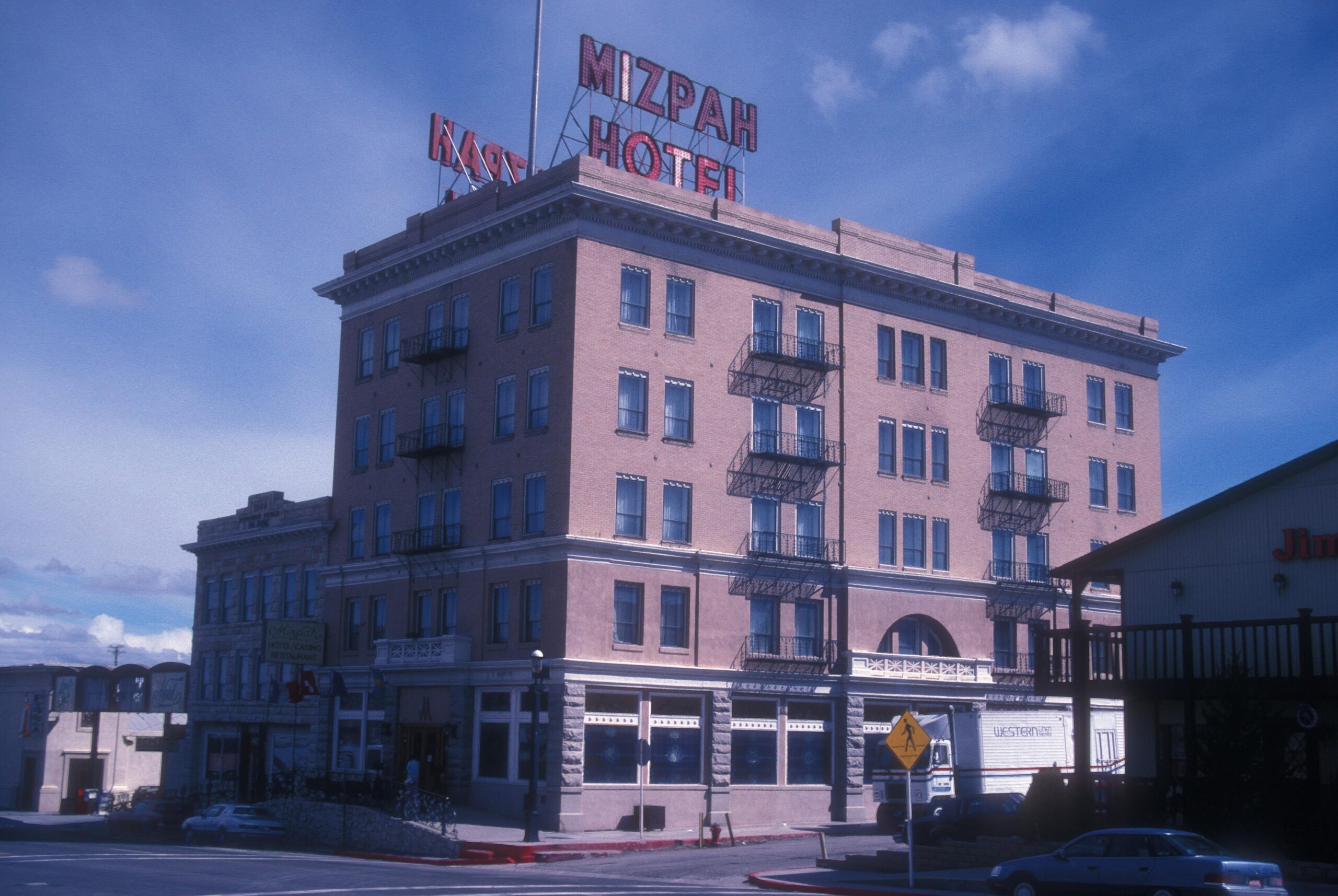
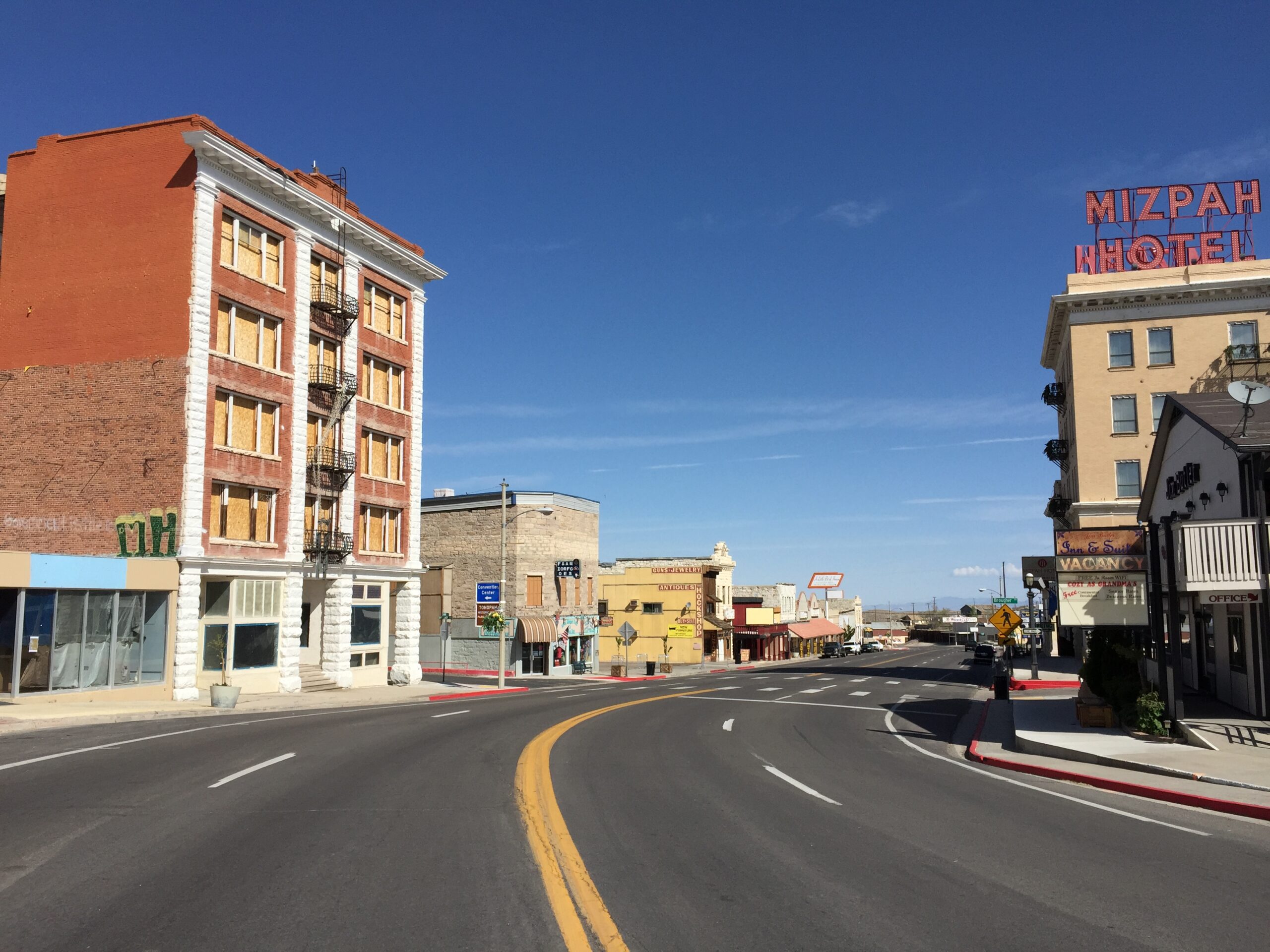
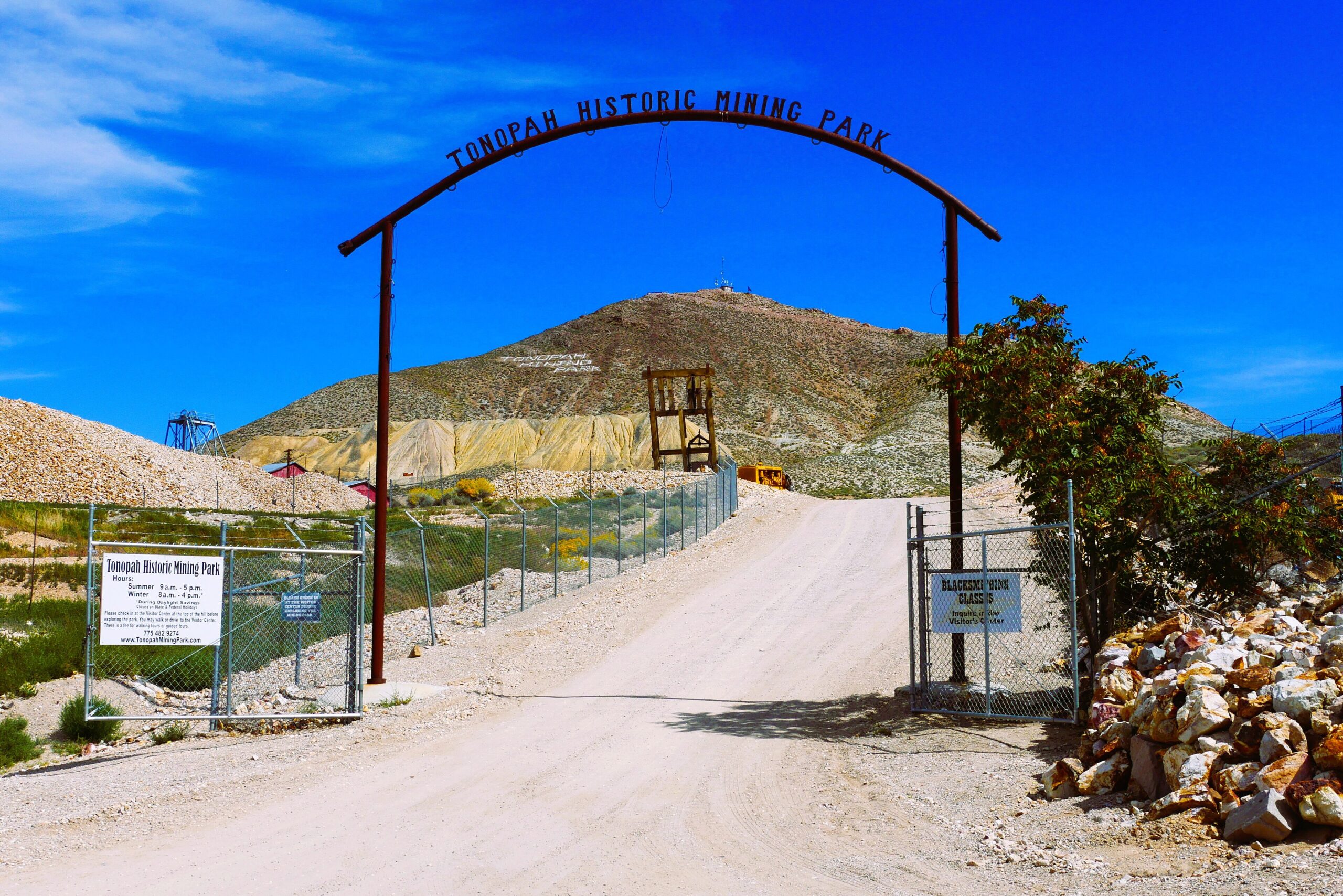
That survival is what makes a visit here different from the usual ghost-town pilgrimage. The stone Nye County Courthouse, the five-story Mizpah Hotel, the Old Tonopah Cemetery, and the sprawling Tonopah Historic Mining Park are not ruins fenced off behind “no trespassing” signs but working parts of a living community. You can sleep in the Mizpah, eat downtown, and walk among original headframes all in the same afternoon.
Getting There
Tonopah sits squarely at the junction of U.S. Route 95 and U.S. Route 6 in central Nevada — about 220 miles north of Las Vegas and 240 miles southeast of Reno, in both cases via U.S. 95. The roads are paved and open year-round, but the distances between towns are long; plan fuel and rest stops accordingly. The Historic Mining Park is on the east edge of town, signposted off Main Street up Burro Avenue toward Mt. Oddie.
Ghost Towns Nearby
Photo credits: hero & historic panorama, C.C. Pierce / California Historical Society (public domain); Mizpah Mine headframe, HAER / Library of Congress (public domain); Mizpah Hotel, Jerrye & Roy Klotz MD (CC BY-SA 3.0); Desert Queen headframe, Agnieszka Kwieciń, Nova (CC BY-SA 4.0); Mining Park entrance, Rick Obst (CC BY 2.0); Main Street, Famartin (CC BY-SA 4.0). Sourced via Wikimedia Commons.