Matlin, Utah
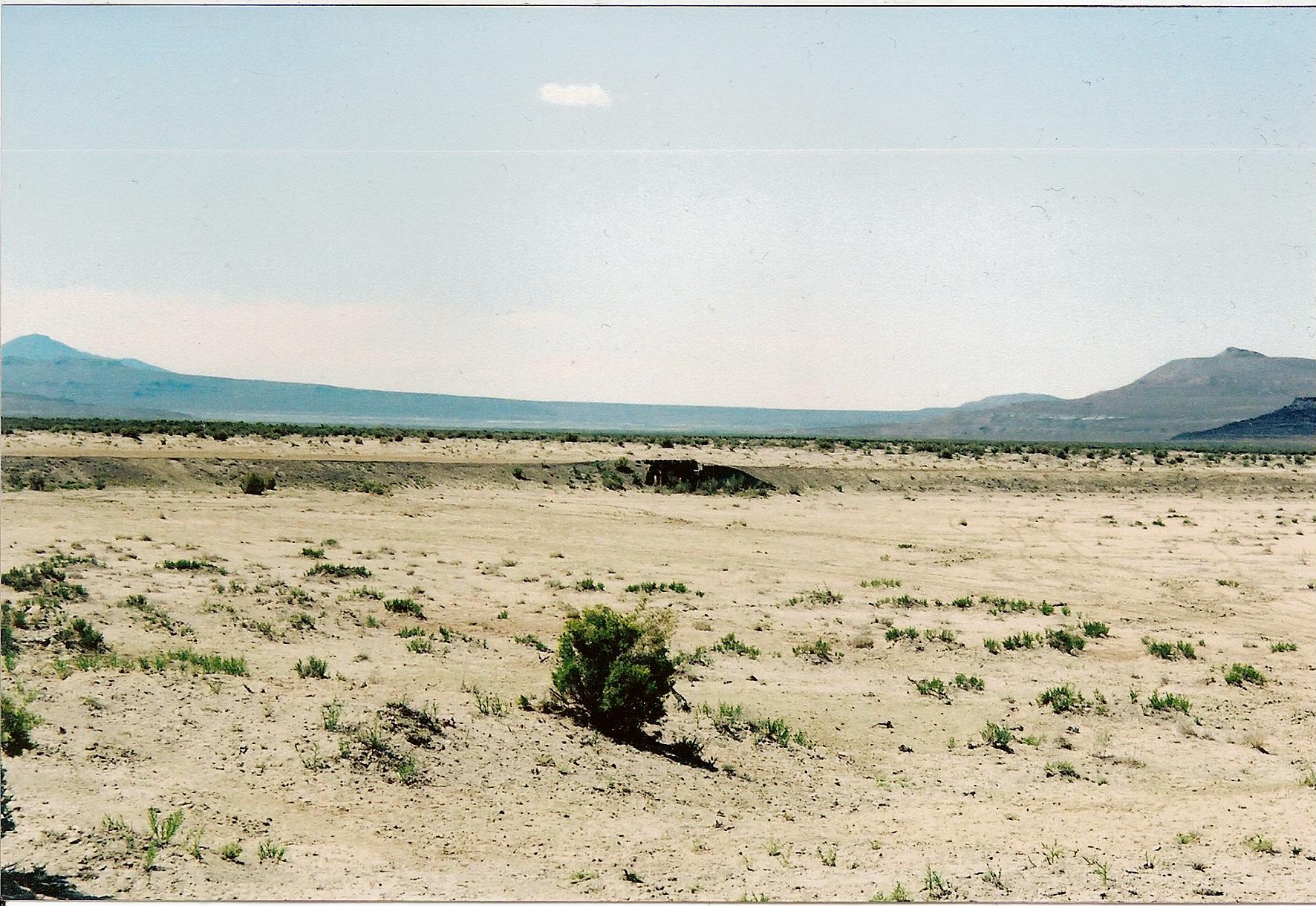
Matlin was a small railroad station in the empty desert north of the Great Salt Lake. Central Pacific track crews reached the spot on April 5, 1869, five weeks before the rails met at Promontory Summit, and the railroad kept a section crew here to look after the track until about 1904. Most of those workers were Chinese, and they lived beside the station in their own bunkhouse and dugouts. When Southern Pacific opened the Lucin Cutoff across the lake in 1904, the old line through Matlin became a quiet branch, and in 1942 its rails were torn up for the war effort. Today Matlin is a stop on a BLM backcountry byway, with an earthen wye, the old grade, scattered traces of the camp and an interpretive sign.
A section station on the desert grade
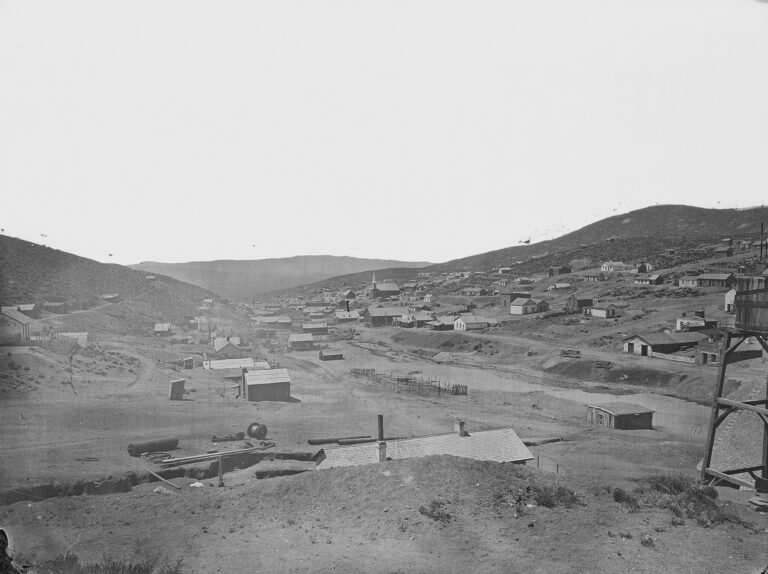
Matlin sits on the 1869 Central Pacific grade in western Box Elder County, 712.8 miles from San Francisco by the railroad’s count. Below the Matlin Mountains, the line crossed open sagebrush flats with no towns for miles. To keep the track safe, the Central Pacific set up section stations along the line, each with a foreman and a gang of track workers. Matlin was one of them.
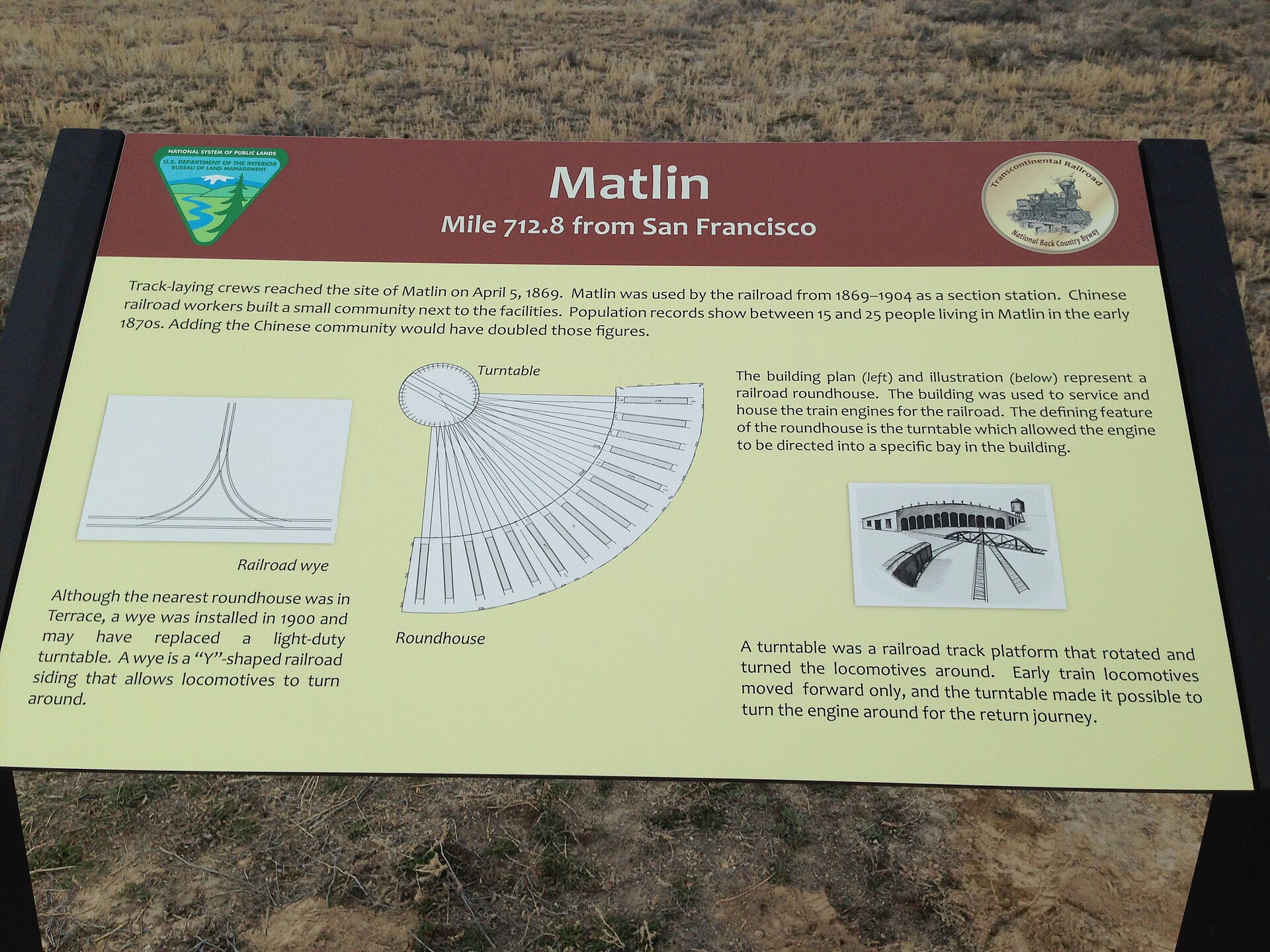
According to the Bureau of Land Management’s study of the Utah stations, Matlin served the railroad from 1869 to about 1904. A railroad station plan from about the 1880s shows a windowless “China Bunk House” about 16 by 24 feet. In 1900 the railroad built a wye, a triangle of track used to turn engines around, which may have replaced a light-duty turntable. The BLM marker notes that the nearest roundhouse was at Terrace, about nine miles west.
According to an archaeologist who works with the State of Utah, Matlin also served as a helper station, a place where extra locomotives were kept to help heavy trains over the grades nearby.
The people of Matlin
Published population figures list 15 people at Matlin in 1870 and 25 in 1876. The BLM sign at the site says Chinese railroad workers built a small community next to the station, and that counting them would have doubled those figures.
Chinese laborers did most of the track maintenance on this part of the Central Pacific for about two decades after 1869. At most section stations their bunkhouse stood apart from the foreman’s house. At Matlin, archaeologists recorded the bunkhouse site in 2018, a low mound of decayed peeled posts that once held the building off the ground. Pieces of Chinese porcelain, including “Bamboo” and “Double Happiness” pattern bowls, along with an opium tin, a clay pipe and teapot fragments, have been found here. The base of one porcelain rice bowl from the station has a mark cut into it to identify its owner, probably one of the Chinese workers. The BLM’s 1981 survey also noted dugouts with 19th-century Chinese artifacts that had been damaged by illegal digging.
A bicyclist stops for the night
In the spring of 1884, Thomas Stevens rode through on the first bicycle trip around the world, following the railroad across the Utah desert. In Around the World on a Bicycle (1887), he wrote that he found a bed at the Matlin section house with a “whole-souled section-house foreman.” It is one of the few first-hand descriptions of daily life at the station.
The Lucin Cutoff and a long fade
The 1869 line looped north around the Great Salt Lake and climbed over the Promontory Mountains. In 1902 Southern Pacific began a straight route across the lake, the Lucin Cutoff. Through freight trains switched to the Cutoff on March 8, 1904, and the BLM study says its completion ended Matlin’s life as a section station.
The rails stayed, though. The old line became the Promontory Branch, and Matlin remained a siding in employee timetables; a 1931 timetable still shows a siding for 33 cars and the wye. On March 31, 1937, the Utah Public Service Commission let Southern Pacific stop running trains between Kelton and Watercress, the stretch that includes Matlin.
The rails go to war
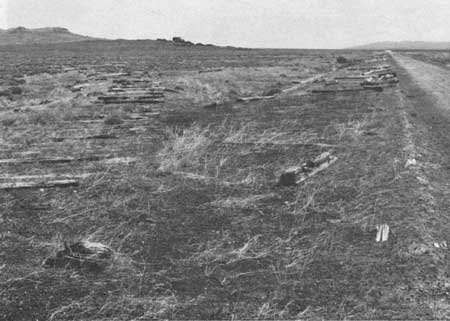
On June 11, 1942, the Interstate Commerce Commission approved abandoning the branch between Lucin and Corinne. The steel was wanted for military depots during World War II. Salvage crews began pulling rail near Corinne on July 1, 1942, and worked west, finishing in early September. On September 8, 1942, Governor Herbert B. Maw joined an “undriving” ceremony at Promontory as a spike was pulled from the old line. The crews left the wooden ties lying along the shoulders of the grade, which later became a road.
The 2020 Matlin Fire
For almost 80 years the dry desert preserved those ties. That changed in June 2020, when a lightning storm started several fires in western Box Elder County. The Matlin Fire was reported on the evening of June 3 and was contained the next evening. News reports put it at about 8,000 acres; the federal fire report listed 6,292 acres.
The fire destroyed two timber trestles from the 1870s and burned the 1940s ties along the grade into lines of ash and shallow marks in the soil. A wooden box culvert from about 1880 to 1900 caught fire. Firefighters put it out, but it flared up again the next morning and had to be doused a second time, and the state hoped to save it by sliding a metal pipe inside. When state historic preservation officer Chris Merritt toured the burn in the days after the fire with BLM archaeologist Mike Sheehan and archaeologist Ken Cannon, he told KSL it was “like driving into Mordor.” The earthen wye at Matlin came through undamaged.
What remains
No buildings stand at Matlin. Visitors can see the raised 1869 grade, the earthen outline of the 1900 wye, cuts and fills along the line, the low remains of the Chinese bunkhouse, scattered cans, glass and porcelain, and the BLM interpretive sign. The ties shown in older photos are gone, burned in 2020.
Where the name Matlin came from is not recorded in the railroad and BLM sources checked for this post. The Matlin Mountains rise to the north.
Timeline
Historic sites nearby
Distances are approximate straight-line miles from Matlin, or rail miles along the old grade where noted. Driving distances are much longer.
Further reading
Sources
Bureau of Land Management — Rails East to Promontory: Matlin and nearby stations; Transcontinental Railroad Back Country Byway; Byway map
Historical Marker Database — Matlin (BLM marker); Wikipedia — Matlin, Utah
Utah Rails — Promontory Branch stations; Southern Pacific in Utah; ICC dockets
National Park Service — Golden Spike cultural landscape report; Central Pacific Railroad Grade Historic District (NRHP)
Polk, Merritt and Cannon — Chinese Workers at Central Pacific Railroad Section Station Camps; Internet Archive — Rails East to Ogden; Merritt, Polk, Cannon and others, “Rolling to the 150th,” Utah Historical Quarterly 85, no. 4 (2017)
KSL — Utah wildfire destroyed nearly 150-year-old pieces of railroad history; Officials gain containment on lightning-caused fires; Railfan & Railroad — Utah wildfire destroys trestles along first transcontinental route; National Interagency Fire Center — Situation report, June 6, 2020
Thomas Stevens — biography
Photos: Bureau of Land Management Utah, photo provided by Ray Kelsey, via Wikimedia Commons (public domain); Bureau of Land Management, Rails East to Promontory, via Wikimedia Commons (public domain); Tricia Simpson, via Wikimedia Commons, CC BY-SA 4.0.