Bombay Beach, California
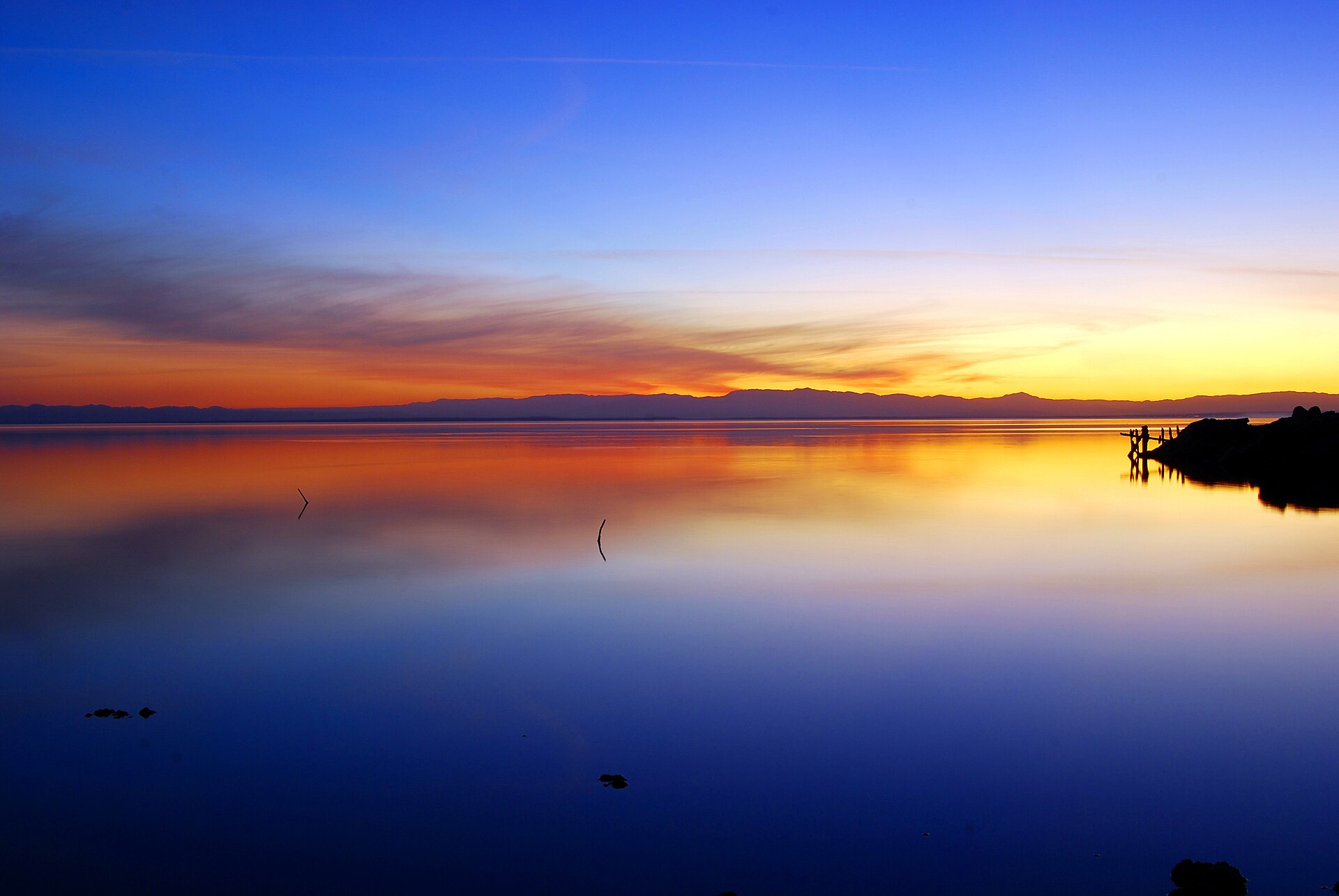
Most ghost towns die of exhaustion — a mine plays out, a railroad reroutes, the water runs dry. Bombay Beach died of the opposite problem: too much water, then poisoned water, then almost none at all. Platted in 1929 on the shore of a sea barely two decades old, it grew into a glamorous mid-century desert resort, collapsed as that sea turned toxic, and — improbably — returned in the 2010s as an off-grid art colony. It is the lowest community in the United States, 223 feet below sea level, on the eastern shore of California’s Salton Sea.
This is the documented history of Bombay Beach — how an engineering accident created its sea, how the “Salton Riviera” boomed and died, and how to visit what remains today. Where the record and the legend diverge, we say so.
An accident makes a sea, 1905–1929
The Salton Sea was born of a mistake. In 1905, heavy winter rains overwhelmed poorly built irrigation canals dug by the California Development Company to divert Colorado River water into the Imperial Valley. For nearly two years the river poured unchecked into the Salton Sink — a deep basin already below sea level — drowning rail lines and homesteads. When engineers finally capped the breach in early 1907, they had accidentally created California’s largest inland body of water.
Land speculators saw opportunity in a vast lake ringed by desert. On October 8, 1929, developer R.E. Gilligan platted the townsite of Bombay Beach, marketing it as an exclusive waterfront retreat for buyers chasing desert air and shoreline recreation.
The Salton Riviera, 1950s–1960s
After World War II, with Palm Springs booming just to the north, promoters rebranded the Salton Sea as the “Salton Riviera.” The California Department of Fish and Game stocked the lake with marine game fish — orangemouth corvina and bairdiella — creating a world-class sport fishery. At its height the sea drew more than 1.5 million visitors a year, outdrawing Yosemite National Park. Marinas, motels, trailer parks, and yacht clubs crowded the shore.
The guest list matched the hype. Frank Sinatra, Bing Crosby, the Beach Boys, Desi Arnaz, Jerry Lewis, and the Marx Brothers all came to boat, water-ski, and fish. For a decade or two, a desert basin below sea level was one of Southern California’s most fashionable playgrounds.
A terminal sea turns toxic, 1970s–1990s
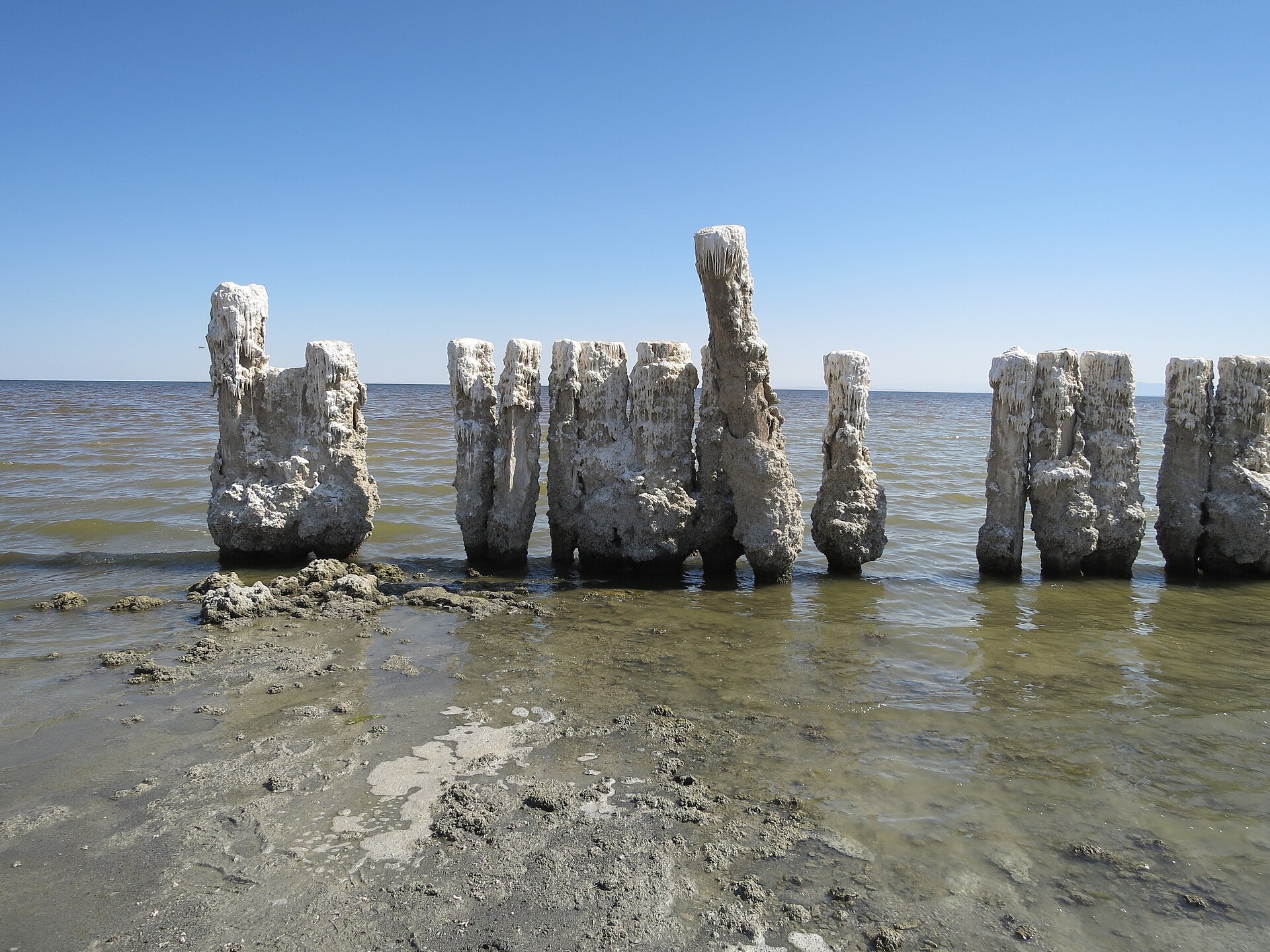
The Salton Sea had a fatal flaw: no outlet. Every drop that entered could leave only by evaporation, so everything dissolved in the water — farm salts, fertilizers, and nitrates draining off the Imperial Valley — simply concentrated. As early as 1961, state biologists warned that rising salinity would eventually destroy the fishery.
The end came in stages. In September 1976, Tropical Storm Kathleen raised the sea eight feet in three hours; storms the following year destroyed docks, motels, and homes. To save what was left, engineers threw up a massive earthen berm along the town’s western edge — and in doing so cut Bombay Beach in two. Everything seaward of the berm was surrendered to the rising, salting water.
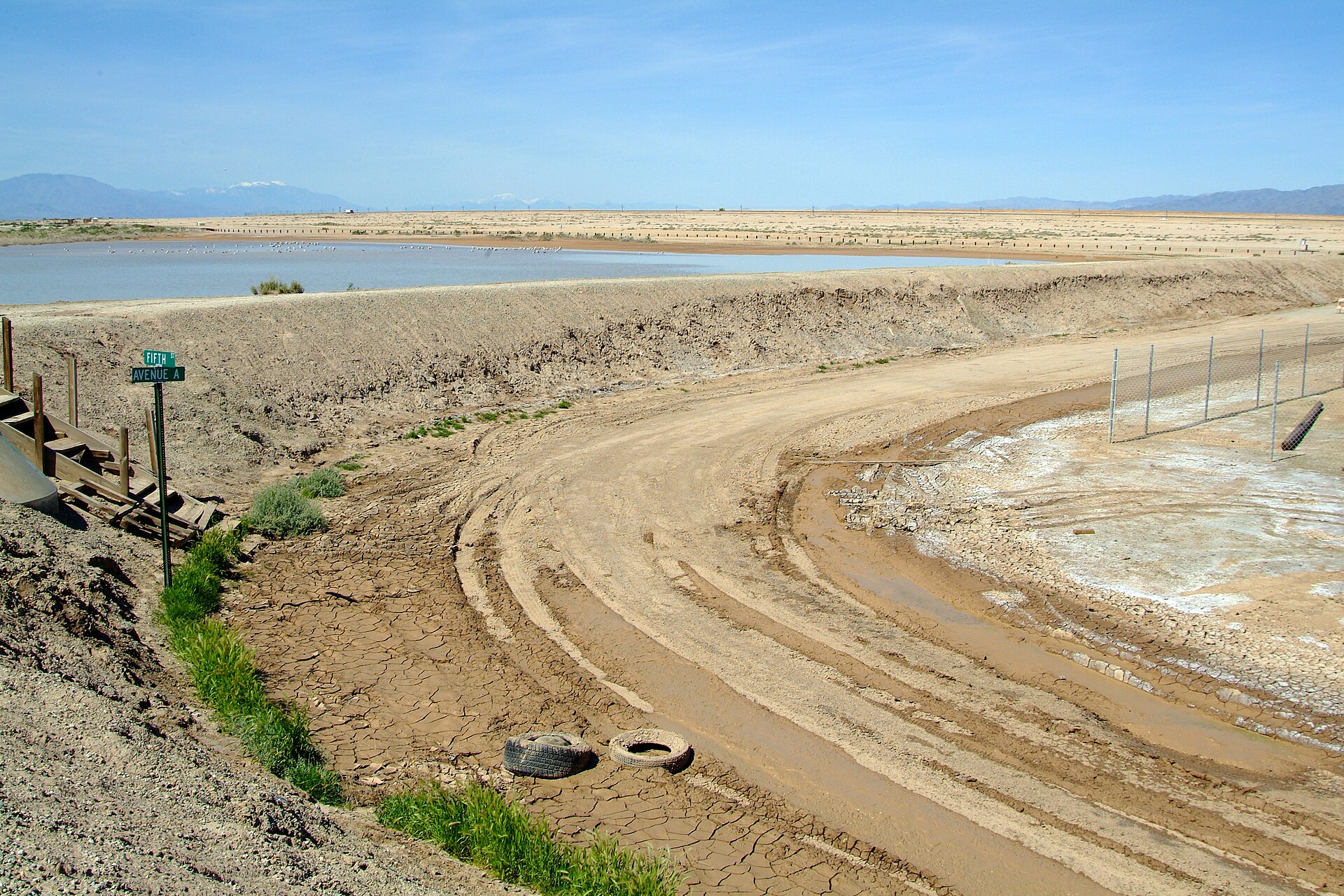
By the 1980s and 1990s the water was nearly twice as salty as the Pacific. Fish died by the millions and rotted on beaches made of crushed barnacle shells; avian botulism killed tens of thousands of migratory birds; the stench of hydrogen sulfide carried as far as Los Angeles. As the sea receded it bared a lakebed of dried agricultural chemicals that blew across the region as toxic dust. Property values collapsed, and residents left furnished homes and trailers to bake in the sun.
Ruins, GTA V, and a bohemian revival
What remained emptied out slowly. The census recorded 991 residents in 1990, 366 by 2000, and 231 in 2020 — an aging population (median age about 60) that thins to roughly 150 in summers above 115°F. The social anchor is the Ski Inn, which bills itself as the lowest bar in the Western Hemisphere at 223 feet below sea level. Beyond the berm, submerged utility poles, half-buried trailers, and salt-crusted foundations form a shoreline that reads as post-apocalyptic.
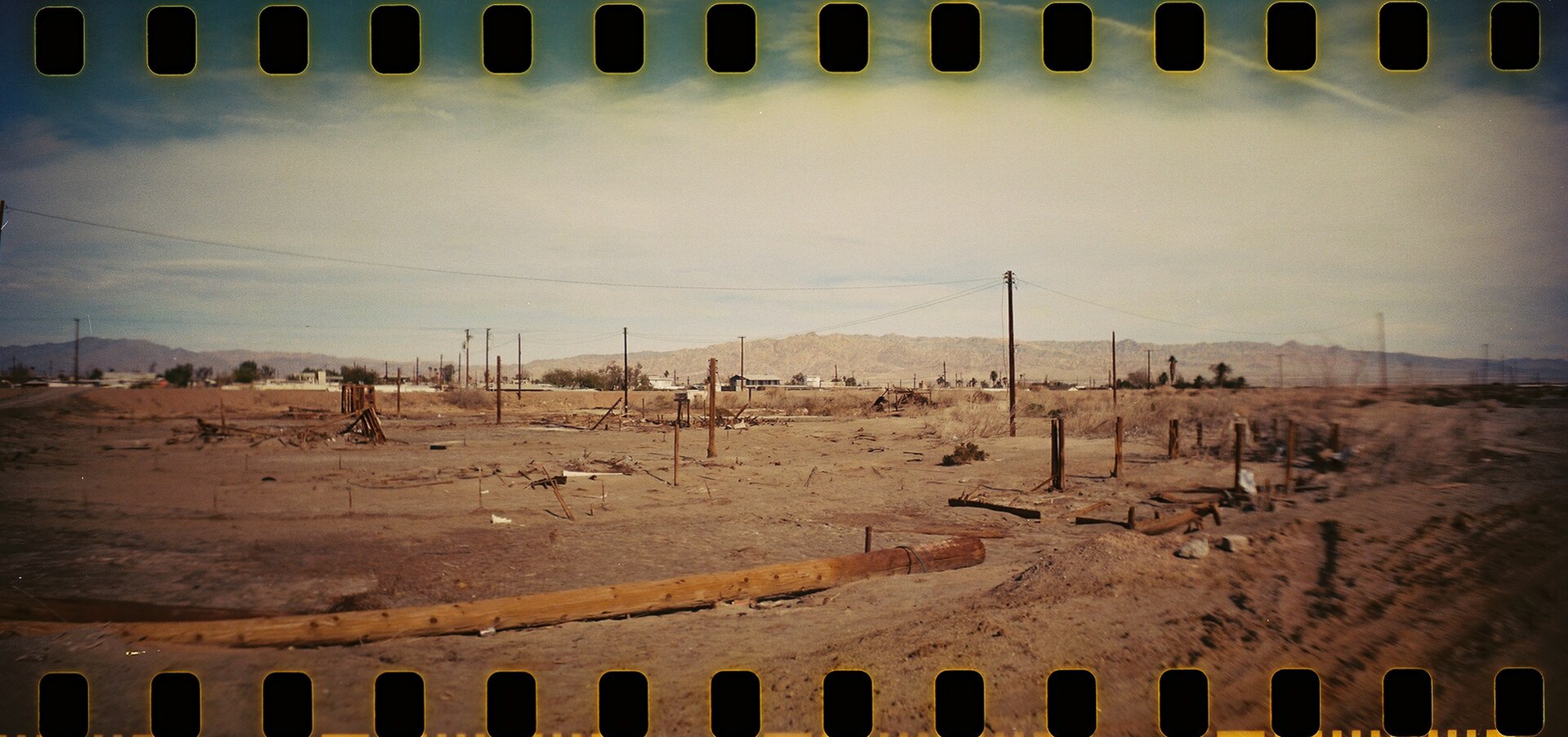
That ruined landscape became famous. Bombay Beach was the real-world model for “Sandy Shores,” the fictional desert town in Grand Theft Auto V. Tragedy has left marks too: on June 30, 2020, a brush fire swept through part of town, killing one person and destroying about 40 structures — a large share of the remaining housing.
Then came the artists. Drawn by cheap lots, an absence of building rules, and a dramatic backdrop of decay, they began buying property in the mid-2010s. In 2015–16, filmmaker Tao Ruspoli, hotelier Stefan Ashkenazy, and philanthropist Lily Johnson-White founded the Bombay Beach Biennale, a satirical nod to the Venice Biennale. Rather than temporary exhibits, artists install permanent, site-specific works across vacant lots and the shoreline — the ZigZag House, Randy Polumbo’s aircraft-fuselage sculpture Lodestar, and an abandoned garage reborn as the Bombay Beach Opera House. The influx has brought friction of its own, between longtime, lower-income residents seeking quiet and a seasonal art crowd.
Timeline
Visiting Bombay Beach today
Bombay Beach is an open, lived-in census-designated place, not a gated park — you can drive in any time, free of charge, and wander the public streets and shoreline art. A few norms keep it that way.
Nearby ghost towns & Salton Sea ruins
The Salton Trough is dense with boom-and-bust sites — railroad sidings at Frink and Durmid, the mining ghost town of Eagle Mountain, and more — most within an hour’s drive along the sea’s two shore highways.
Further reading
Sources
Bombay Beach, California — Wikipedia. en.wikipedia.org
Salton Sea — Wikipedia. en.wikipedia.org
Lost Ship of the Desert — Wikipedia. en.wikipedia.org
Bombay Beach Biennale — official site. bombaybeachbiennale.org