Boston Mills, Ohio
Ohio
Milling
Canal era · 1805–2016
9 min read
Founded
Surveyed 1805; Boston Township organized 1811
Peak Population
~300 residents (1842)
County / Region
Summit County · lower Cuyahoga Valley
Elevation
~610 ft (186 m) along the river
Land Management
NPS · Cuyahoga Valley National Park
Status
Depopulated by federal buyout; structures cleared, site restored
Free entry
Grounds open 24h
Paved towpath & trails
Visitor center on site

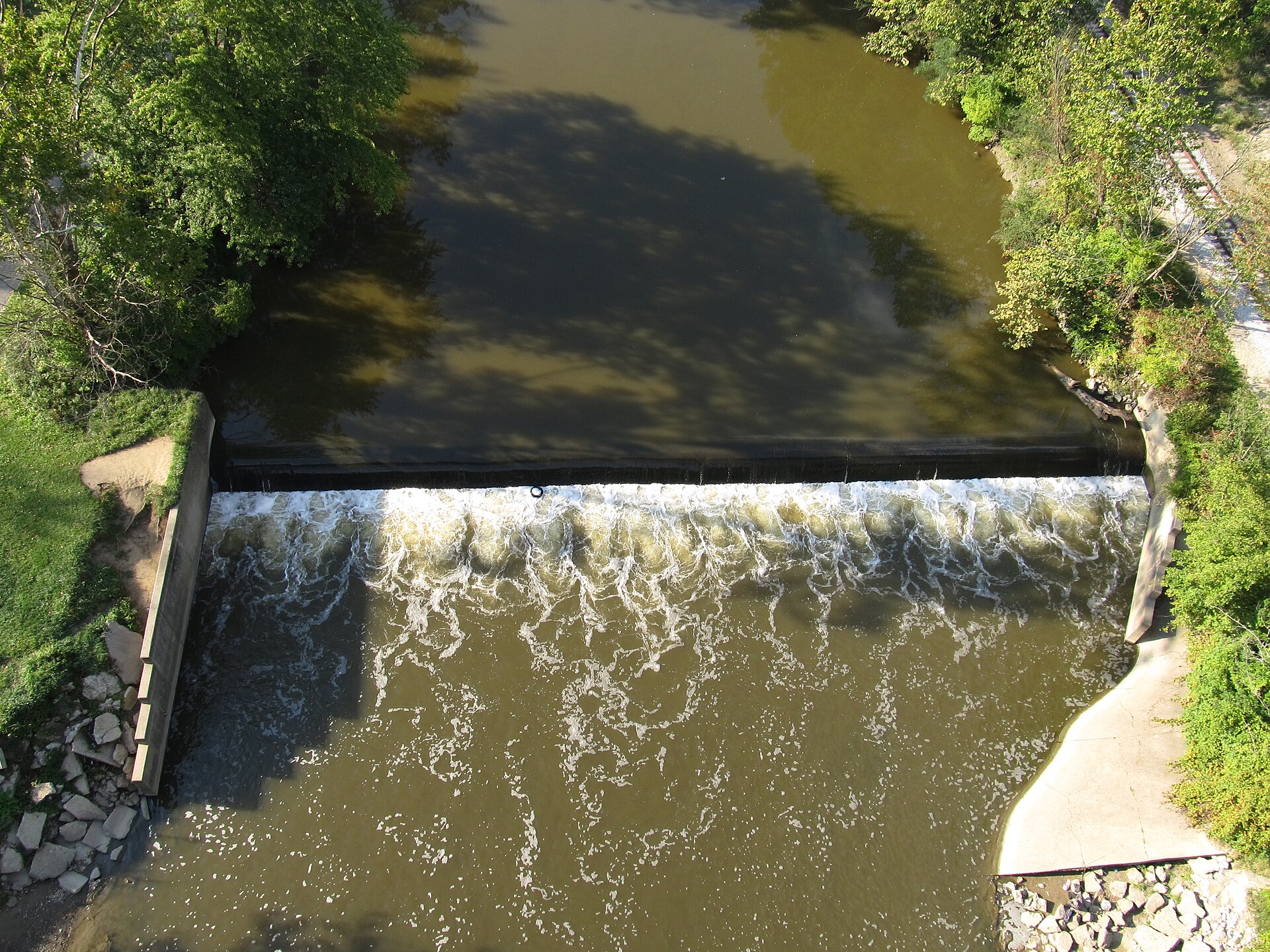
The Cuyahoga River in the valley that swallowed Boston Mills, now Cuyahoga Valley National Park. Photo: Ken Lund, CC BY-SA 2.0.
Most ghost towns die of exhaustion — a mine plays out, a railroad reroutes, the young people drift away. Boston Mills is stranger than that. It was Summit County’s first settlement and a thriving canal town, and it did not fade so much as it was bought — house by house, under federal eminent domain — to make room for a national park. For years afterward its boarded-up homes stood empty behind government “No Trespassing” signs, and some were burned to the ground in fire-department training exercises. That eerie in-between landscape gave the place its second, far more famous name: Helltown.
This is the documented history of Boston Mills, the real origins of the Helltown legends, and how to visit what is today one of the quieter corners of Cuyahoga Valley National Park. Where the record is genuinely disputed, we say so.
“Now we know how the Indians felt.”
— graffiti reportedly left inside a vacated Boston Township home after the federal buyout, widely repeated in local accounts
A canal town before it was a legend, 1805–1842
The land was first surveyed in 1805 by Alfred Wolcott and James Stanford, working for the Connecticut Land Company as it divided the Connecticut Western Reserve. The pair came back in 1806 to buy in, raising the township’s first log cabin near what became the Boston Cemetery. On January 15, 1811, the area was formally organized as Boston Township — Range 11, Town 4 of the Reserve — making Boston the earliest permanent settlement in what would become Summit County. For its first two decades it was an ordinary farming hamlet on the Cuyahoga River.
The Ohio & Erie Canal changed everything. Completed through the Cuyahoga Valley in 1827, it put Boston squarely on the water highway linking Lake Erie to the Ohio River, and the village was platted as a canal town that same year. Water power spun up sawmills, gristmills, and paper mills; a dry dock built and repaired canal boats. By 1842 — two years after Summit County itself was organized — Boston reached its peak of roughly 300 residents, with a hotel, general stores, a warehouse, and a working boatyard.
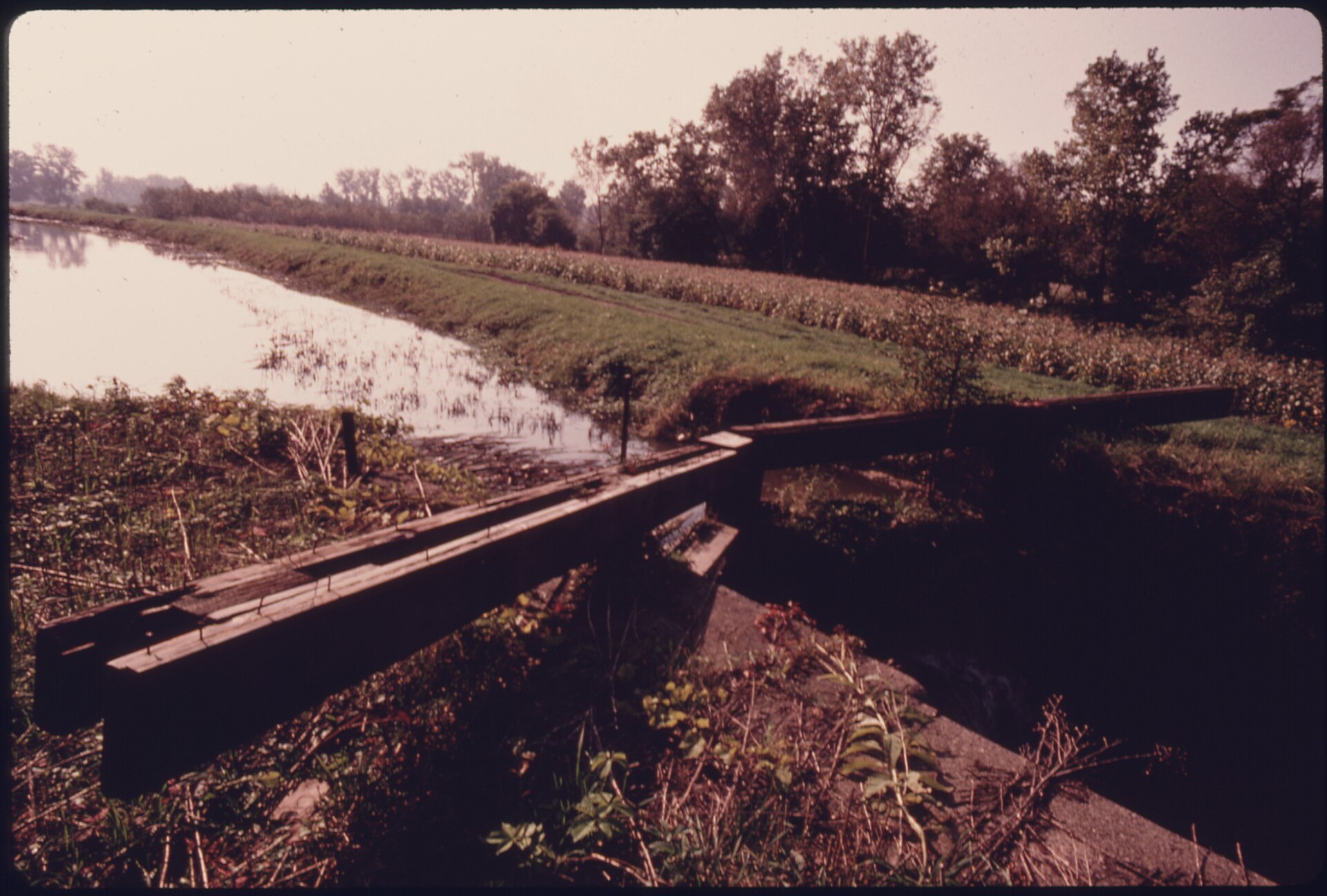
The Ohio & Erie Canal towpath and a surviving lock. The canal that built Boston Mills is now a rail-trail through the national park. Photo: Frank J. Aleksandrowicz, U.S. National Archives (DOCUMERICA), public domain.
Rails, paper bags, and a slow unwinding, 1880–1928
Rail arrived in 1880, when the Valley Railway opened a line down the valley connecting Cleveland’s industries to the coalfields to the south. Its station here was named Boston Mills — after the town’s prominent saw- and paper mills, and to tell it apart from other “Boston” stops — and that station name gradually attached itself to the village. Around 1900 the Cleveland-Akron Bag Company arrived, drawing Polish immigrant workers and building company housing. Its general store, raised about 1905, is the building that survives today as the park’s main visitor center.
Decline came in layers rather than all at once. Canal freight had been bleeding away to the railroads since the 1860s, and the Great Flood of 1913 destroyed the locks and aqueducts for good, ending navigation. The village’s cut-stone quarrying lost out to poured concrete in the 1920s; the main sawmill was dismantled in 1923; and the Cleveland-Akron Bag Company closed and sold its plant in 1928, ending major manufacturing in the township. Boston Mills carried on as a quiet residential hamlet — but its economic reason for being was gone.
A note on two “company stores.” Popular accounts routinely merge them. The historic Boston Store dates to the canal era (c. 1836) and today interprets canal-boat building. The separate building serving as the main Boston Mill Visitor Center is the c. 1905 Cleveland-Akron Bag Company general store, rehabilitated and reopened in 2019. They are two different structures — a detail even some travel write-ups get wrong.
Public Law 93-555: how a town empties, 1974–2016
The event that truly ended Boston Mills was a change in federal policy. Amid postwar sprawl spreading between Cleveland and Akron, a movement grew to protect the open Cuyahoga Valley between them. On December 27, 1974, President Gerald Ford signed Public Law 93-555, authorizing federal acquisition of land along the river to create the Cuyahoga Valley National Recreation Area — redesignated a National Park in 2000.
To assemble a continuous park boundary, the National Park Service was empowered to use eminent domain across Boston Township. Longtime owners were compelled to sell, and the forced loss of family land bred lasting resentment. Then came the strange part: backlogs and thin funding meant the Park Service could not demolish what it had bought. Dozens of ordinary 19th- and 20th-century houses sat empty for years — boarded up, posted with U.S. government notices, yards going to brush. To clear some of them efficiently, the government let local volunteer fire departments burn selected houses as training exercises, leaving charred foundations scattered among the boarded survivors. Demolition dragged on for decades; the last vacant ruins were finally cleared around 2016 and the ground returned to forest.
It is hard to design a better recipe for a horror legend: modern suburban houses, suddenly and inexplicably abandoned, marked by the federal government, some of them literally burned. Teenagers from Akron and Cleveland came at night to see it, read the barricades and warning signs through the lens of campfire horror — and “Helltown” was born.
Helltown: the legends vs. the record
The Helltown mythos is one of the most durable in the American Midwest. Nearly every piece of it traces back to a real, mundane object or event that trespassers reinterpreted in the dark. Here is each legend against what actually happened.
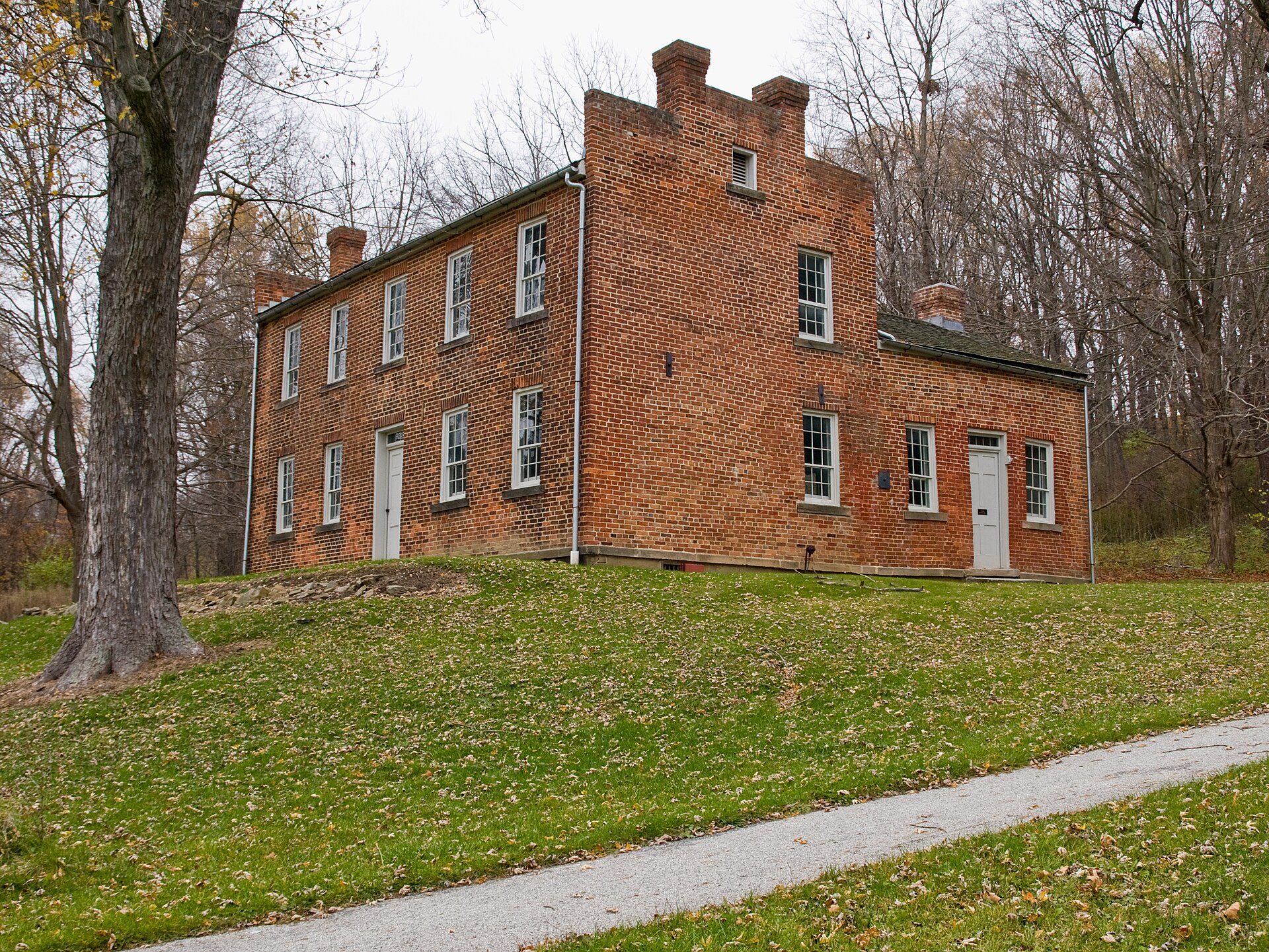
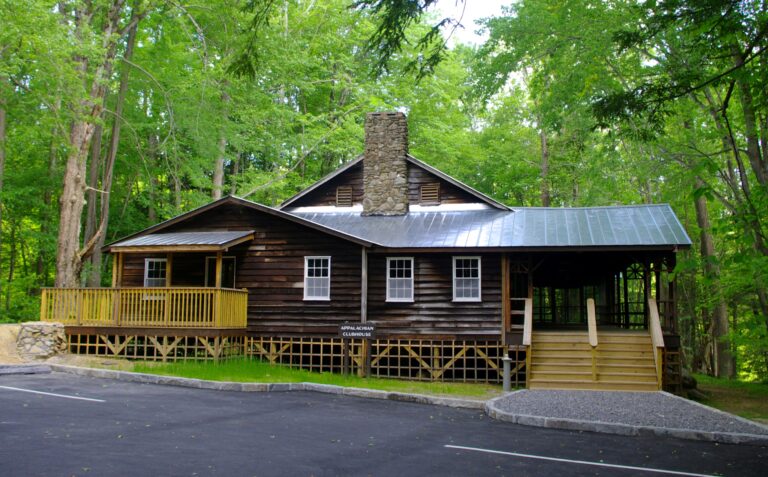
Surviving 19th-century homes in the valley hint at how the emptied village once looked. The abandoned houses that fed the legend are gone. Photo: Ted Toth, National Park Service, public domain.
Legend — The Satanic Church. The story: a devil-worshipping cult ran the village church, hung upside-down crosses, and kept a guardian in the basement; candles burned in the windows at night. The record: the building was the Boston Community Church, an ordinary Protestant (originally Presbyterian) congregation that closed as its membership dwindled and was bought out. Gothic Revival trim, read in shadow by night visitors, was mistaken for inverted crosses.
Legend — The Haunted School Bus. The story: a busload of children was murdered by a serial killer, a cult, or an escaped mental patient, and their ghosts haunt the rusted chassis. The record: no such killing appears in any Summit County record. The bus was bought by a local family to live in temporarily while their house was repaired; when the government acquired the land, it was left behind until the Park Service towed it away to deter trespassers.
Legend — Crybaby Bridge. The story: park on the bridge and you will hear an infant crying, then find small, dusty handprints pressed onto your car. The record: a local version of the “Crybaby Bridge” motif attached to dozens of bridges across North America — a migratory folk legend, not a Boston-specific event.
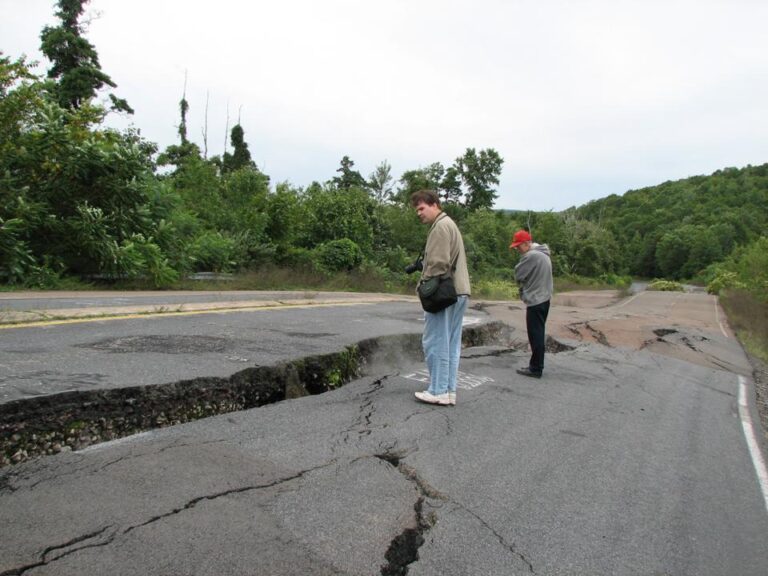
Legend — Stanford Road, the “End of the World.” The story: a road ends in a sudden drop-off into an abyss, and driving it leads to supernatural encounters or a cult’s trap. The record: Stanford Road was simply closed to traffic by the park. Its steep grade and abrupt barricade create an optical illusion — the pavement appears to vanish over a horizon line — that reads as a “drop” at night.
Legend — Toxic Mutants & a Government Cover-Up. The story: a chemical spill spawned mutant wildlife — even a giant “Peninsula Python” — and the park “buyout” was really a military evacuation in disguise. The record: this exaggerates a genuine disaster. In 1985 the Park Service acquired the Krejci Dump, an unpermitted industrial dump that had taken thousands of drums of solvents and toxic waste. Rangers fell ill; the EPA declared it a Superfund site and ran a multimillion-dollar cleanup that hauled away tens of thousands of tons of contaminated soil, largely finished in the 2010s. Real poison, real cleanup — no mutants.
Timeline
1805–06
Land surveyed by Wolcott and Stanford; first cabin raised near the future Boston Cemetery.
1811
Boston Township organized — Summit County’s earliest settlement.
1827
Ohio & Erie Canal completed through the valley; Boston platted as a canal town.
1842
Peak population ~300; mills, hotel, stores, warehouse, and boat dry dock in operation.
1880
Valley Railway opens; the station is named “Boston Mills.”
1900–05
Cleveland-Akron Bag Company arrives; its general store (c. 1905) is today’s visitor center.
1913
The Great Flood destroys the canal’s locks and aqueducts; navigation ends.
1923–28
Sawmill dismantled (1923); the bag company closes and sells its plant (1928).
1974
President Ford signs Public Law 93-555, authorizing the Cuyahoga Valley National Recreation Area.
1970s–80s
NPS buyouts empty the township; boarded houses stand for years; some burned in fire-training exercises.
1985
NPS acquires the Krejci Dump; later an EPA Superfund cleanup.
2000
Redesignated Cuyahoga Valley National Park.
~2016
Last vacant structures cleared; the site returns to a naturalized state.
2019
The rehabilitated 1905 store reopens as the Boston Mill Visitor Center.
Visiting Boston Mills today
There are no ruins to hunt. The houses, the boarded windows, the rusted bus — all gone. What remains is a well-kept national park with a visitor center, trails, and a scenic railroad. Come for the history and the valley, not for “ghost hunting.”
Plan your visit
Visitor Center
Boston Mill Visitor Center, 6947 Riverview Rd, Peninsula, OH 44264
Fees
Free — no entrance fee or pass required
Park Grounds
Open daily, 24 hours; some day-use lots close at dusk
Visitor Center Hours
Generally ~9:30 a.m.–5 p.m. daily, seasonal; confirm with NPS
Getting There
I-271 (Exit 12), I-77, Ohio SR-303, and Riverview Rd
Nearest Services
Peninsula and Boston Heights (fuel, food, restrooms)
⚠ This is a national park, not an abandoned town. Nighttime “Helltown” expeditions are unwelcome and can be trespassing on closed roads or remaining private inholdings. Closed roads such as Stanford Road are barricaded — do not drive around barriers. Watch normal park hazards: the Cuyahoga River, uneven trails, ticks, and fast-changing weather. Stay on marked paths.
Federal regulations: drones (uncrewed aircraft) are prohibited parkwide, and firearms are barred inside federal facilities. Collecting artifacts, plants, or rocks is not permitted. Leash and clean up after pets on trails that allow them.
Boston Mill Visitor Center, near the intersection of Boston Mills Road and Riverview Road.
Nearby ghost towns & canal hamlets
Everett
~4 mi S · Summit Co.
A canal hamlet in the same township, declined after the 1913 flood and absorbed into the park. Preserved 19th-century homes remain, along with the photogenic Everett Road Covered Bridge.
Jaite
~5 mi N · Summit/Cuyahoga line
A 1903 company town built by Charles Jaite for his paper mill. Its yellow company houses survive as park offices — the Jaite Mill Historic District on the National Register.
Sprucevale
~48 mi SE · Columbiana Co.
An 1830s mill town on the failed Sandy & Beaver Canal, now a true ruin in Beaver Creek State Park. Surviving stonework includes Lock 41 — “Gretchen’s Lock” — and its own haunting lore.
Everett, Jaite, and Sprucevale would all make natural additions to the archive — each shares Boston Mills’ canal-and-milling story. (None are profiled here yet.)
Further reading
Ohio Ghost Towns (county-by-county series)
Richard M. & N. Helwig · Center for Ghost Town Research in Ohio — founding dates, plats, and reasons for decline across Summit, Cuyahoga, and neighboring counties.
Centennial History of Summit County, Ohio (1908)
William B. Doyle — foundational archival source on Boston Township’s early settlement and mills.
Haunted Ohio (series)
Chris Woodyard — regional folklore and the origins of tales like the Crybaby Bridge cycle.
The Ghosts of Ohio / Helltown investigations
Jim Willis — weighs the Helltown legends against land records and municipal history; a key debunking text.
Regional histories of Northern Ohio
Jane Ann Turzillo — how Western Reserve events hardened into local legend.
World’s Scariest Places 2: Helltown (fiction)
Jeremy Bates — horror novel built on the Boston Mills legends.
Disambiguation
The true-crime book Helltown by Casey Sherman is about Cape Cod murders, not Boston Mills, Ohio — despite sharing search results.
Sources:
National Park Service, “Boston Mill Visitor Center,” Cuyahoga Valley National Park — nps.gov/cuva.
National Park Service, “When Was That? Key Dates in Making Cuyahoga Valley National Park” — nps.gov.
Gerald R. Ford, “Statement on Signing Legislation Establishing the Cuyahoga Valley National Recreation Area” (Dec. 27, 1974), The American Presidency Project — presidency.ucsb.edu.
“Boston Mills Historic District” (NRHP, listed Mar. 13, 2009) — en.wikipedia.org.
Conservancy for Cuyahoga Valley National Park, “A Visual History of Boston Mill” and visitor-center pages — conservancyforcvnp.org.
Atlas Obscura, “Helltown, Ohio” — atlasobscura.com. All That’s Interesting, “Helltown, Ohio” — allthatsinteresting.com. U.S. EPA, Krejci Dump Superfund Site records.
Photo credits: Hero, Cuyahoga River (Wikimedia Commons — [author / license]). Canal towpath & lock (Wikimedia Commons — [author / license]). Historic valley house (Wikimedia Commons — [author / license]). Replace each bracket with the author and license shown on the file’s Commons page.
← Explore more ghost towns