Bauer, Utah: The Mill Town With an Orchard Fed by Mine Water
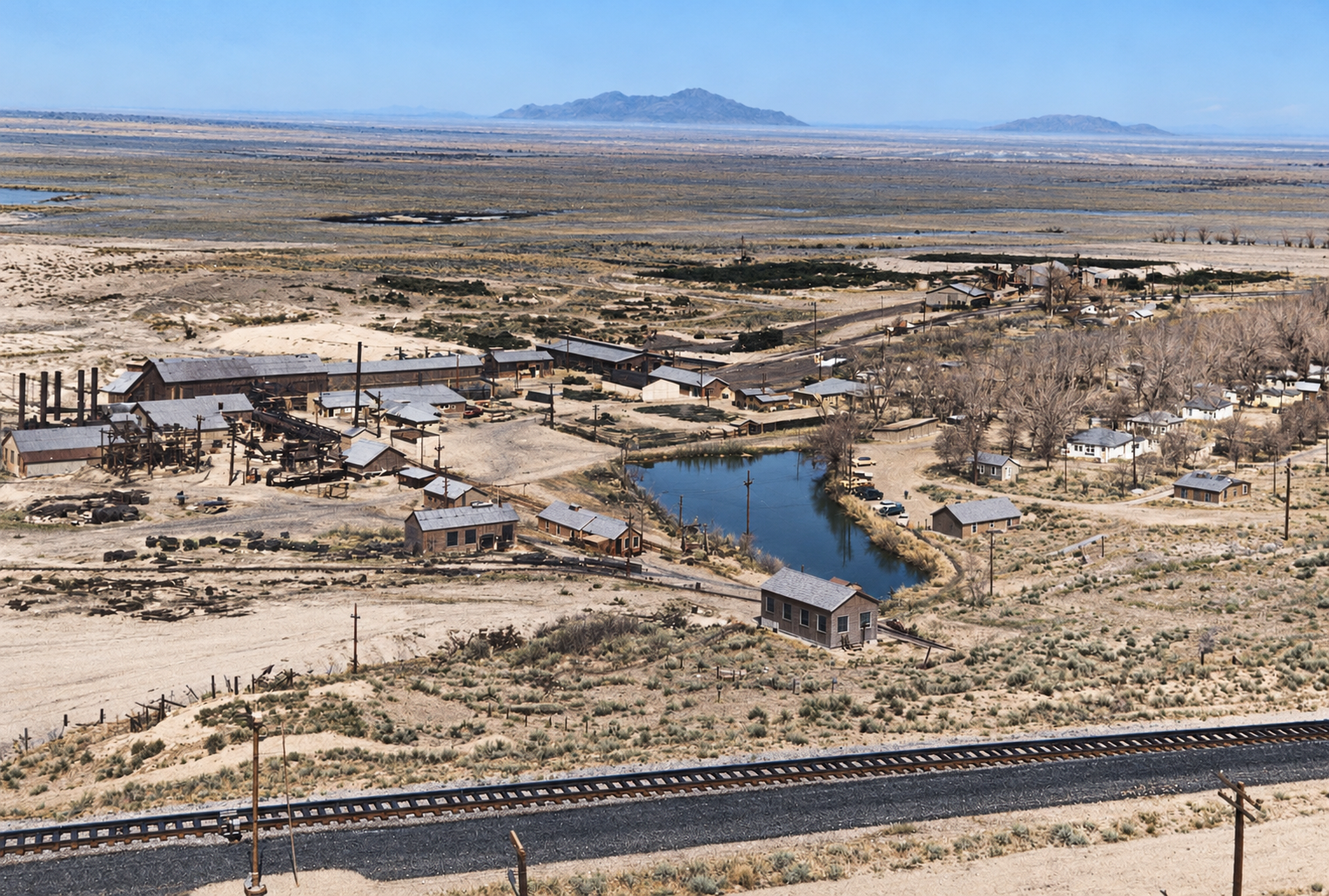
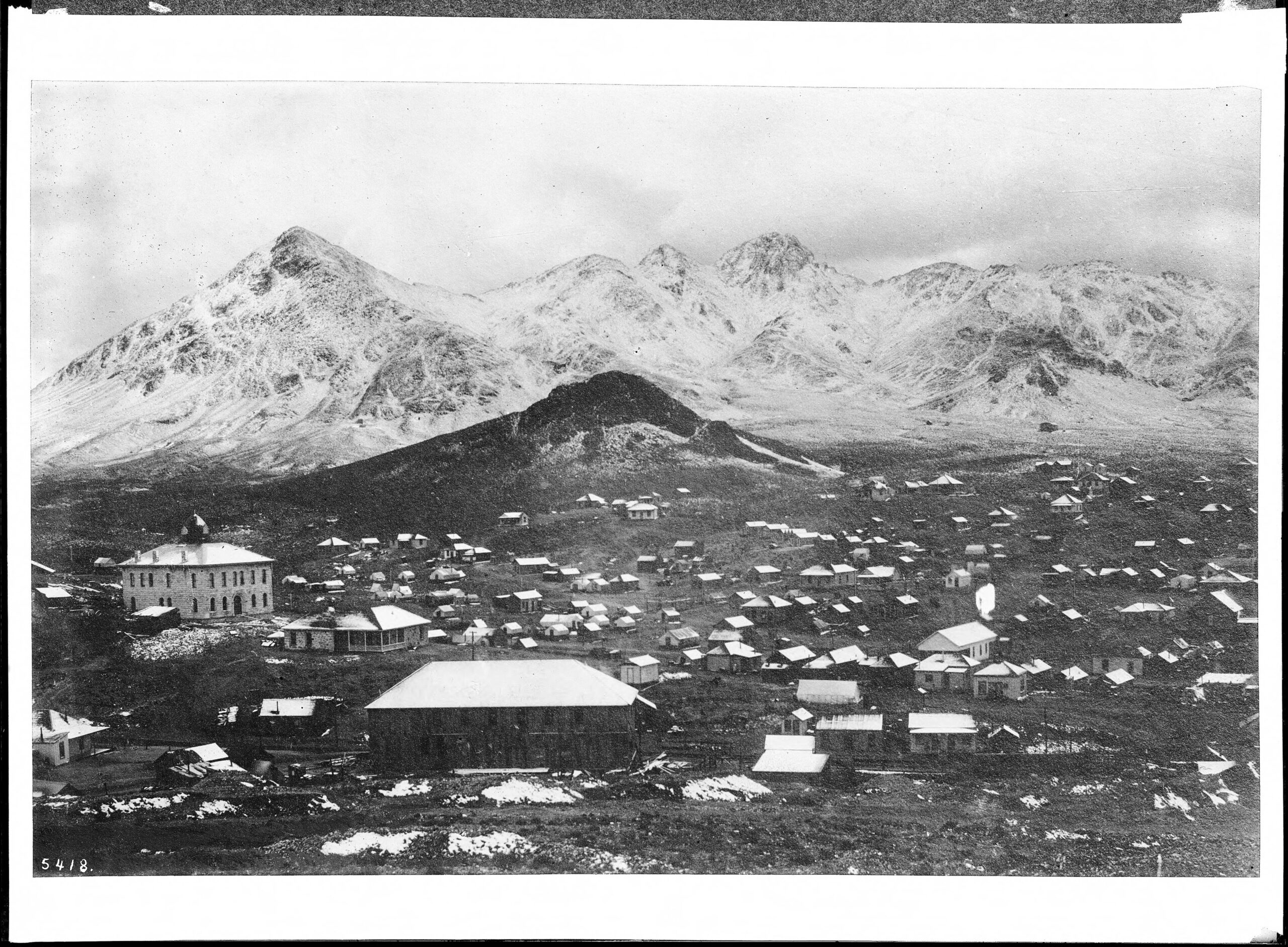
Bauer sat on a gravel bench at the foot of the Oquirrh Mountains, about five miles southwest of Tooele and three miles north of Stockton. It was never large. At its busiest it held perhaps a hundred or two hundred people. But few Utah camps packed so many different things into one site: a railroad terminus, the outlet of a long mine-drainage tunnel, a commercial orchard watered from the mine, a custom flotation mill that treated ore from several states, and a plant that refined coal resin.
The mill is gone and most of the town went with it. What remains is concrete, a large capped field of tailings and a list of cleanup records. This post follows the site’s four lives, separates the documented history from the loose retellings, and explains why the best way to see Bauer is from far away.
Terminus, Buhl and Bauer
Mormon stockmen grazed animals on the bench from about 1855, but nothing industrial was there yet. In September 1877 the narrow-gauge Utah Western Railway reached the valley floor from Salt Lake City. Its way south toward the Stockton and Ophir mines was blocked by the Stockton Bar, a gravel ridge left by ancient Lake Bonneville, so the line stopped at its foot. The railhead was called Terminus, and ore wagons from Stockton, Ophir and Mercur transferred their loads to railcars there.
About 1900 the Honerine Mining and Milling Company consolidated claims on the mountain above, and the railhead was renamed Buhl, apparently for Pittsburgh steel man and mining investor Frank H. Buhl. In 1910 the Bullion Coalition Mines Company took over the Honerine property and the settlement became Bauer, named for Benjamin F. Bauer, a Salt Lake City businessman who managed the company.
The Honerine Drain Tunnel
The mines of the Stockton district ran into water. Shafts cut into the Oquirrh limestone hit flooded ground that early steam pumps could not handle. Between 1901 and 1906 the company drove the Honerine Drain Tunnel, a long horizontal adit reported at about 13,000 feet, to drain the workings by gravity. Its portal came out at Bauer, and the water poured onto the valley floor, reportedly between 2,000 and 10,000 gallons a minute depending on the season.
The tunnel’s outflow created the town’s unusual second business.
An orchard in the desert
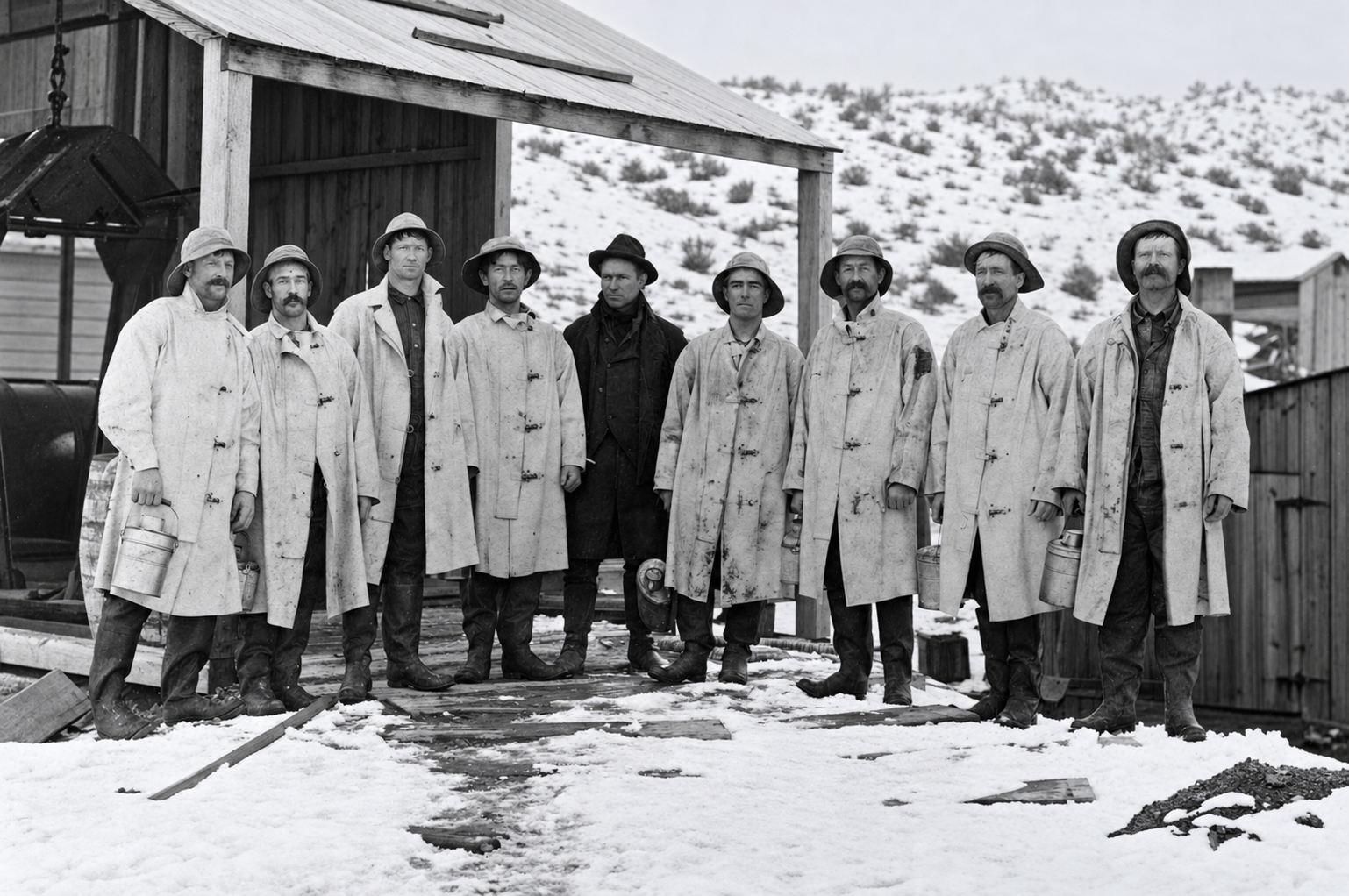
In 1910 company men, including Bauer and Charles L. Crockwell, found a use for the discharge. Below the tunnel mouth they planted about 175 acres of fruit trees. At its height the orchard reportedly held some 19,000 trees, mainly apples with peaches and apricots, along with alfalfa and potatoes. It was described as the largest orchard in the state and as a rare case of a mining company running a commercial farm. Fruit was packed in an underground cold-storage cellar and shipped out by rail, and one account says that during the Depression some of it was given to needy families. The operation ended in 1938, after pumping at a connected mine stopped, cutting the tunnel’s flow, and the remaining water was sent to the mill.
Combined Metals and selective flotation
Bauer’s main place in history came on October 5, 1923, with the incorporation of the Combined Metals Reduction Company. It was organized by mining economist and metallurgical engineer Edward H. Snyder, with the National Lead Company as a half partner, and it absorbed the Bullion Coalition holdings and the Bauer works in 1924.
The problem it addressed was the complex sulfide ores of the Great Basin, in which lead, zinc and iron minerals are grown together in tiny grains. Smelters penalized zinc, and gravity methods could not separate lead and zinc minerals whose weights are too close. At Bauer, Snyder and his staff worked out commercial selective, or differential, flotation: the ore was ground to a fine slurry, and chemicals were used to float the lead minerals first and then, after a second chemical treatment, the zinc. The result was a plant that treated ore from Pioche, Nevada, from Idaho, and from the Bingham area, brought in by rail.
By the late 1950s the Bauer mill handled about 1,000 tons a day, working alongside the company’s larger Caselton mill in Nevada. One history credits the two plants with more than 7,000,000 tons of ore and $120,000,000 in concentrate sales. Those totals come from a single railroad-history source and should be treated as approximate.
In 1952 the company turned its flotation methods to a new product. The Blackhawk Resin and Chemical Company floated fossil resin out of Utah coal, then refined it at a solvent-extraction plant on the north side of the site into a very pure resin used in inks, varnishes and adhesives.
Company town life
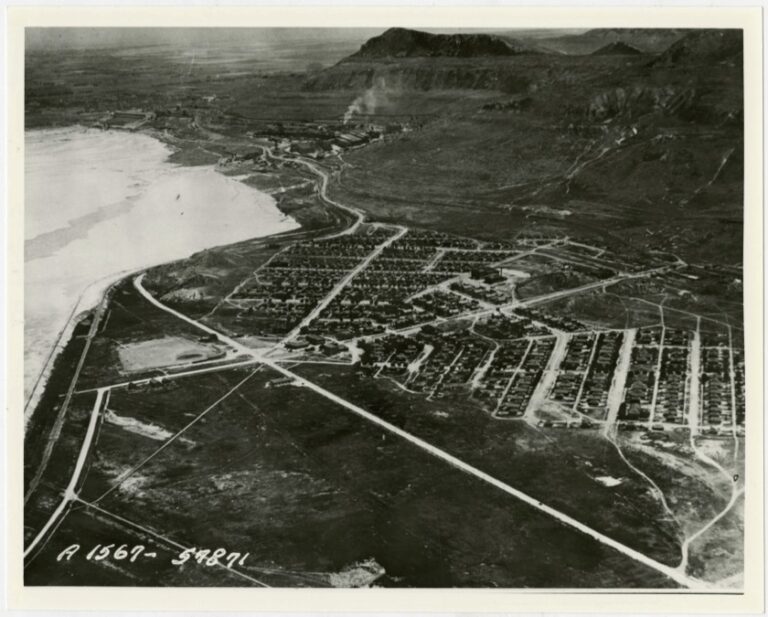
Bauer was a company town, with managers in frame cottages on the upper bench, workers in company bungalows laid out on a street grid, and single men in a large two-story boardinghouse. It had a store, a ballfield and shared bathhouses, and the workforce belonged to the International Union of Mine, Mill and Smelter Workers. Population is a soft number: one source says between about 100 and 200 residents in the mid-century years, with a 1941 survey counting just 50.
The best window into daily life is Stephen S. Lottridge’s memoir The Book of Bauer: Stories from a Forgotten Town (University of Utah Press, 2024), written by a man who grew up there in the early 1950s. He describes children bused over the Stockton Bar to school in Tooele, families keeping cattle and hogs in the ravines, company dances, and a close community that was also marked by the dust and the smell of the mill.
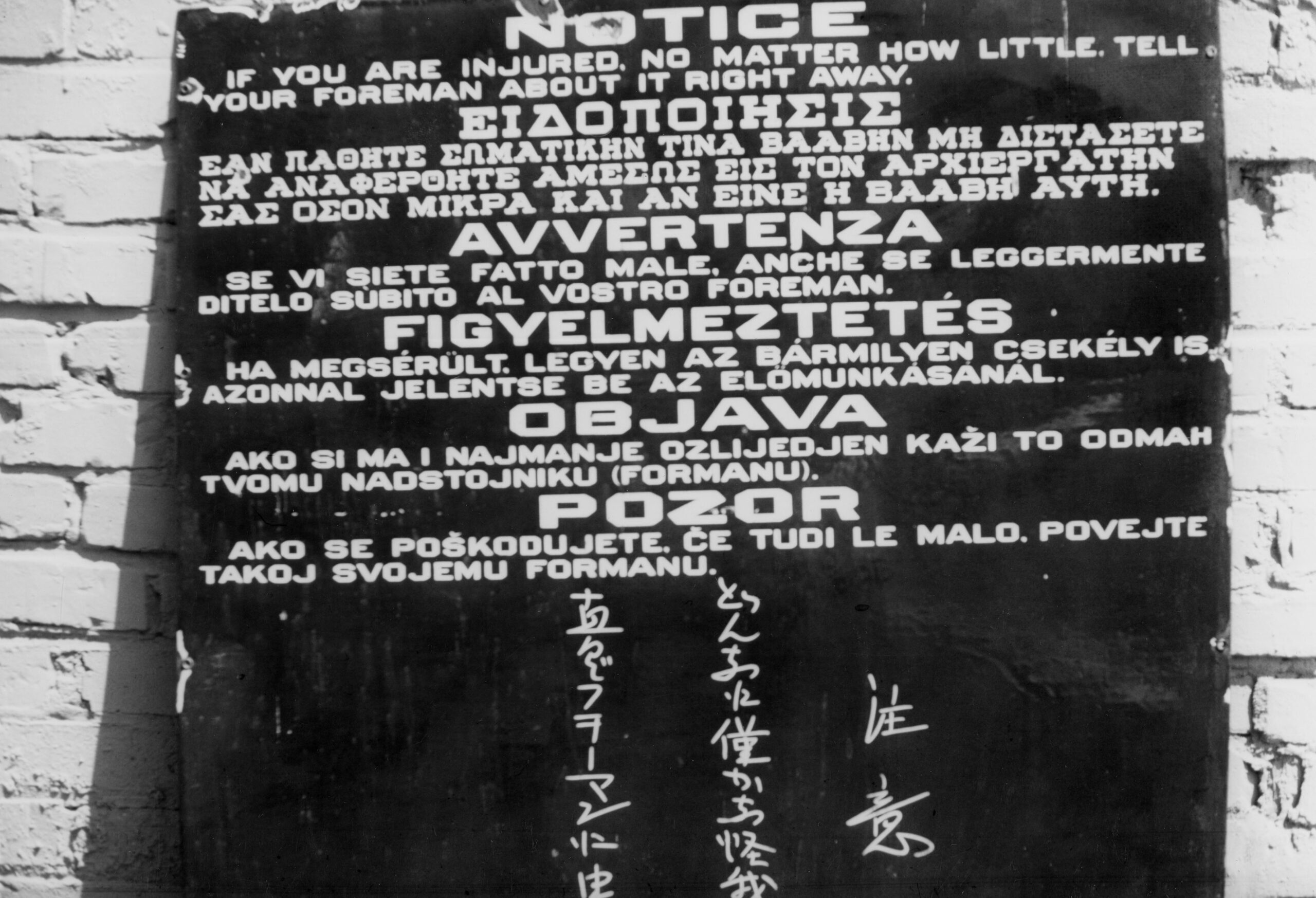
The sign hints at who worked in Utah’s mines and mills: the same message, repeated in the languages of the Greek, Italian, Hungarian, South Slavic and Japanese immigrants who made up much of the workforce. The photograph is undated and I would not put an exact year on it.
Decline and erasure, 1955–1985
Bauer’s slide began in the mid-1950s with the end of wartime metal-purchase contracts, foreign competition and long smelter strikes. In December 1955 the company sold its main ore source, the Butterfield mine in Bingham Canyon, to Kennecott for $1,000,000, leaving Bauer to survive on custom toll milling for other mines. That business dwindled through the 1960s.
A federal receiver was appointed in June 1968, and a Chapter X bankruptcy petition was filed in September 1970 and approved in February 1971. The resin plant was auctioned on June 5, 1973, and the mill, land and equipment sold on June 20, 1974. The site was abandoned in 1979, and a resident caretaker, Rulon Aufdemorte, stripped copper, steel and lumber before leaving.
Then the rest burned or was cleared. A large fire destroyed the Blackhawk resin refinery in September 1980. In the early 1980s the empty bungalows and the boardinghouse were bulldozed or burned. In 1985 buried coal and resin residue smoldered and ignited, and two trespassing children broke through the crust and were badly burned, which led the state to issue emergency cleanup orders.
Tailings and the EPA cleanup
Decades of milling left fine-grained tailings over an area reported at more than 150 acres, in places over 15 feet deep, rich in lead and arsenic and bare of vegetation. Strong winds across Rush Valley blew the dust into drifting dunes that reached Stockton and Tooele, and an old containment berm failed, washing contaminated material outside the plant boundary. A 2006 federal health assessment found the surface contamination serious, but because there was little evidence of leaching into the deep drinking-water aquifers, the site did not qualify for the National Priorities List.
Trespassers, including off-road riders, target shooters and paintball players, kept breaking the crust and raising dust. In late 2021 EPA Region 8 approved a $5,825,000 time-critical removal action. Crews regraded the tailings field, dug rock-lined drainage channels around it, and covered the whole footprint with an engineered cap of local alluvium and gravel. The work was completed in April 2022, and the site is now classed as removal complete and non-NPL, with continuing monitoring by the Utah Department of Environmental Quality.
Timeline
Historic sites nearby
Further reading
Sources
UtahRails.net — Combined Metals Reduction Company — company history, ore sources, capacity and the bankruptcy
U.S. EPA — Bauer Tailings site profile — site description and trespass hazards
Utah Humanities — The Honerine Drain Tunnel’s Poisonous Orchards — the orchard and the tunnel
Utah State Historical Society and University of Utah Marriott Library — Saline Stories: Combined Metals Reduction Co., Bauer — historic photographs
Archives West — Combined Metals Reduction Company records — archival holdings
Utah Public Radio — Access Utah on The Book of Bauer — community life and memory
Stockton Bicentennial History Committee — Stockton city history — the nearby smelter town
UtahRails.net — Pioche Railroads and Mines — the separate Nevada Bullionville
Additional detail draws on the two research compilations assembled for this post. Where they disagree, as on the name, the acreage and the cleanup status, the better-supported version is used and the difference is noted above. Distances to nearby sites were calculated from coordinates. Historic photographs courtesy of the Utah State Historical Society. The image marked “colorized” was colorized with AI and is an interpretation, not original color.