Galena, South Dakota: The Black Hills Silver Camp on Bear Butte Creek
Galena is a silver camp in the northern Black Hills, tucked into a narrow gulch on Bear Butte Creek about ten road miles southeast of Deadwood. Prospectors recorded the first claims here in 1875, and when the 1876 rush poured into the Hills they found silver-bearing lead ore, galena, which gave the town its name. At its height in the 1880s Galena had a smelter, a school, several mines and, by some estimates, as many as 2,000 people, but lawsuits, thin ore and the long fall of silver drained it. A railroad spur arrived in 1902 and was gone by 1929, and when the nearby Gilt Edge Mine closed in 1941 most of the remaining families left. Today about two dozen people live along Galena Road, and the 1882 schoolhouse, a church steeple and Vinegar Hill Cemetery are what most visitors come to see.
Silver in Galena Gulch
The Black Hills belonged to the Lakota under the Fort Laramie Treaty of 1868, but after Custer’s 1874 expedition reported gold, miners flooded in anyway. According to the National Register nomination for the Galena School, the first claims in Galena Gulch were recorded in 1875. A camp formed in the spring of 1876, and unlike most of the Hills, where men were chasing placer gold, the prospectors here were after silver.
The silver came in lead ore. Mines with names like the Sitting Bull, Richmond, Florence and Branch Mint worked the hills along Bear Butte Creek, and the camp grew quickly. By one account it had about 200 people, four stores, three butchers and a livery stable by June 1877, and about 400 people by the end of that year. When residents chose a name for the new post office in 1877, Galena beat out Caribou and Hardscrabble.
Some histories say Galena was also home to the first smelter in the Black Hills, the McDonald, built in 1877. Smelting silver-lead ore on the spot saved the long, costly haul to smelters outside the Hills, and it set the pattern for the camp’s best years.
Colonel Davey and the war over the Sitting Bull
The man who did the most to build Galena also did the most to stall it. Colonel John H. Davey of Chicago arrived in 1878 with his wife and son, Frank, bought the Sitting Bull and Florence mines and finished his own smelter, the Davey Smelter, in 1883.
The Sitting Bull lay next to the Richmond, and the two companies soon fought over where one claim ended and the other began. The Richmond’s owners sued over ore taken from the disputed ground, and a court ordered the Sitting Bull shut. The territorial supreme court upheld that order in February 1886. Davey was ruined; he left the Hills, his company was liquidated, and the Richmond took over the Sitting Bull property. The National Register nomination says the litigation held back mining in Galena for some 16 years.
Davey’s men were involved in violence too. In 1882 a guard working for him, Billy Thatcher, shot and killed a man named Gorman during a dispute that involved Frank Davey. Thatcher was tried for murder and acquitted, and Colonel Davey paid for his defense.
A boom and a long decline
Galena’s peak came in the 1880s. The town had stores, a church and, from 1882, a white frame schoolhouse that a builder named W. V. Doyle put up on a low bid of $1,135. It was dedicated on September 26, 1882.
The camp never recovered from the lawsuits, and the falling price of silver after the 1880s made its ore less and less worth the trouble. Galena held on as a smaller mining town. The Branch Mint company bought up more than 200 claims, built a 20-stamp mill and laid its own narrow-gauge line from its mill across Terrible Gulch to the Hoodoo Mine, but it went into receivership in 1912.
The bigger railroad came late. In 1902 the Deadwood Central, a narrow-gauge line controlled by the Burlington, built a spur up Bear Butte Creek to Galena. It came too late to save the town. Traffic faded within a decade, the line was abandoned in the 1920s, and by most accounts the rails were pulled up in 1929.
The Gilt Edge Mine and the last miners
West of town, the Gilt Edge Mine worked a different ore: gold and silver in sulfide rock. It ran from 1900 to 1901, again from 1905 to 1916, and once more in the late 1930s, when it gave Galena a last small boom. When the Gilt Edge closed in 1941, most of the families still in town moved away. The Galena School taught its last classes during the war, and the town settled into the quiet place it is now.
The Gilt Edge came back once more, in a very different form. In 1987 Brohm Mining began open-pit gold mining there, using cyanide heap leaching. In July 1999 Brohm abandoned the site in the middle of its parent company’s bankruptcy, leaving behind open pits and waste rock that drained acid and metals into the creeks. The Environmental Protection Agency took over, and on December 1, 2000, the Gilt Edge Mine was added to the national Superfund list. Cleanup and water treatment have gone on ever since; South Dakota Public Broadcasting reported in 2023 that EPA had spent about $120 million there.
People of Galena
Aunt Sally Campbell. Sarah Campbell, known as Aunt Sally, was born into slavery in Kentucky, won her freedom in court as a young woman and came to the Black Hills in 1874 as a cook with Custer’s expedition. She is usually described as the first non-Indian woman to enter the Hills, and her name appears on an August 1874 mining company notice from French Creek. She later lived at Crook City and then Galena, where she worked as a cook and midwife. She is buried in Vinegar Hill Cemetery above town.
Thomas F. Walsh. Years before he struck it rich at the Camp Bird Mine in Colorado, a young Tom Walsh spent a short time in Galena around 1876 or 1877, by some accounts selling tools to prospectors. His daughter, Evalyn Walsh McLean, later owned the Hope Diamond. One modern guide says Walsh’s cabin still stands in Galena; we could not confirm which building that is.
Tootsie the coyote. In 1947 a coyote pup found near Custer Peak was taken in by Fred and Esther Borsch of Galena. They named her Tootsie, and she became famous for howling along when Fred sang. In August 1949, at Deadwood’s Days of ’76 celebration, Governor George T. Mickelson proclaimed Tootsie South Dakota’s official animal. That same year the legislature made the coyote the state animal, a law that still stands. Tootsie lived until 1959.
Legends of Galena
The preacher and the dance hall. The town’s favorite story says Galena’s Methodists raised money for a church, the preacher ran off with the funds, and the half-finished building became a dance hall instead. Several popular histories tell it as fact, but no record of the theft has been found, and at least one account doubts Methodist services were ever held there. Take it as local legend. A church steeple, dated to 1887 by the National Register nomination, still stands in town.
The Hope Diamond connection. Galena’s link to the Hope Diamond is real but distant: it runs through Tom Walsh’s later fortune, made in Colorado, not anything found here.
What remains
Galena is a quiet residential canyon today, with a handful of year-round homes and summer cabins along Galena Road. What you can see:
The Galena School. The white frame schoolhouse from 1882, with its bell tower and 1914 front porch, still has its old desks, blackboards and coal furnace inside. The Galena Historical Society formed in 1983 when the school district planned to tear it down, and it took ownership of the building in 1997. It was listed on the National Register of Historic Places in 1999 and is the best-preserved building from the boom years.
The church steeple. The tower of the old church, the one tied to the dance hall legend, still stands in town.
Vinegar Hill Cemetery. Up a steep road on the hill above town, with the graves of miners, Civil War veterans and Aunt Sally Campbell.
Mine scars. Old dumps and workings line the hills, and the Gilt Edge pits and water treatment works lie west of town.
Don’t confuse this Galena with the far bigger Galena, Illinois, or with the Galena Creek School in Custer County, South Dakota, a separate historic schoolhouse in the southern Hills.
Timeline
Historic sites nearby
Further reading
Sources
National Park Service — Galena School National Register listing and nomination; Galena Historical Society — Galena Schoolhouse and Vinegar Hill Cemetery
U.S. EPA — Gilt Edge Mine Superfund site; South Dakota Public Broadcasting — Gilt Edge cleanup and 2024 lease news
South Dakota Magazine — Galena’s Ghosts; South Dakota State Historical Society Foundation — South Dakota’s official state animal
BlackPast — Sarah Campbell; True West — Aunt Sally
Legends of America — Galena, South Dakota; Western Mining History — Galena; Black Hills Visitor — Galena; Wikipedia — Galena, South Dakota and Galena Schoolhouse
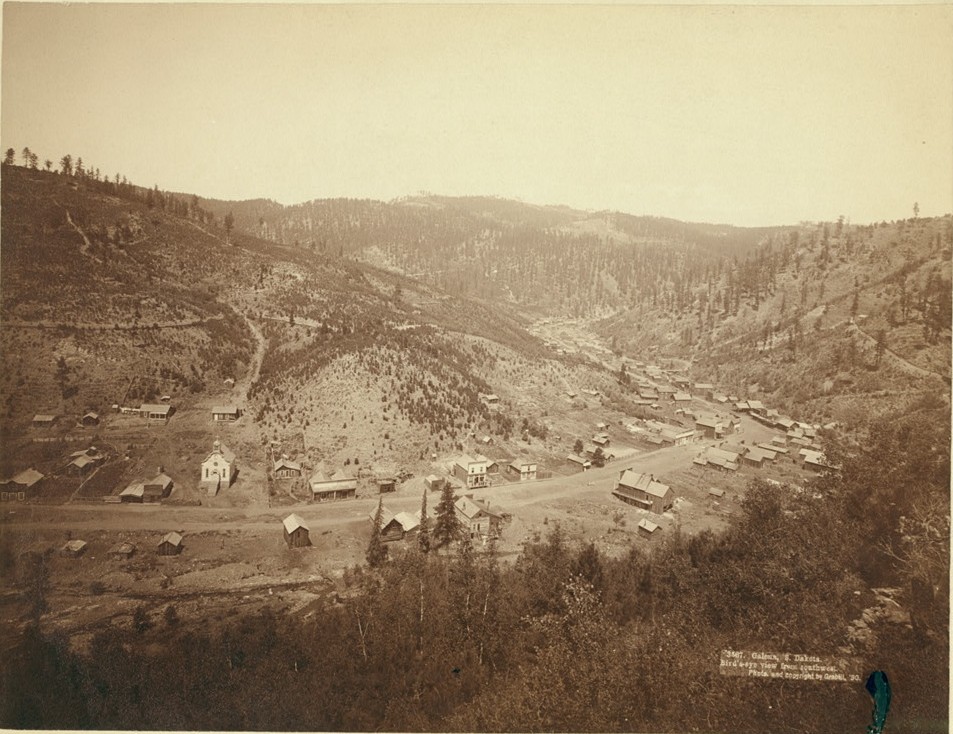
Photo: John C. H. Grabill, Galena, S. Dakota. Bird’s-eye view from southwest, 1890, Library of Congress Prints and Photographs Division, no known restrictions on reproduction