Silver City, Utah: The Tintic Camp Jesse Knight Tried to Turn Into a Smelter Town
UtahGold & Silver MiningGhost town · Private claims and open mine workings·~11 min read
Quick facts
What it wasFirst commercial center of the Tintic Mining District; later Jesse Knight’s smelter town
FoundedLate 1869; district organized December 13, 1869
Peak populationAbout 1,500 in 1908 (about 800 in 1899)
SmelterBuilt 1908, dismantled 1915 and moved to Murray
MillKnight-Dern (Tintic) Mill, about 1916 to the early 1920s
Last census count111 people in the 1940 census precinct
ElevationAbout 6,158 feet
LocationAbout 39.91°N, 112.13°W, mouth of Dragon Canyon
State / CountyUtah / Juab County
Nearest townEureka, about 4 miles north
National RegisterTintic Smelter Site and Silver City Cemetery, both listed March 14, 1979
What survivesTerraced concrete mill ruins, slag fields, mine dumps and a cemetery
⚠ Private patented claims and active mining lease · Open shafts and toxic tailings · View the ruins from the road · No facilities
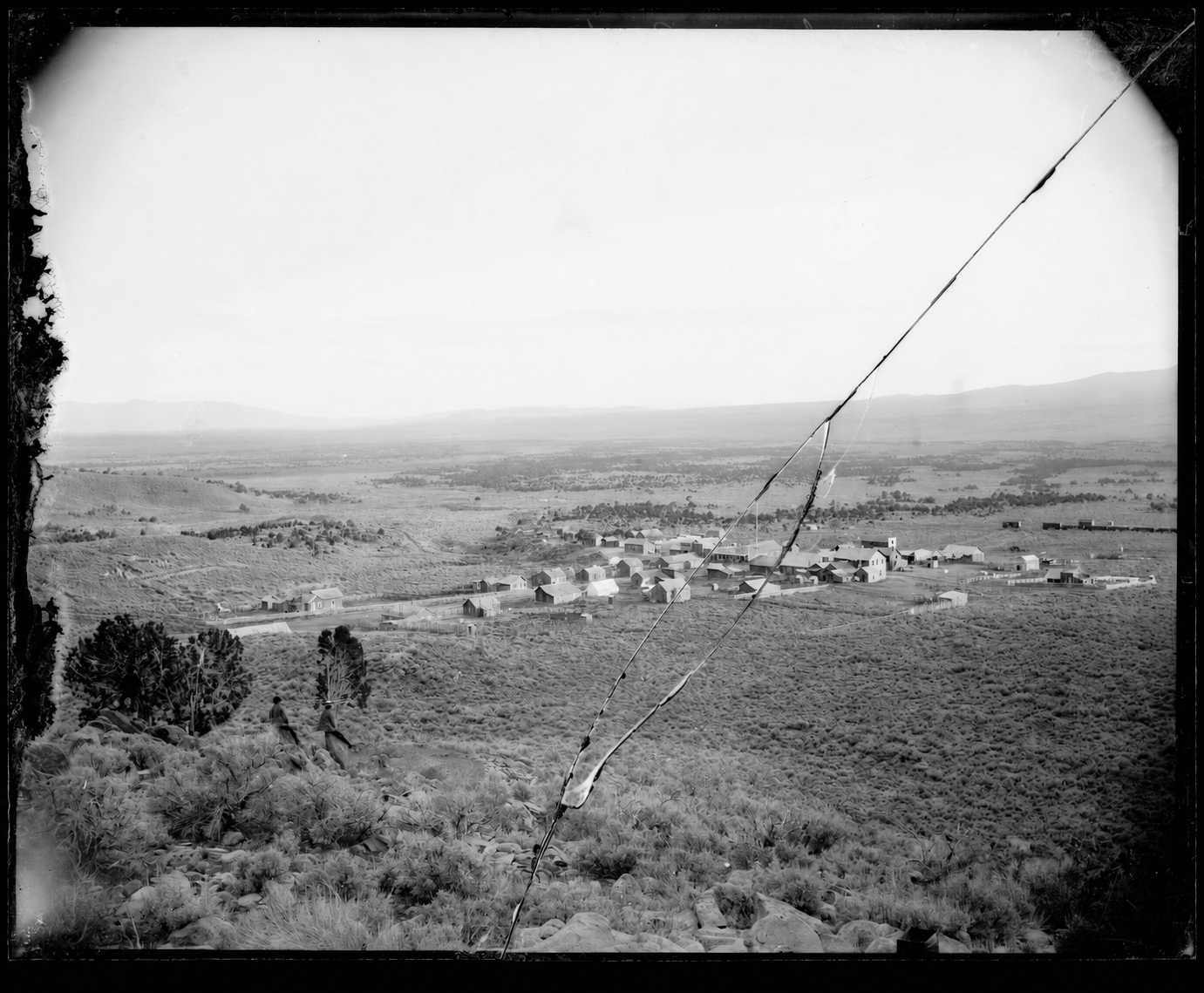
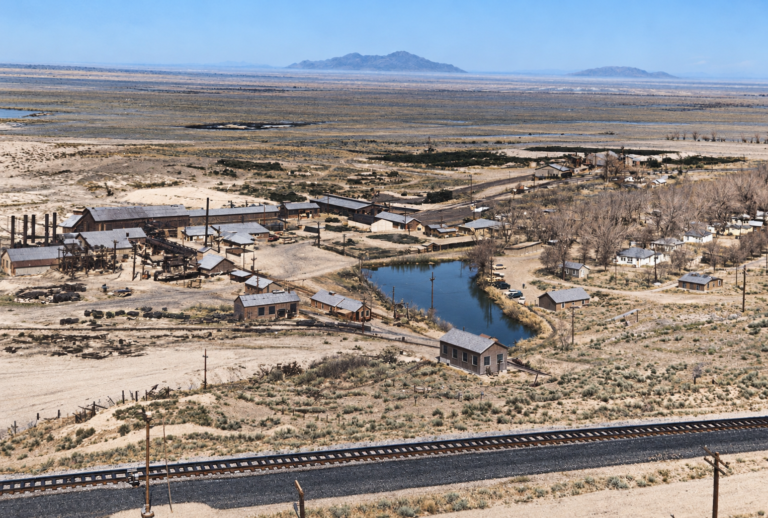
Silver City seen from a hillside above the broad flat where it grew. The line across the image is a crack in the glass negative. Undated. Original photo: Brigham Young University Library.
Silver City was the first town of the Tintic Mining District and, for a while, its busiest. It began as a tent camp at the mouth of Dragon Canyon in 1869, held the district’s first recorder’s office and assay shops, and then watched richer mines open farther up the hills while its own deep shafts flooded. Nearly forty years later a Mormon mining millionaire, Jesse Knight, picked its wide flat ground for a smelter, and the town doubled in a couple of years. It then lost nearly everyone just as fast.
The first camp in Tintic
Prospectors working the west side of the East Tintic Mountains in the autumn of 1869 found outcrops in an area where earlier visitors had apparently gathered mineral. On December 13, 1869 the district was organized around the Sunbeam claim, and the nearby Black Dragon lode turned out to hold huge bodies of iron-rich ore that smelters across the region wanted as flux. The camp that grew where Dragon Canyon opens onto the valley floor soon had a telegraph office, an express and stage station, assay shops and the district’s mining recorder.
Location mattered. Neighboring Diamond to the south and Mammoth to the north were squeezed into narrow gulches, while Silver City sat on a broad alluvial apron with room for mills, lots and rail yards. Through the 1870s and 1880s ores from the surrounding discoveries came here for first treatment, in stamp mills and chloridizing furnaces. The Salt Lake & Western Railway, a Union Pacific affiliate, built into town in 1882, and the Rio Grande Western’s Tintic Range Railway followed in 1892 and 1893, so ore could leave by two lines.

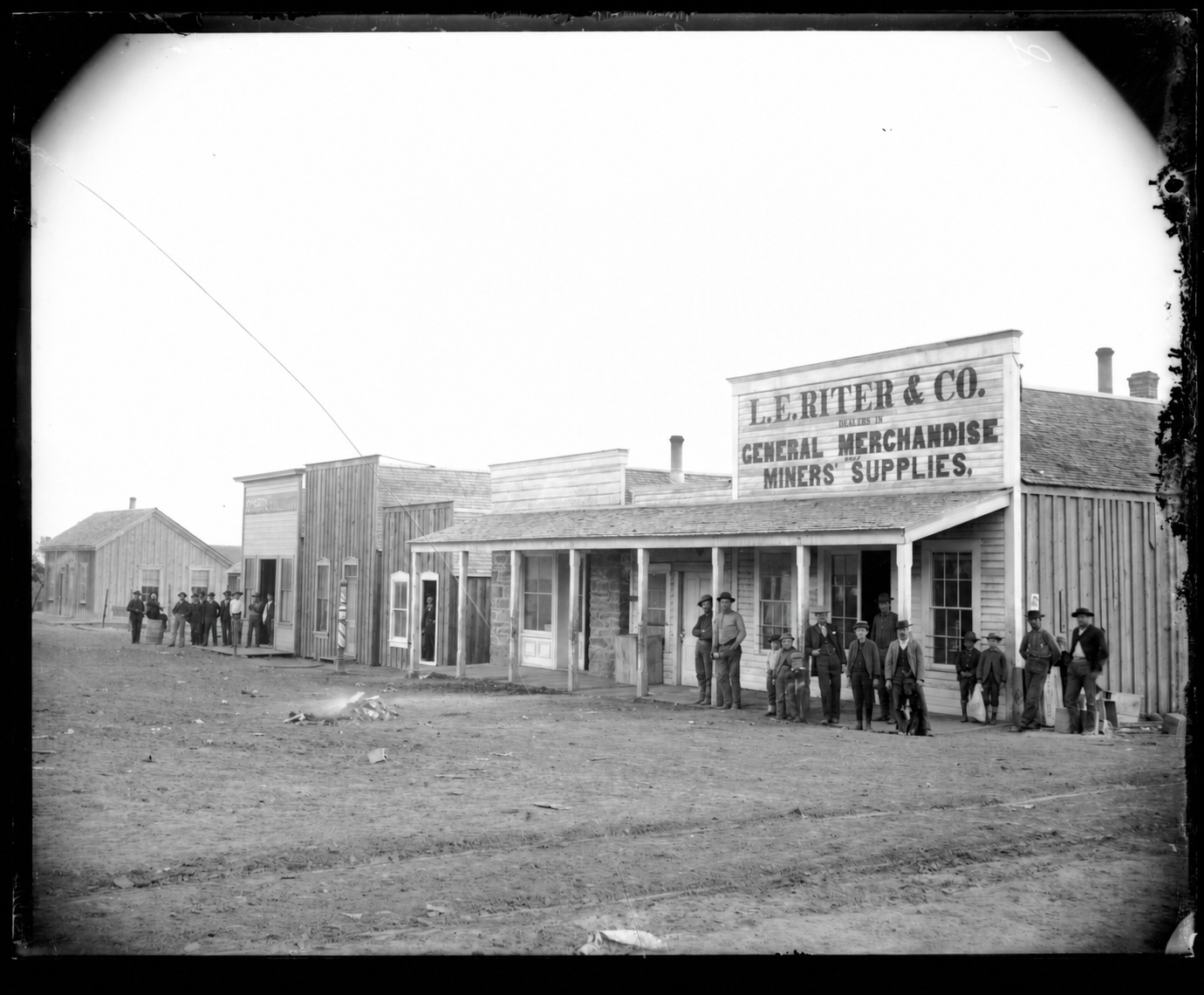
Frame stores along the main street, including L. E. Riter & Co., “general merchandise, miners’ supplies.” The collection title also names an Occidental Saloon. Undated.Original photo: Brigham Young University Library
On who found it: Accounts credit different people with the Tintic discovery. One names the prospector George Rust, who found old workings in Dragon Canyon in 1869. Another says the Sunbeam claim was located by a party that included Joseph Hyde, Moroni Billingsley, W. J. Harris, E. M. Peck and Lewes R. Perry. Both can be partly right, since finding old diggings and filing a claim were separate events, but the tellings do not agree on the details.
Water in the shafts
Silver City’s mines were cut into hard igneous rock, in steep fissure veins carrying silver, lead and copper. As shafts went below about 400 to 600 feet in the late 1880s and 1890s to reach unoxidized ore, they broke into water trapped in the fractured rock. Steam pumps, fed by coal hauled in by rail, kept the best properties working, but every added foot of depth cost more. The fall in silver prices and the Panic of 1893 sealed it, and smaller operators shut down their pumps, which let water spread through connected workings. By the mid-1890s deep mining along the Swansea vein was effectively stalled, and capital moved to the drier limestone mines around Eureka.
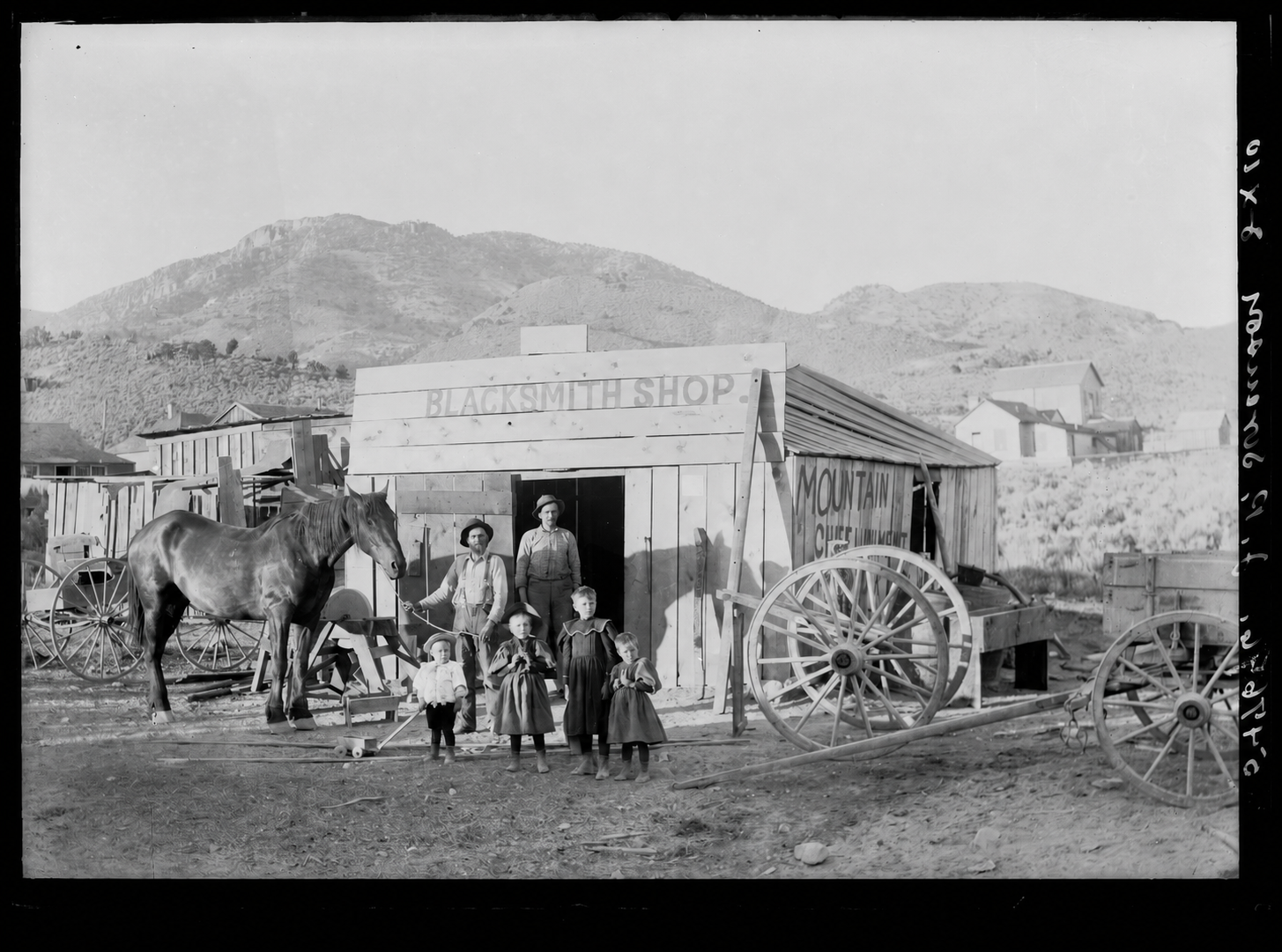
A blacksmith shop with a horse, two men and four children, wagon wheels at right. Undated.Original photo: Brigham Young University Library
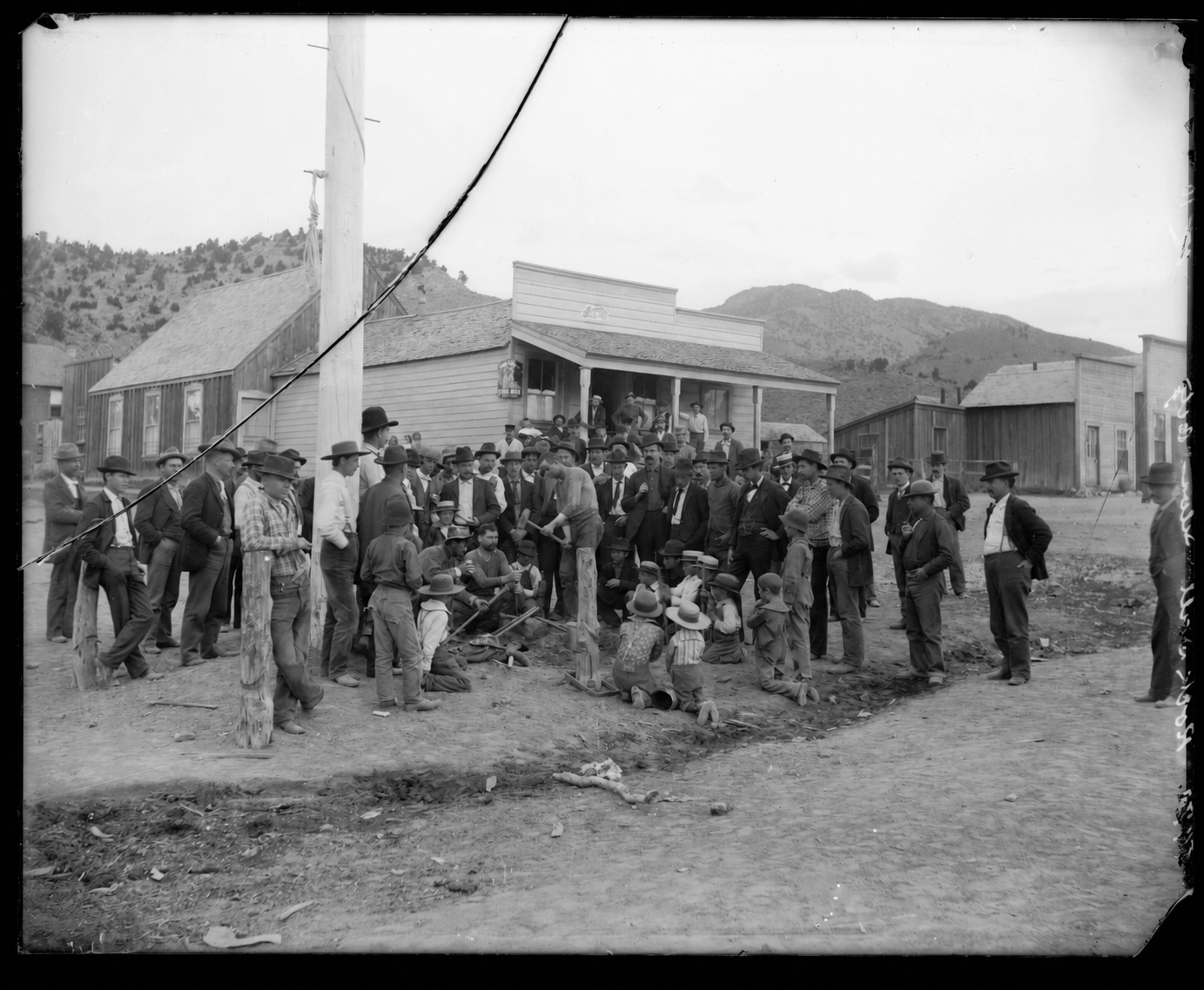
A crowd gathers in a street of frame buildings. The collection title refers to rock drilling, a favorite mining-camp contest. Undated.Original photo: Brigham Young University Library
A fire in 1902 burned much of the business district. By 1904 only about 18 businesses were left. Population, which had reached roughly 800 in 1899, slid with it.
On the underground river: A common story says miners struck a vast underground river that swallowed drill strings and flooded the shafts overnight. The documented cause is slower and less dramatic: perched groundwater in fractured rock and pumping costs that outran the value of the ore.
Jesse Knight builds a smelter
Jesse Knight, nicknamed “Uncle Jesse” and the “Mormon Wizard,” had made his money at the Humbug, Uncle Sam, Beck Tunnel and Colorado mines on the east side of the district. Independent mine owners in Tintic were squeezed by smelting charges and freight rates controlled from outside, and Knight wanted to treat the district’s ore in the district. He chose Silver City because its broad, gentle ground suited slag yards, rail spurs and furnace foundations, and because the two railroads met there and Dragon Canyon offered a route into his mines.
Between 1906 and 1908 he built an industrial complex: the Utah Ore Sampling Company mill, a power system, more than 100 frame houses, and the Eureka Hill Railway, a 3-foot narrow-gauge line worked by geared Shay locomotives up grades as steep as 6 percent to his upper mines. At the center was the Tintic Smelter, designed to treat about 800 tons a day, which fired its first charges in June 1908. Population jumped to about 1,500, most of them Knight employees and their families. According to research, Knight paid union-scale wages without recognizing a union, kept an eight-hour day and discouraged saloons, gambling and brothels in the settlements he controlled.
On July 24, 1908, he tied the plant’s formal opening to Pioneer Day. “Smelter Day” drew thousands on special excursion trains from both railroads for a parade, barbecues, drilling contests, brass bands and tours of the furnaces, and it is remembered as one of the largest civic celebrations in Juab County’s history.
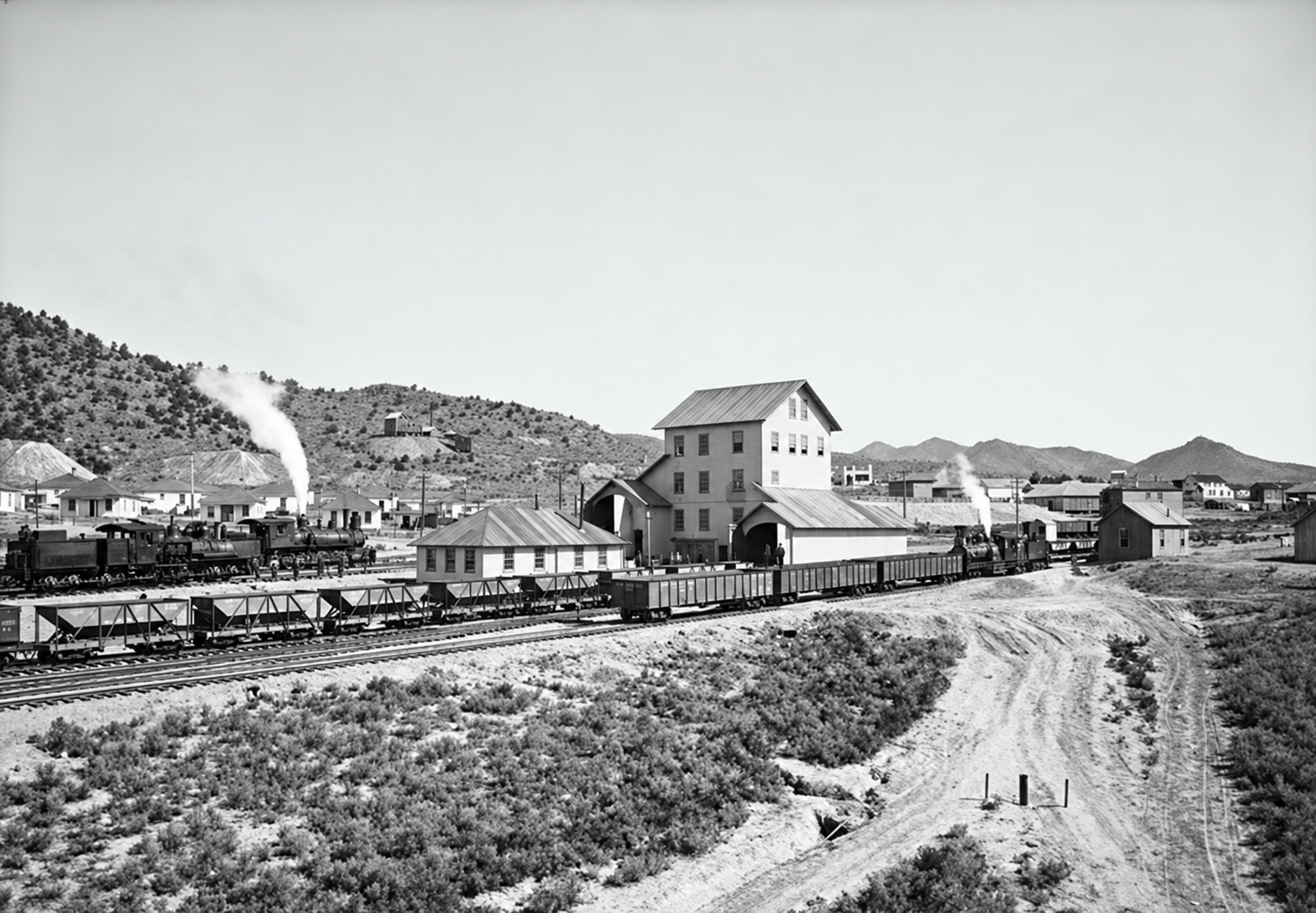
A tall mill building beside the rail yard, with a locomotive at left and a long string of ore cars. Early 1900s.Original photo: Brigham Young University Library
On Knight and the legends: The usual explanation for the site is the flat ground, though some tellings say Knight chose it by spiritual premonition. Stories that voices and visions led him to ore are told about him generally and are not documented in the mining record. The popular picture of Knight as a purely generous patriarch also glosses over a hard-headed business rationale for the wages and short hours, which kept unions out. Tales of lost Spanish workings in the nearby hills are folklore. Some accounts also blur the sampling mill, the smelter and the later Knight-Dern mill into one plant, though they were separate operations.
Freight rates and a short boom
The smelter’s problems were chemical and political. Lead furnaces need a steady balance of lead, silica, lime and iron, and Tintic had plenty of silica and Dragon Canyon iron but ran short of basic lead ore and rich copper, so Knight had to bring in flux from as far as Bingham and Pioche, Nevada. Meanwhile the large Salt Lake Valley smelters at Murray and Midvale had cheaper water and coke. According to research, they worked with the Denver & Rio Grande to cut rates on raw ore going north from Tintic while keeping rates high on inbound coke and outbound lead bullion from Silver City. Knight moved his traffic to the other railroad and used his narrow-gauge line to dodge switching fees, but could not close the gap.
By about 1912 it was cheaper for Tintic mines to ship past Silver City, the smelter went quiet and population fell to roughly 300. In 1915 the works were shut for good, dismantled and partly moved to the Murray smelter.
Knight tried again on the same terraces. With George Dern and Theodore Holt he formed the Tintic Milling Company, whose Knight-Dern Mill used the Holt-Dern process: low-grade ore was roasted with salt and coal dust, leached with acidified brine in wooden vats, and the metals were precipitated onto scrap iron. It started up in early 1916, grew to about 300 tons a day and ran through World War I. Falling metal prices and worked-out tailings ended it in the early 1920s, and it was closed for good by 1926. The Eureka Hill Railway was torn up in 1937. The 1940 census still counted 111 people in the Silver City precinct, mostly scavengers and stockmen, and the town was soon empty.
On the smelter’s end: Sources disagree on timing. One account has the smelter suspended by 1912, another has it running until the works were dismantled in 1915. Dates for the Knight-Dern Mill’s closing also vary between 1923 and 1926. The years above are the ones that most accounts share.
What remains
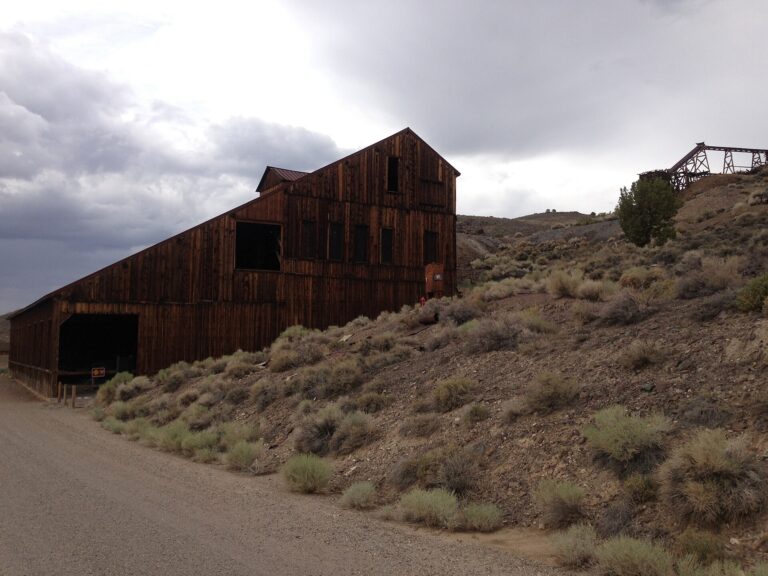
All the wooden buildings are gone, along with the headframes. What is left is stone and concrete. The big ruin is the stepped concrete foundation of the smelter and mill, about five acres of reinforced retaining walls stepped down a slope so ore could move by gravity from the upper rail spurs through crushers, roasters and vats to the lower sidings. Machinery studs, concrete pilasters and scatters of fire brick remain. Below it lie fields of black glassy slag from the smelter years. Cuts and fills mark the old rail grades, and chalky dumps east of town mark the Swansea and South Swansea mines.
The cemetery
Silver City Cemetery sits on a gentle rise about half a mile east of US-6, on open range. It covers less than an acre and, by one count, holds roughly five dozen identified graves from the 1870s to the 1920s. The markers include carved pink sandstone, weathered white marble, zinc monuments and iron family enclosures, and the surnames reflect the district’s English, Cornish, Scandinavian and Slavic workforce. A cluster of children’s graves, among them four infants from one family between 1915 and 1920, speaks to the camp’s later years. Visitors who enter by the pasture gate are asked to rechain it so cattle do not damage the markers.
Timeline
Late 1869
Prospectors find ore at Dragon Canyon and stake the Sunbeam claim.
December 13, 1869
The Tintic Mining District is organized; Silver City becomes its first commercial center.
1882
The Salt Lake & Western Railway reaches Silver City.
1892–1893
The Tintic Range Railway builds a second line into town.
About 1896
Flooding stalls deep mining along the Swansea vein.
1902
A fire burns much of the business district.
1906–1908
Knight builds the sampling mill, the Eureka Hill Railway, houses and the Tintic Smelter.
June 1908
The smelter fires its first charges.
July 24, 1908
“Smelter Day” celebrates the new plant; population peaks near 1,500.
About 1912
Valley smelter competition and freight rates idle the plant; population falls to about 300.
1915
The smelter is dismantled and partly moved to Murray; the Tintic Milling Company is formed.
Early 1916
The Knight-Dern Mill begins operating on the smelter terraces.
1923–1926
The mill stops running and is closed for good.
1937
The Eureka Hill Railway tracks are removed.
1940
Census counts 111 people in the Silver City precinct.
March 14, 1979
The Tintic Smelter Site and Silver City Cemetery are listed on the National Register.
Visit guide — Silver City, Utah
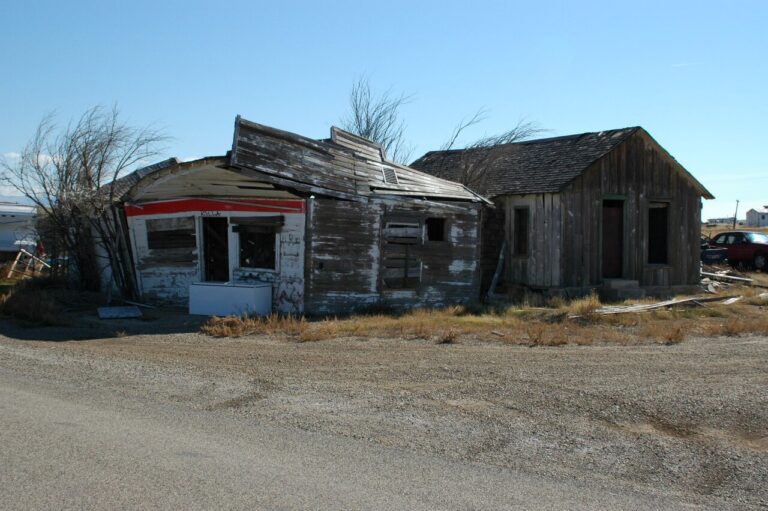
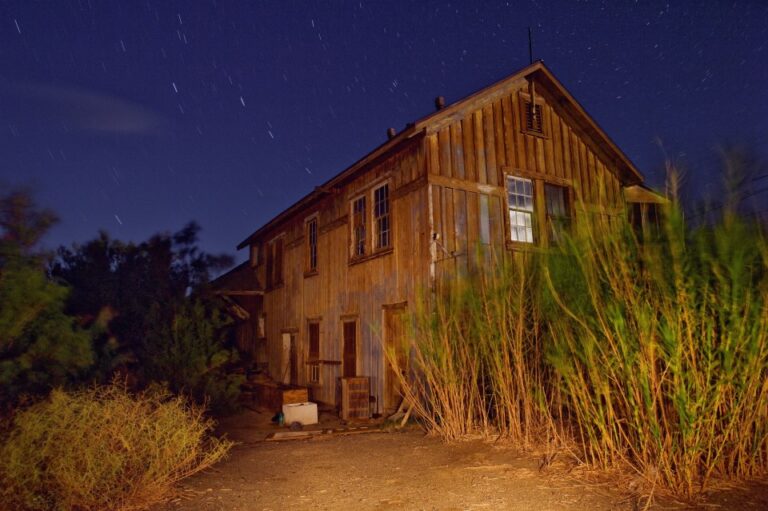
Can you visit?Yes, to look. The mill ruins and cemetery can be seen from the road. The smelter ruins, mine dumps and processing flats are private patented claims, and upper Dragon Canyon is an active mining lease, fenced, signed and closed.
Getting thereDrive US-6 about 4 miles south of Eureka and turn east onto the unpaved Silver City Road (Dragon Canyon Road) between mile markers 137 and 138. The cemetery is about half a mile in, on a rise south of the road. The mill terraces are just north of the road.
CoordinatesAbout 39.91°N, 112.13°W for the townsite. Approximate, not a survey.
Road conditionsGraded dirt with washboard. One account says a passenger car can manage it when dry; another recommends high clearance or 4WD, especially beyond the first stretch. After rain or snowmelt the clay turns to slick mud and the road can become impassable.
Land statusA mosaic: BLM public land around the townsite, private patented claims at the ruins and dumps, and a private mining lease in upper Dragon Canyon.
FacilitiesNone. Carry water, a spare tire and a charged phone; service is poor.
Best seasonLate spring and fall in dry weather. Summer is hot and shadeless.
Serious hazards: Open vertical shafts, winzes and subsidence craters are hidden in the sagebrush around the Swansea, South Swansea and Sunbeam workings. The mill terraces drop 10 to over 30 feet with no railings, and century-old concrete breaks away at the edges. Tailings, slag and flue dust contain lead, arsenic and cadmium: do not kick up dust or handle them, keep pets leashed, and wash hands and shoes afterward.
Respect the ground: Stay on established tracks, keep out of fenced and gated areas and off the ruin walls, rechain the cemetery gate, and take only photographs.
Approximate location of the Silver City townsite at the mouth of Dragon Canyon, Juab County, Utah.
Historic sites nearby
Knightsville, UT
~4 miles northeast, also on this site
Knight’s saloon-free camp above Eureka
Mammoth & Robinson, UT
~2–3 miles north-northwest, also on this site
Two camps in one canyon · Mill ruins
Dividend, UT
~6 miles east-northeast, also on this site
Company town for the Tintic Standard mine
Eureka, UT
~4 miles north
Tintic’s surviving town · Historic district, Bullion Beck headframe, mining museum
Diamond, UT
~3 miles south
Early rival camp · Cemetery and building pads
Further reading
Books, studies and records about Silver City and Tintic
Faith, Hope, and Prosperity: The Tintic Mining District
Philip F. Notarianni, 1982 — Social and industrial history of the district.
A History of Juab County
Pearl D. Wilson, Jerome Wyckoff and David Turner, 1996 — County centennial history.
Geology and Ore Deposits of the Tintic Mining District, Utah
Waldemar Lindgren and G. F. Loughlin, USGS Professional Paper 107, 1919 — Classic geology and water-table study.
Geology and Ore Deposits of the East Tintic Mountains
Hal T. Morris and T. S. Lovering, USGS Professional Paper 1024, 1979 — Later mapping of the district.
Jesse Knight, Utah’s Mormon Mining Mogul
Utah Historical Quarterly — Biography and business of the smelter’s builder.
Silver CityUtahJuab CountyTintic Mining DistrictJesse KnightSmelterSilver MiningUtah Ghost Towns