Centralia, Pennsylvania: The Town That Set Itself on Fire in 1962 and Still Hasn’t Gone Out
Most ghost towns die slowly. Centralia, Pennsylvania did not. A town of almost 3,000 people was effectively erased in the span of a few decades by a fire that started in a landfill, slipped underground into a network of abandoned coal mines, and has been burning ever since. The fire began in May 1962. Experts estimate it could continue for another 250 years.
What makes Centralia different from every other ghost town in this archive is that it isn’t abandoned in the usual sense. The town was not economically bypassed, or flooded, or simply left behind when the ore ran out. It was condemned — the buildings demolished by the state, the ZIP code revoked, the residents bought out or evicted, the most famous road buried under fill during a pandemic. As of 2026, approximately five to eight people remain, protected by life-estate settlements that allow them to stay until they die. After that, the state takes everything.
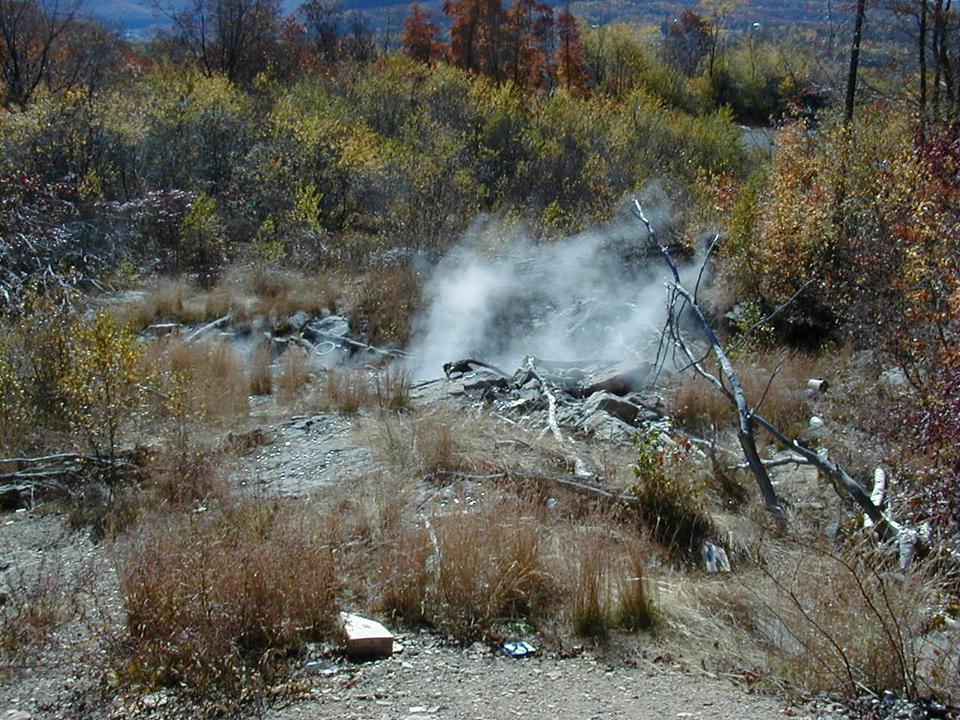
The fire is still burning beneath what used to be the streets. Steam vents break through the surface. The ground can collapse without warning into sinkholes that drop hundreds of feet. Carbon monoxide seeps invisibly from the earth. Centralia is not a ghost town you can visit. It is a ghost town that is actively trying to kill the last people who live in it.
“The very geological resource that created Centralia ultimately ensured its total eradication. The coal that built the town became the furnace that consumed it.”
The anthracite era: Bull’s Head to Centralia (1832–1890)
The valley that became Centralia was purchased by colonial agents from its Native American inhabitants for £500 in 1749 and remained largely wilderness for decades. Settlement began in earnest in 1832 when an entrepreneur named Jonathan Faust opened the Bull’s Head Tavern in what was then Roaring Creek Township, giving the nascent community its first name. The region’s transformation came in 1842 when the Locust Mountain Coal and Iron Company purchased the land. Their mining engineer, Alexander Rae, recognized the valley’s logistical potential and formally laid out streets and residential lots, initially naming the village Centreville. A postal conflict with a neighboring Centreville in Schuylkill County prompted the official rename to Centralia in 1865; the borough was formally incorporated in February 1866.
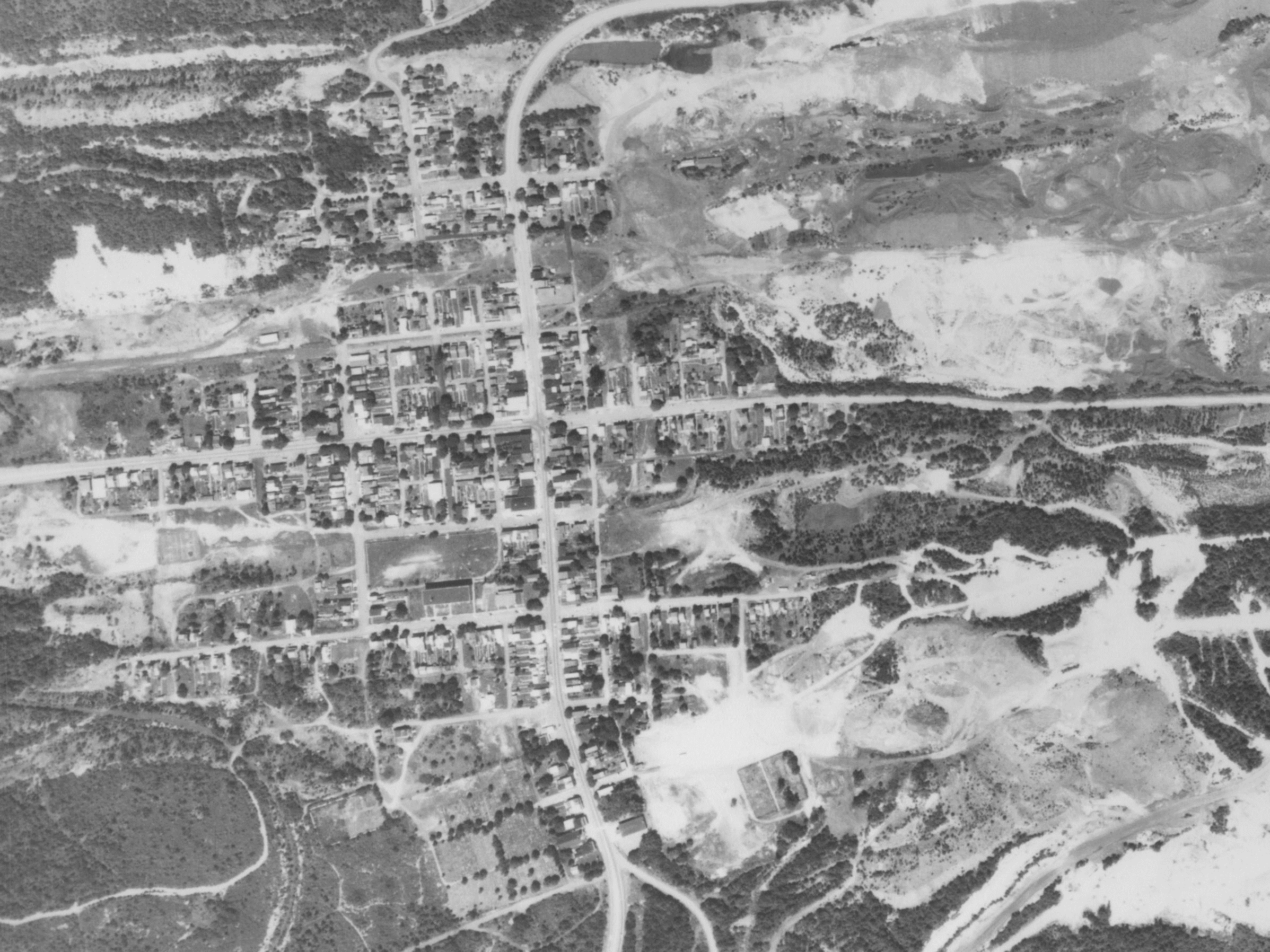
The construction of the Mine Run Railroad in 1854 catalyzed the industrial boom. The first commercial mines opened in 1856, and by the late 19th century Centralia had an infrastructure outsized for its 0.24-square-mile footprint: 7 churches, 5 hotels, 27 saloons, 2 theaters, and 14 grocery and general stores serving a peak population of 2,761 residents recorded in the 1890 census. It was, in every respect, a typical coal region company town — dense, self-contained, and entirely dependent on a single economic engine.
The Molly Maguires and the murder of Alexander Rae
Centralia’s early decades were shadowed by the violent labor struggles that characterized the Pennsylvania anthracite fields. The town became a local epicenter for the Molly Maguires — a secretive society of Irish-American miners who used intimidation, sabotage, and assassination to fight the oppressive conditions enforced by the mine operators. Extreme poverty, dangerous working conditions (the 1869 Avondale Mine disaster killed 111 miners), and systemic discrimination against Irish immigrants had created an environment of sustained, organized violence.
The most significant event was the assassination of Centralia’s own founder. On October 17, 1868, Alexander Rae was ambushed and beaten to death in his buggy on the road between Centralia and Mount Carmel. The exact motive — robbery of a payroll sum, or targeted labor retaliation — has been debated ever since. The investigation went cold until 1876, when a local informant named Manus Coll confessed and implicated three men: Patrick Hester, Patrick Tully, and Peter McHugh. Their trial became national news. All three were convicted and hanged in Bloomsburg on March 25, 1878. The prosecutions — largely built on evidence gathered by Pinkerton detective James McParlan — effectively dismantled the Molly Maguires as a formal organization.
The conditions for catastrophe: bootleg mining and pillar-robbing
Centralia’s eventual destruction was not caused by the 1962 fire alone. It was caused by decisions made thirty years earlier during the Great Depression. When the Wall Street Crash of 1929 forced the Lehigh Valley Coal Company to shutter five major local mines, unemployed miners turned to bootleg mining in the idle, abandoned shafts — illegal extraction operations that used a technique called pillar-robbing.
In conventional mining, massive columns of coal are intentionally left in place to support the mine roof. Pillar-robbers extracted these structural supports for the coal they contained, causing cascading roof collapses throughout the subterranean network. The consequence was a vast, labyrinthine system of interconnected voids and collapsed passages beneath Centralia — a honeycomb of tunnels with its own internal ventilation system, fully oxygenated and waiting. Decades later, those voids would become the fuel delivery system for an inextinguishable fire.
The fire: May 1962
The ignition was routine, almost mundane. In May 1962, the Centralia borough council decided to clean up an illegal, unregulated refuse dump in an abandoned strip-mining pit before the upcoming Memorial Day celebrations. They set it on fire — a common waste management practice of the era. Volunteer firefighters were dispatched, the surface flames were extinguished, and the matter appeared resolved.
It was not resolved. The selected pit had been excavated directly over an outcropping of the Buck Mountain Coal Bed, and crucially, it contained an unsealed opening into the abandoned mine network below. The fire transferred from surface refuse to anthracite coal and slipped underground. Surface fires repeatedly reignited over the following weeks as residents complained of acrid smells. Local authorities attempted increasingly futile containment measures over the next several years — flushing with water, capping with clay, pumping slurry into the voids — but the pillar-robbed tunnels simply channeled the oxygen to keep the fire burning deeper and wider. By the late 1960s, rail service to Centralia had ended, and the fire had established an underground foothold across four distinct fronts covering over 400 acres.
The tipping point: Todd Domboski and the 1981 sinkhole
For nearly two decades the fire remained an ongoing but largely invisible problem — steam vents, sulfur smells, and occasional ground warming that authorities consistently underestimated. The danger became impossible to ignore on Valentine’s Day, 1981.
Twelve-year-old Todd Domboski was playing in his grandmother’s backyard on Locust Avenue when the earth collapsed beneath him, opening a steaming, 150-foot-deep sinkhole directly into the burning mine. Domboski managed to grab exposed tree roots as he fell and clung to them until his older cousin pulled him out. The vent he had fallen into was emitting lethal concentrations of carbon monoxide gas. Had he gone all the way down, he would not have survived.
The incident received immediate national television coverage and forced the Pennsylvania state government and the U.S. Department of the Interior to publicly acknowledge what the residents of Centralia had been saying for years: the mine fire was not a nuisance. It was an uncontrollable, catastrophic public health emergency.
Relocation, demolition, and the holdouts
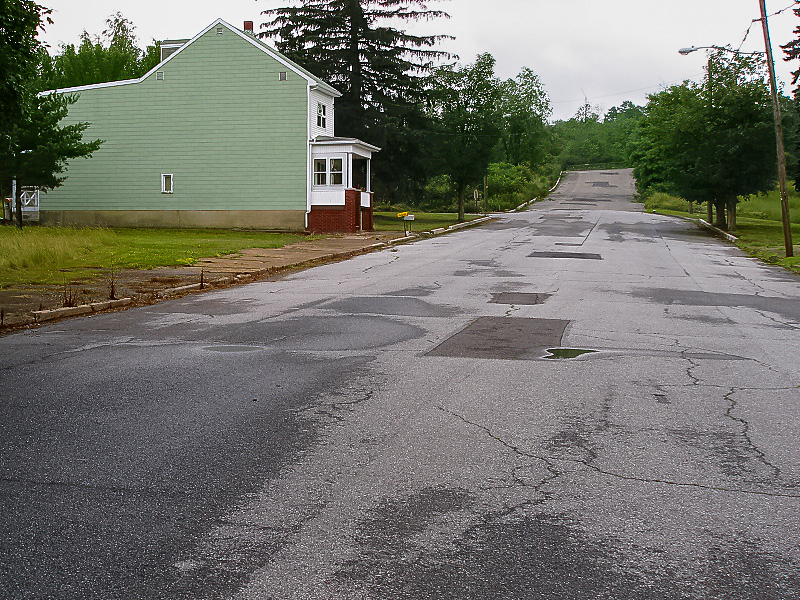
In 1983, Congress allocated over $42 million for a voluntary relocation program for Centralia’s residents. The program fractured the community along bitter lines. Most accepted the buyout and left. A minority — many of whom believed the dangers were exaggerated by a government that wanted the coal rights beneath their town — refused. Throughout the 1980s, the Columbia County Redevelopment Authority demolished the vacated homes block by block, leaving behind an eerie grid of paved, orphaned streets cutting through overgrown fields where neighborhoods had stood.
By 1992, with the population down to approximately 50, Governor Robert Casey authorized formal condemnation of all remaining properties via eminent domain. The U.S. Postal Service revoked Centralia’s ZIP code (17927) in 2002. In 2009, Governor Ed Rendell issued formal eviction notices to the final residents, including prominent holdouts John Comarnisky and John Lokitis Jr. The resulting legal battle lasted years.
In 2013, the Commonwealth reached a settlement with the remaining seven residents, paying a combined total of $349,500 and granting each individual a life estate — the right to remain in their home until death or voluntary departure, after which the state seizes and demolishes the property. As of the 2020 census, five people remained. Regional estimates for 2026 place the count at approximately eight residents in five surviving households.
The Graffiti Highway and its burial
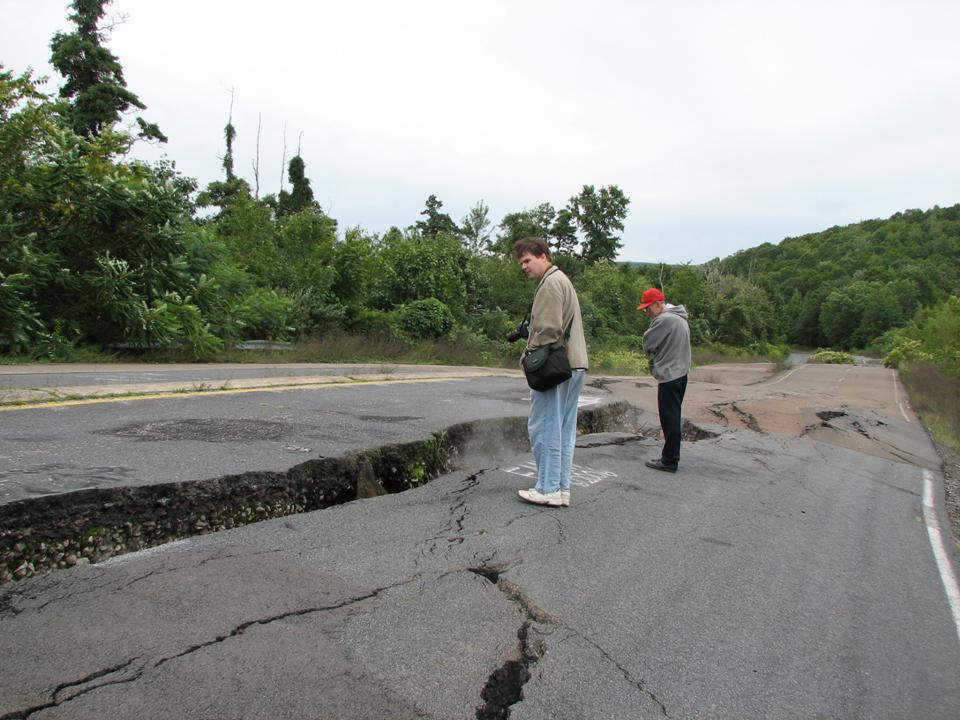
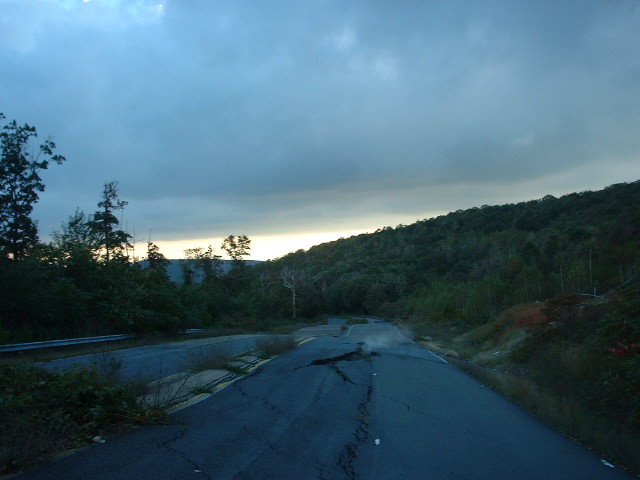
For over two decades, Centralia’s most famous attraction was a 0.75-mile stretch of the original Pennsylvania Route 61, abandoned in the 1990s after the subsurface fire caused severe thermal buckling, deep fissures, and ground subsidence. The road had been covered over the years by thousands of visitors who transformed the cracked asphalt into a dense canvas of spray-painted murals, earning it the name Graffiti Highway.
In 2018 PennDOT relinquished its right-of-way over the abandoned section, transferring ownership to a private coal company, Pitreal Coal. During the spring of 2020 — at the start of COVID-19 lockdowns — Centralia experienced a surge in visitors, with crowds camping on the road, riding ATVs through private yards, and vandalizing cemeteries. Responding to the chaos, Pitreal Coal initiated a large earth-moving operation in April 2020, burying the entire stretch under thousands of tons of dirt and gravel. The artwork is gone. The road is inaccessible. Visitors seeking the iconic imagery will find only earthen mounds and no-trespassing signs.
What survives: the Ukrainian Catholic Church and the holdout borough
The most prominent surviving structure in Centralia — and an inadvertent rebuke of the town’s most famous piece of folklore — is the Assumption of the Blessed Virgin Mary Ukrainian Catholic Church. Built in 1911, it sits on a hilltop above the desolate borough, its Eastern Catholic onion-shaped domes visible from the surrounding hills. A 1987 core-drilling survey discovered the reason for its survival: the church sits atop a massive shelf of solid rock rather than a combustible coal seam, geologically insulating it from the fire below.
The church is fully active in 2026, serving a congregation that travels from surrounding municipalities. In 2015, Major Archbishop Sviatoslav Shevchuk officially declared it a sacred pilgrimage site. Annual pilgrimage events are held in August. St. Mary’s Orthodox Church also remains standing on a hillside just outside the traditional borough boundaries.
The borough’s municipal building still stands on Locust Avenue, housing a fire engine and ambulance. The multiple cemeteries on the southern edge of the borough — where smoke frequently billows from vents — remain maintained and legally accessible to families. Beyond these, the physical town is essentially gone: paved streets ending in forest, fire hydrants attached to nothing, the occasional front step leading to bare ground.
Timeline
Centralia is not a ghost town you can tour. The entire borough is either state-owned land seized via eminent domain or strictly enforced private property. Walking on the empty street grids, exploring the forested lots, or approaching the remaining occupied homes constitutes trespassing under Pennsylvania law — a summary offense or misdemeanor depending on circumstances, with potential for significant fines.
The Graffiti Highway was buried in 2020 and no longer exists. Visitors seeking it will find only earthen mounds and no-trespassing signs.
Physical hazards are not hypothetical. The mine fire burns across 400 underground acres at temperatures reaching 400°F directly beneath the surface. Ground collapse into sinkholes can occur without warning at any time. Carbon monoxide gas vents continuously from the ground in the southern portions of the borough — it is colorless, odorless, and lethal at sufficient concentration. The Pennsylvania DEP issues ongoing public warnings about these conditions.
You can legally drive through the borough on the active alignment of Route 61 and observe the landscape from your vehicle. That is the extent of legal access.
Related sites nearby
Further reading
Sources
Wikipedia — Centralia, Pennsylvania — founding, population data, fire timeline, ZIP code revocation, 2013 settlement
Pennsylvania DEP — Centralia Mine Fire Resources — current fire status, environmental hazard warnings
David DeKok — Centralia News and Unseen Danger, Chapter 16 — Todd Domboski incident, political timeline
Dark Tourism — Centralia — trespassing law, Graffiti Highway burial, legal status 2026
Wikipedia — Assumption of the BVM Ukrainian Catholic Church, Centralia — geological survival, pilgrimage designation
CNEWA — Pilgrims flock to Ukrainian Catholic Church in abandoned Pennsylvania town
LitReactor — Exploring the Real Town Behind Silent Hill — Silent Hill connection, film vs. game origins
Priceonomics — How a Pennsylvania Coal Town Became Hell on Earth (Joan Quigley research) — ignition timeline, containment failures
UncoveringPA — What to do in Centralia — current access conditions, legal status
Bloomsburg University Libraries — The Murder of Alexander W. Rea — Molly Maguires trial records