Bullfrog, Nevada: The Gold Camp That Lost to Rhyolite
Part of Death Valley ghost towns and ghost towns near Las Vegas.
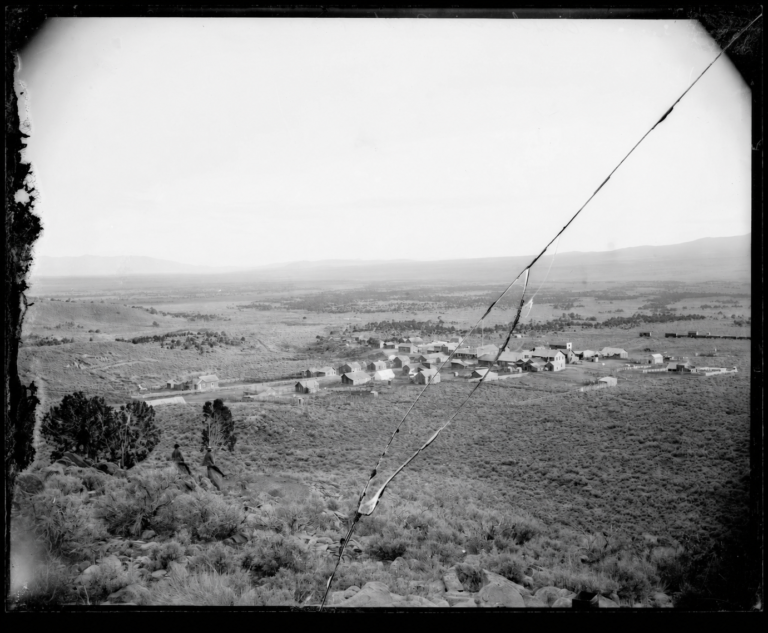
Bullfrog is the town that gave its name to one of Nevada’s last great gold rushes, then lost almost everything to the neighbor a mile up the road. Two prospectors found green, gold-flecked rock in the hills west of Beatty in August 1904, and within months about a thousand people were living in tents and dugouts on the desert. In the spring of 1905 the camp moved to a new townsite and took the name Bullfrog, with hotels, saloons, a bank and its own newspaper. But Rhyolite, platted at the same time and closer to the best mine, pulled away the money, the railroads and finally the buildings themselves. By 1909 Bullfrog’s post office had closed, and today the town is a few stone walls, an old icehouse and a desert cemetery it shares with Rhyolite.
A green rock in the Bullfrog Hills
In the summer of 1904 Frank “Shorty” Harris and Ed Cross were prospecting east of Death Valley, coming over from the Keane Wonder area into the hills above the Amargosa Desert. On August 4 or 9, 1904 (accounts give both dates), they broke open a ledge of quartz stained green by copper and spotted with free gold. Harris later described the rock as “green, almost like turquoise” with big chunks of yellow metal.
They called the claim the Original Bullfrog. The usual explanation is the color: green rock with gold spots, like a frog’s back. Another story credits a song Cross liked to sing. Either way, the name stuck to the claim, the hills, the town and the whole mining district.
The samples assayed rich, and the news reached Goldfield and Tonopah, the two big Nevada camps of the day, almost at once. Prospectors, promoters and freighters started across the desert within weeks.
From Amargosa to Bullfrog
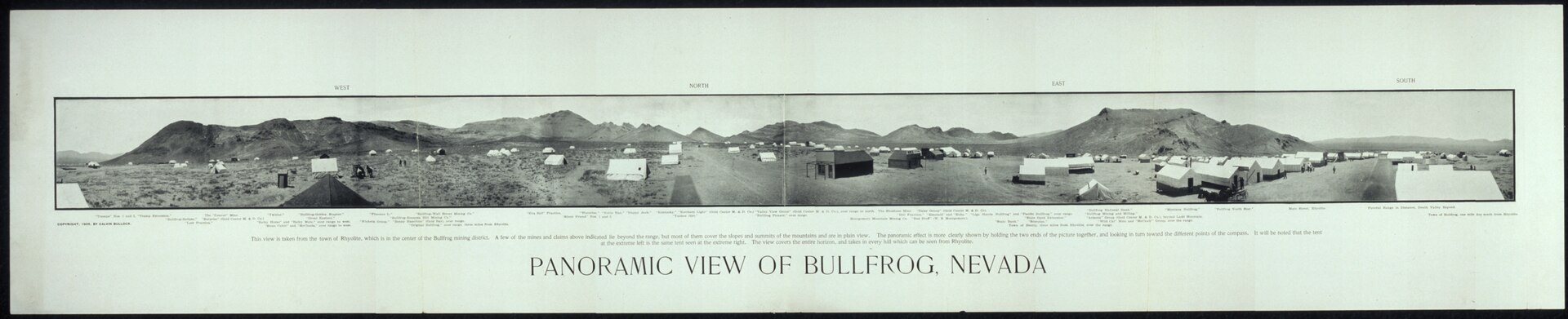
The first settlements in the new district were tent camps near the strike, the best known called Amargosa. By the winter of 1904 to 1905 roughly a thousand people were living there in tents, dugouts and shacks built from whatever could be hauled in.
In the spring of 1905 most of the camp moved a few miles east to a new townsite, which took the Bullfrog name. It sat on the desert flat about a mile south of the spot where Rhyolite was being laid out at the same moment.
A town built on promotion
Bullfrog grew fast through 1905. One history counts three hotels, three saloons, a general store and the district’s first bank that year, and the two-story Merchants Hotel was among the bigger buildings. The town had an icehouse, telephones and a stone jail. Its newspaper, the Bullfrog Miner, put out its first issue on March 31, 1905.
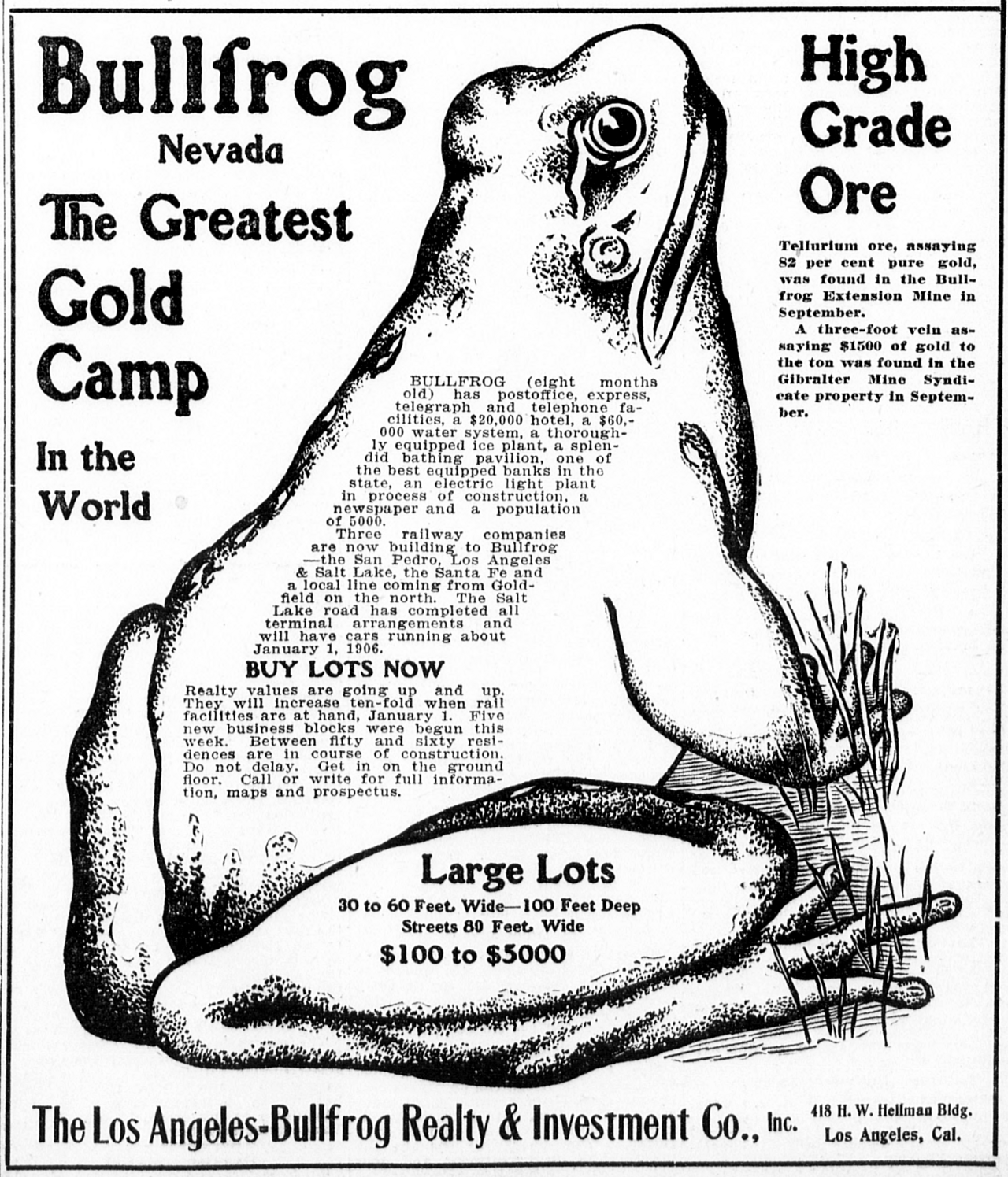
Much of the growth was sold from a distance. Townsite companies advertised lots in Los Angeles and other cities, and promoters offered settlers water by the barrel at a discount or even free, because water had to be hauled in before pipelines reached the camps. Main Street lots reportedly sold for as much as $1,500.
Bullfrog also drew one famous resident. William M. Stewart, the Comstock lawyer who had served Nevada in the U.S. Senate for nearly three decades, moved to the district in May 1905 at about 78. He chose Bullfrog as his home and, by most accounts, built a complex there that included a 10-room adobe house and a law office, reportedly at a cost of about $20,000. He died in Washington, D.C., in 1909.
Losing the race to Rhyolite
Rhyolite had one big advantage: it sat closer to the Montgomery Shoshone, the richest mine in the district. Bob Montgomery located it in 1904, and when the steel magnate Charles M. Schwab bought it in February 1906 and built a large mill, money and attention followed him uphill.
Bullfrog’s businesses went too. By the middle of 1906 most of them had moved to Rhyolite, some reportedly hauling their wooden buildings along. Three railroads then built into the district, the Las Vegas and Tonopah in December 1906, the Bullfrog Goldfield in 1907 and the Tonopah and Tidewater by the end of 1907, and Rhyolite got the grand Mission-style depot, finished in 1908 at a cost of about $130,000.
On June 25, 1906, Bullfrog’s hotel, by then largely empty, burned down. The town never rebuilt it.
Panic, decline and the end
The financial panic of 1907 cut off the eastern money that kept small mines digging, and the rich surface ore in many claims gave out at depth. Most mines in the district had closed by 1909, and the Bullfrog post office shut in May of that year.
Rhyolite lasted a little longer on the Montgomery Shoshone, whose directors voted to close it on March 14, 1911. Through 1921 the whole district produced only about 110,000 ounces of gold. The 1910 census found 675 people in Rhyolite; by 1920 it counted 14. Bullfrog was already empty, and the desert took what was left.
Gold again, and a county with no people
The Bullfrog name came back twice in the late twentieth century. From 1989 to 1999 a large open-pit mine, built by Bond Gold and later run by LAC Minerals and then Barrick, worked the low-grade ore the old miners had passed over. By federal figures it produced about 2.3 million ounces of gold, many times the district’s whole historic output. In the 2020s AngloGold Ashanti bought the neighboring North Bullfrog project and agreed to buy the company that owns the old pit ground, so the hills may be mined again.
In 1987 the Nevada Legislature created Bullfrog County, a 144-square-mile piece of Nye County around Yucca Mountain, where the federal government planned a nuclear waste repository. The county had no residents. Its purpose was to tax the repository heavily, at a 5 percent property rate, with the money going to the state. Nye County sued, and in February 1988 retired state Supreme Court justice David Zenoff ruled the county unconstitutional because a county with no residents could not have a representative government. The legislature dissolved it in 1989. The old townsite was never part of it.
Shorty Harris, the legend
Bullfrog made Shorty Harris famous, and he spent the next three decades as one of Death Valley’s best-known characters. He told his own story to writers many times, and the stories grew. The best known has him selling his share of the Original Bullfrog during a long drinking spree and waking up with little to show for it.
Harris kept prospecting until the end. He died in 1934, at about 78, and was buried in Death Valley beside his friend Jim Dayton. His marker calls him “a single blanket jackass prospector.”
What remains
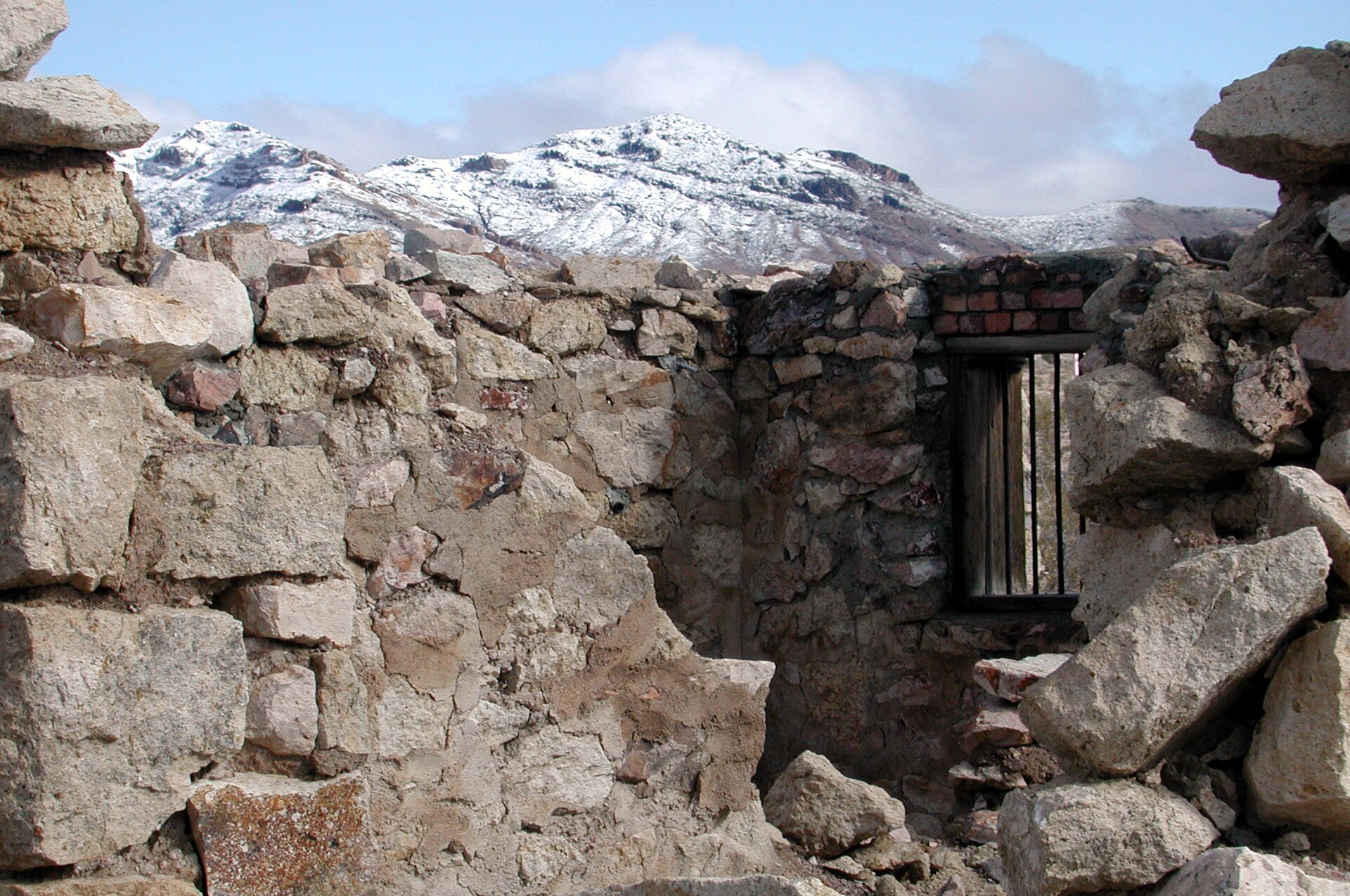
Very little of Bullfrog stands. The most complete ruin is the stone jail, roofless, with its barred window still in place. It sits on a private lot, so look from the road. Across the street are the stone ruins of the icehouse. The rest of the town is foundations, dugouts and scattered debris in the creosote, right beside the Goldwell Open Air Museum and its Red Barn.
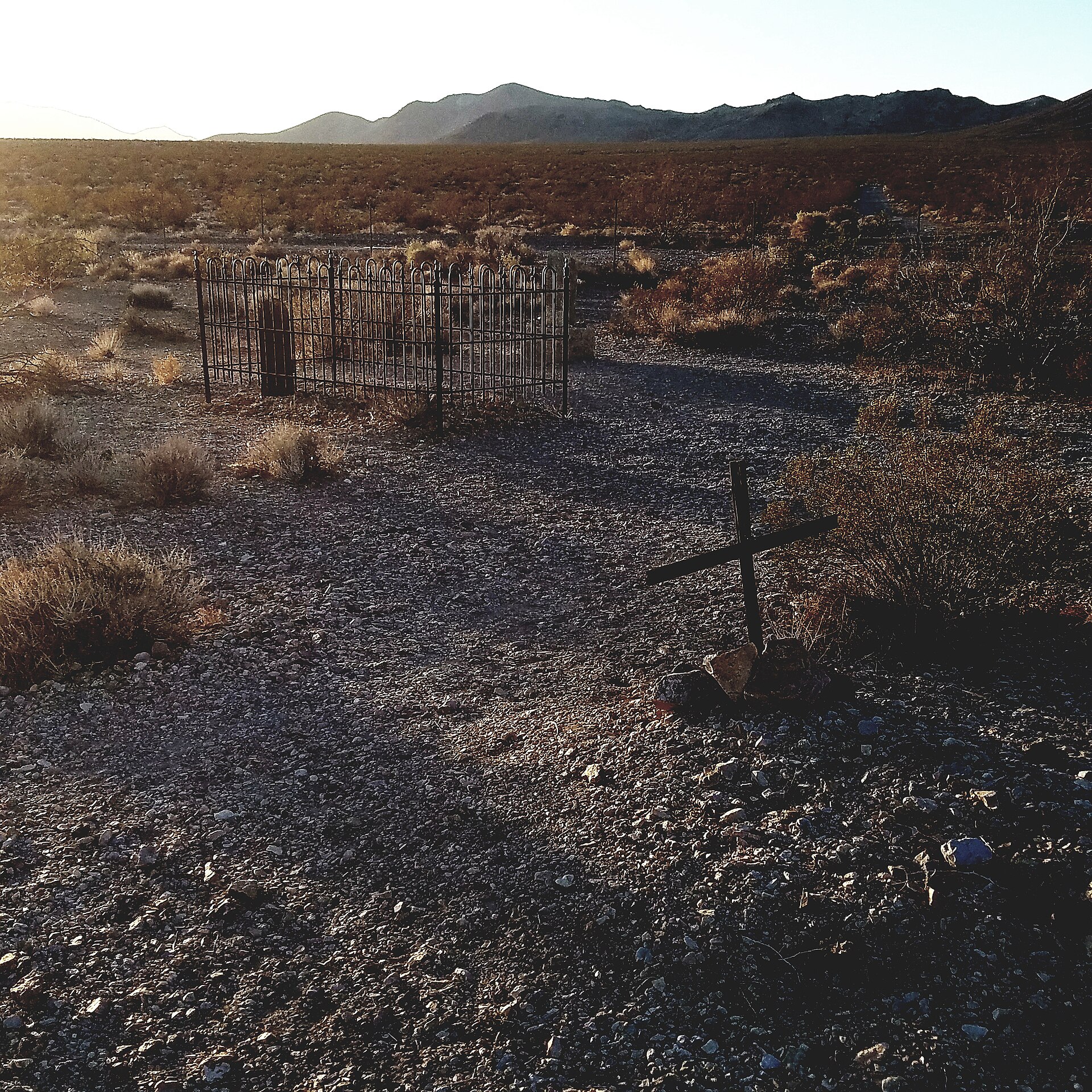
About half a mile south is the Rhyolite-Bullfrog Cemetery, used by both towns. Most graves are marked only by wooden crosses, iron fences or mounds of rock, and few names can still be read. A bronze plaque near the entrance, dated April 1959, honors those buried there. The best-known grave belongs to a much later prospector: Mary Elizabeth Madison, known across the desert as Panamint Annie, who died in 1979 and lies in the northwest corner.
Timeline
Historic sites nearby
Further reading
Sources
Wikipedia — Bullfrog, Nevada, Rhyolite, Nevada and Bullfrog County, Nevada
Western Mining History — Bullfrog, Nevada, Shorty Harris and the Bullfrog Claim and Barrick Bullfrog Mine
National Park Service — Perils of Opportunity: The Mining Towns
Bureau of Land Management — Rhyolite Historic Area
Nevada Appeal — The Nevada Traveler: the mining camp of Bullfrog (2021)
Nevada Expeditions — Bullfrog; Destination4x4 — Bullfrog Nevada
Photos: Finetooth, CC BY-SA 3.0; Library of Congress, public domain; Los Angeles Herald, 1905, public domain; Waningwonder, CC BY-SA 4.0