Chloride, Arizona: The Silver Camp That Became a Living Ghost Town
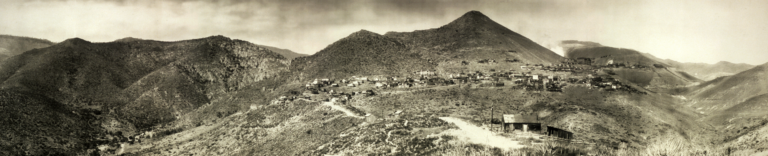
Most silver camps in northwestern Arizona burned out and blew away. Chloride caught fire, lost its railroad, watched its mines close — and simply refused to die. It is the oldest continuously inhabited mining town in the state, and today it trades ore for art.
Chloride at a Glance
- Location
- Cerbat Mountains, Mohave County, Arizona
- Founded
- Mining camp from the early 1860s
- Named for
- Silver chloride ore in the surrounding hills
- Peak
- ~5,000 residents (1900–1920)
- Industry
- Silver, gold, lead, zinc, copper, turquoise
- Today
- ~229 residents; a living ghost town open to visitors
- Elevation
- ≈4,009 ft (1,222 m)
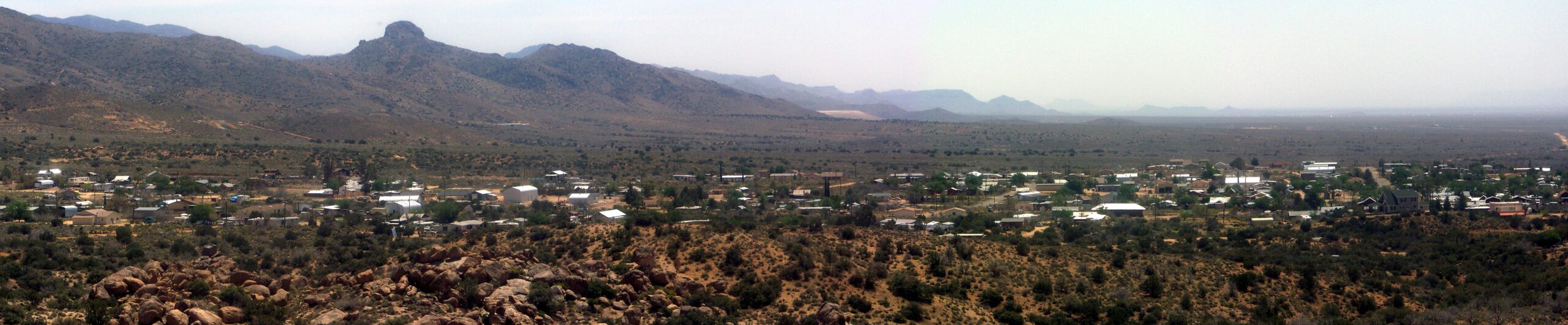
Chloride sits on the dry western flank of the Cerbat Mountains, about twenty-three miles northwest of Kingman. The range holds a rich pocket of hydrothermal ore — silver, gold, lead, zinc, copper, and even turquoise — and the town took its name from the silver chloride that early prospectors chipped out of the outcrops around a rise still called Silver Hill. Where dozens of contemporary camps in the same country have vanished into foundations and tailings, Chloride is still inhabited, still receiving mail at one of Arizona’s oldest post offices, and still welcoming travelers who come as much for its rock murals and yard sculpture as for its history.
The story here is not really one of collapse but of adaptation — a town that outlived its mines by reinventing what it was for.
Silver in the Cerbats
Prospectors were poking through the Cerbat range as early as the 1840s, but organized mining did not really begin until the 1860s. In 1863 the prospector John Moss struck a substantial silver vein and touched off a rush that gathered into the informal camp of Chloride. The same silver fever was reshaping camps across the Southwest, among them Shakespeare, New Mexico, which boomed and busted on the metal in the very same years. Growth was slow at first: the district was isolated, and there was sustained conflict between the incoming miners and the Hualapai, whose homeland this was. Only after U.S. Army campaigns and the signing of a peace treaty with the Hualapai in 1870 did large-scale investment become possible, and the Cerbat Mining District opened up to serious capital.
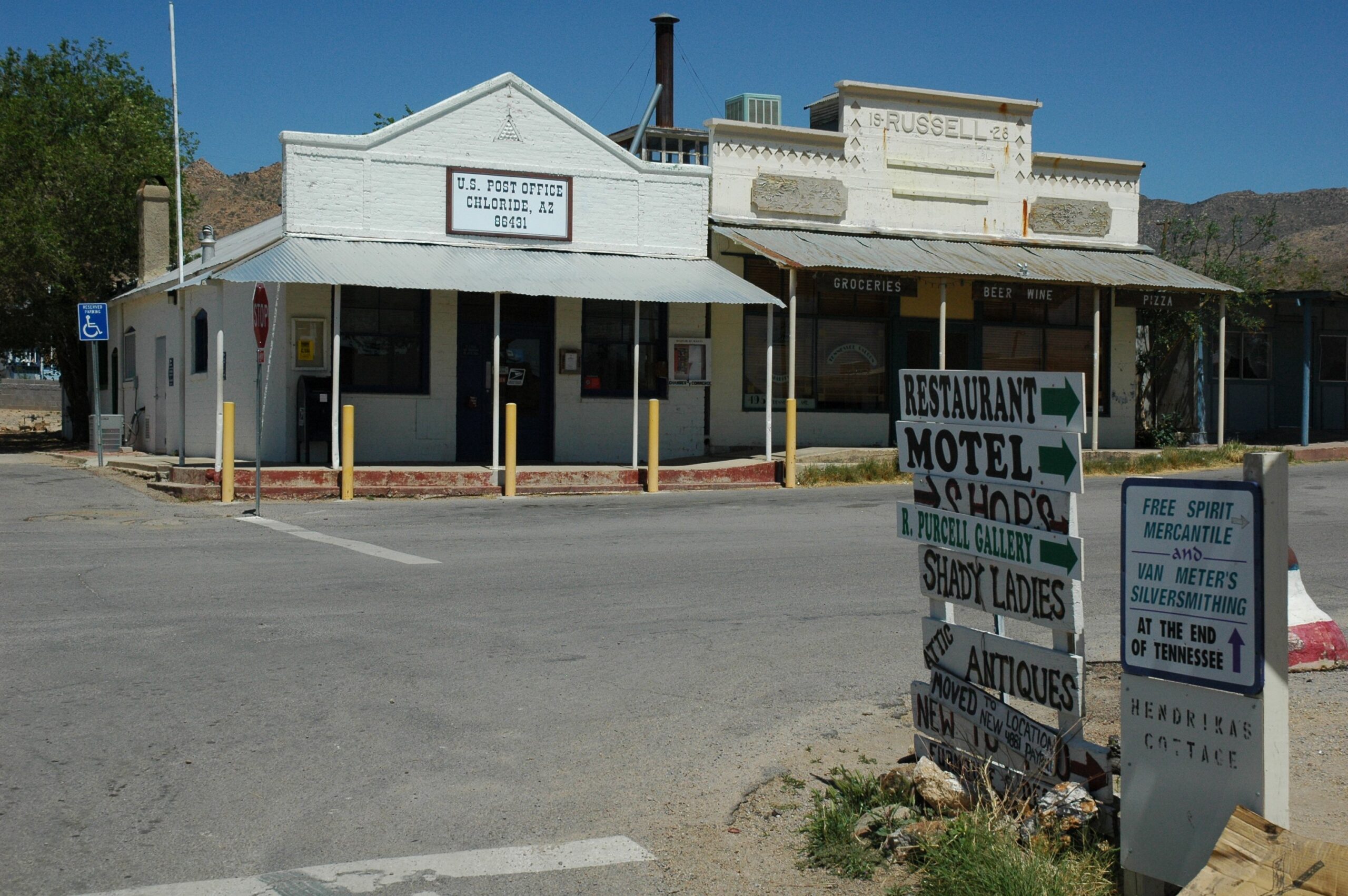
From there the camp rose quickly. In 1871 Chloride was named the seat of Mohave County, a marker of its early standing in the northwest corner of the territory. The post office, first established in the 1860s, has operated continuously since 1893 — one of the oldest unbroken postal runs in Arizona. For decades the Butterfield Stage Line kept a stop and repair station in town, and in 1899 the Arizona and Utah Railway finished a branch connecting Kingman directly to Chloride, a line whose ceremonial last spike — driven by Miss May Krider — was silver. By 1910 rail spurs reached the mouth of the Tennessee Mine, the district’s biggest producer.
Between roughly 1900 and 1920 Chloride reached its peak, with a population near 5,000 and more than seventy-five active underground mines in the surrounding district. The town carried the institutions of a real community: hotels, a bank, a theater, a school system, general stores, saloons, barbershops, churches, and a hospital. The Tennessee, Schuylkill, and nearby Golconda mines together pulled millions of dollars in silver, gold, zinc, and lead out of the Cerbats through the early twentieth century.
Life in boom-era Chloride carried the texture of a town that expected to last. Payrolls from the Tennessee and Schuylkill mines moved through the little Arizona Central Bank; ore rolled out on the rail spur while stagecoaches still rattled in on the old Butterfield route; and a school, a hospital, and several churches served families who had put down roots rather than merely staked claims. That density of institutions is part of why the place never fully emptied — when the mines faltered, there was still a town underneath them.
Decline, Fire, and Survival
Chloride’s decline came in stages rather than a single crash. The first blow fell after World War I, when global demand for base metals like zinc and lead collapsed and the local economy contracted; by 1917 the population had already slipped from its peak toward roughly 2,000. In the late 1920s a major fire swept the town, destroying much of the wooden commercial core and residential district. Because many of the surrounding mines were already yielding less high-grade ore, property owners often lacked the capital to rebuild, and the burned lots stayed empty.
The Great Depression pushed mineral prices down further, and in 1935 the Santa Fe Railroad — which had taken over the original branch line — abandoned service to Chloride altogether. World War II production briefly revived the Tennessee Mine, but rising labor costs against fixed, low metal prices made underground mining unprofitable, and commercial operations ceased by 1944.
Here Chloride diverged from the standard boomtown script. Instead of emptying out entirely, it held onto a small core of permanent residents. The 1960 census counted just 135 people, but the town was never fully deserted — and that unbroken thread of habitation is exactly what earns Chloride its title as Arizona’s oldest continuously inhabited mining town. In the later twentieth century the community leaned into heritage tourism, art, and retirement living; the 2020 census recorded 229 residents.
The Roy Purcell Murals
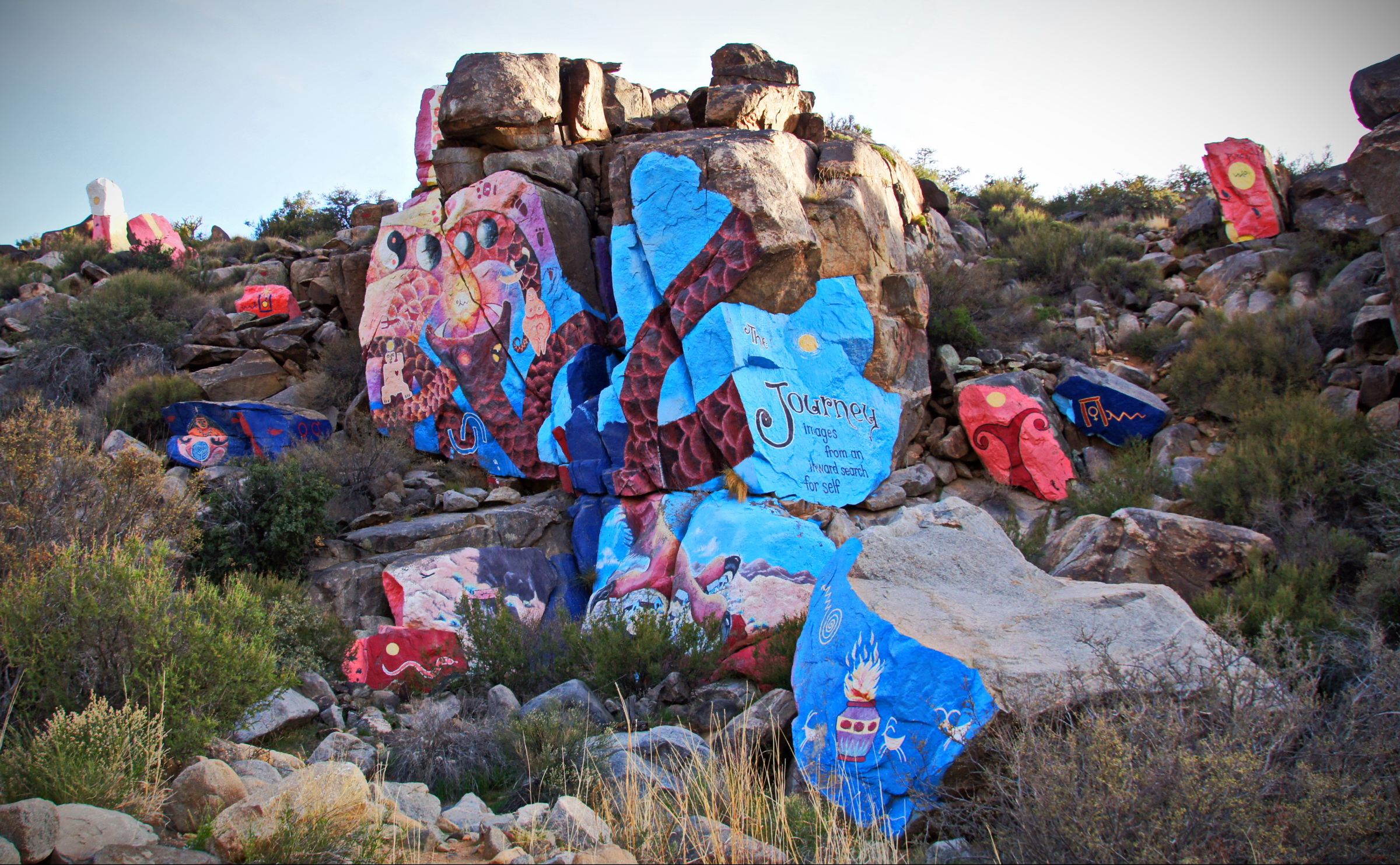
About 1.3 miles east of town, in a canyon in the Cerbats, granite cliff faces carry one of the more surprising works of public art in the desert Southwest. In 1966 Roy Purcell — then a fine-arts and creative-writing graduate student from Utah State University, working as a miner on a break from school — painted a sprawling series of images across roughly 2,000 square feet of rock. He titled the work “The Journey: Images From an Inward Search for Self.”
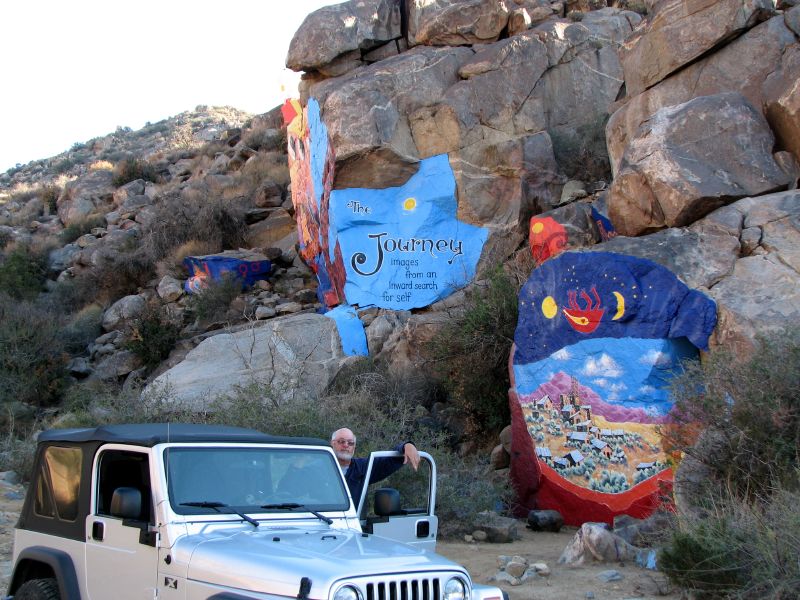
The imagery mixes surrealism, ancient symbolism, and personal reflection: a fertility goddess, a great red serpent that stretches across several boulders, a yin-yang, a taloned foot, and a rendering of the nearby Tennessee Mine. The setting adds another layer — the painted rocks sit directly across from petroglyphs left by the Chloride Band of the Hualapai, so modern and ancient rock art face each other across the same canyon. Purcell went on to direct the Mohave Museum of History and Arts and earned national recognition as a printmaker; he returned in 1975 and again in 2005–2006 to restore the murals, using durable automotive paints to hold their color against the sun.
Junk Art and Yard Sculpture
The murals set the tone for a town that treats found objects as raw material. Chloride is dotted with roadside “junk art” — sculptures welded and assembled from scrap metal, old tools, and cast-offs. Residents have made flamingos from fuel tanks, tin figures, metal spiders, caterpillars out of bowling balls, bottle trees, and utensils dangling from branches. Even the cemetery joins in, where a few historic graves are topped with vintage black rotary telephones. The overall effect is less a preserved relic than a lived-in, still-evolving folk-art landscape.
What makes the murals more than a curiosity is how they reframed the whole town. A place that had spent a century measuring itself in tons of ore suddenly had a signature that had nothing to do with mining — and it embraced it. The murals draw visitors up the rough canyon road year after year, they anchor the town’s identity in guidebooks and travel features, and they gave a template for the do-it-yourself sculpture that now fills yards and roadsides. In Chloride, the line between historic artifact and living art is deliberately blurry.
Documented Events and Local Legend
Two well-attested stories anchor Chloride’s modern lore. The writer Louis L’Amour passed through in the late 1920s after selling a Nevada mining claim; when a fire broke out, he joined a bucket brigade that failed to save most of the wooden business district, an episode he later described in his memoir Education of a Wandering Man. And the town keeps its Old-West theater alive with reenactment troupes — including one promoted as an all-female gunfighting group — staging mock gunfights in the Cyanide Springs area on select Saturdays.
- A “basement cowboy” said to move objects and make footsteps in the sub-levels of old buildings.
- A Victorian-dressed woman reported near the bank and cemetery.
- A saloon ghost known only by the initials “T.S.,” supposedly killed in a gunfight.
- “Vince,” a resident who died in 2001 and is jokingly blamed for rearranging cutlery in local diners.
What Still Stands
For a town that burned and shrank, Chloride retains a remarkable set of historic buildings. The post office still operates under ZIP 86431. The little masonry Arizona Central Bank building, once used to hold bullion and payroll, survives as a preserved landmark, as does the 1898–99 Santa Fe depot that anchored the rail line until 1935. Yesterday’s Restaurant occupies a former stage stop from the Butterfield era; the whitewashed Baptist church, with its steeple and original pews, is still in use; and the old jail now serves as the Jim Fritz Museum. A mid-century replica, the Silver Belle Playhouse, hosts community events and reenactments.
Timeline
- 1863
John Moss strikes silver in the Cerbats; the camp of Chloride takes shape.
- 1870
A peace treaty with the Hualapai opens the district to large-scale mining.
- 1871
Chloride is named the seat of Mohave County.
- 1893
The post office begins its continuous operation, still unbroken today.
- 1899
The Arizona and Utah Railway reaches town; the last spike is silver.
- 1900–20
Peak years: ~5,000 residents and 75+ active mines in the district.
- late 1920s
A major fire destroys much of the wooden business district.
- 1935
The Santa Fe abandons rail service to Chloride.
- 1944
Commercial mining ends after a brief wartime revival.
- 1966
Roy Purcell paints “The Journey” murals on the canyon cliffs.
- 2020
A census counts 229 residents — a living ghost town.
Visiting Chloride
Good to Know
- Chloride is open year-round — no gates, no admission, no parking fee.
- Public streets and the outdoor art are accessible any time; shops and restaurants keep daytime hours.
- Mock gunfights run on select Saturdays around midday.
- It is a real residential town — respect private property and residents’ space.
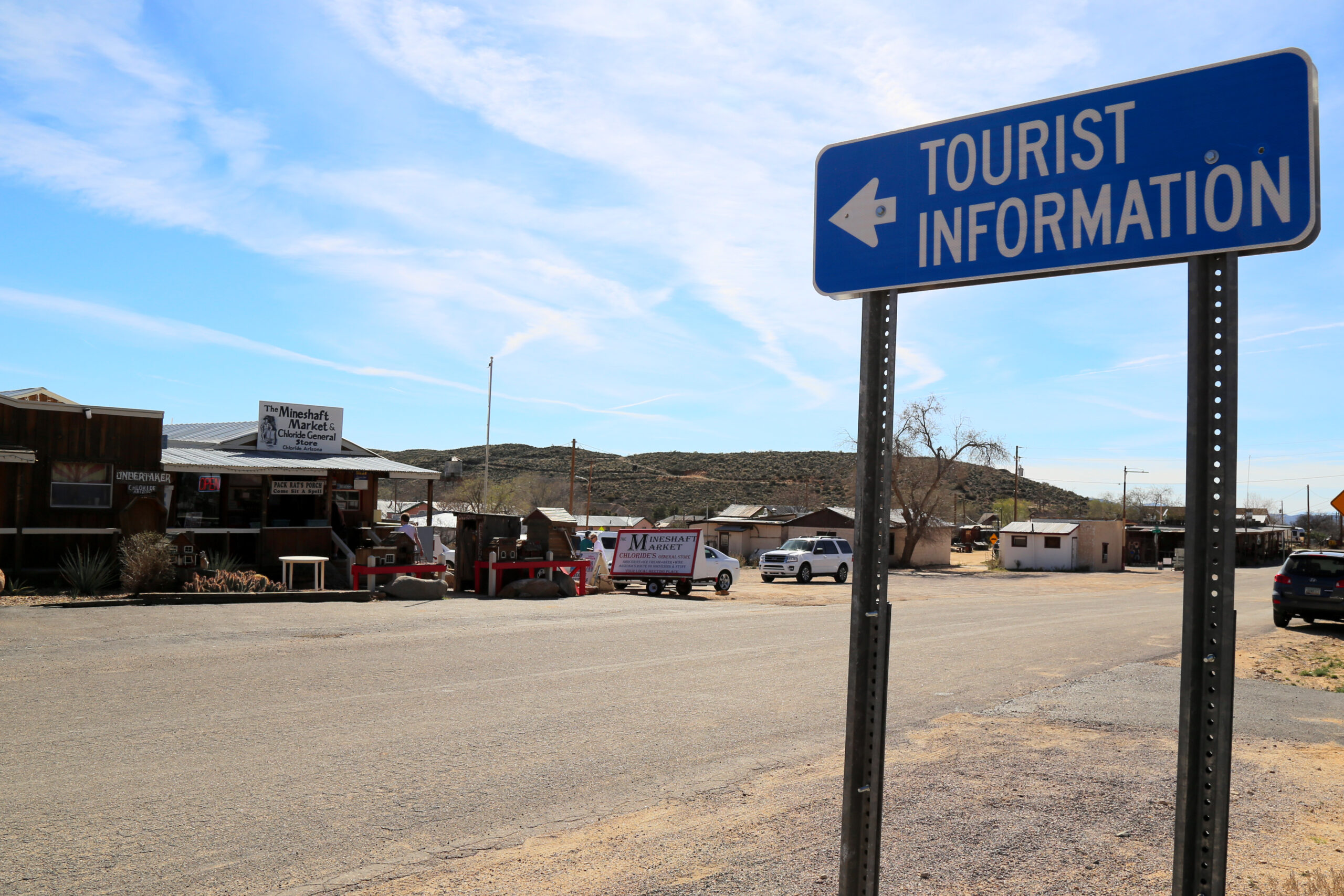
- Start at the Mineshaft Market for tourist information.
Getting There
Chloride lies about twenty-three miles northwest of Kingman. From U.S. Route 93 near Grasshopper Junction, turn east onto County Road 125 (Tennessee Avenue) and drive roughly four miles straight into town on paved road. To reach the Purcell murals, continue east to the paved end of Tennessee Avenue, cross the cattle guard, and follow the unpaved canyon track about 1.3 to 1.5 miles; the road is rough enough that a high-clearance or four-wheel-drive vehicle is recommended.
Ghost Towns Nearby
Mineral Park
Mohave County · ~5 mi SE
Silver, copper, and turquoise site largely absorbed by a modern open-pit copper mine; historic ruins are restricted.
Cerbat
Mohave County · ~12 mi SE
1860s silver and gold camp and an early county seat; stone foundations, tailings, and timber ruins remain.
Santa Claus
Mohave County · ~10 mi SW
A 1930s Christmas-themed roadside development along US 93, now an abandoned, weathered novelty stop.
Oatman
Mohave County · ~40 mi SW
A living Route 66 gold town famous for its wild burros, historic hotels, and daily street gunfights.
Why Chloride Matters
Chloride is a useful counter-example to the usual ghost-town story. The same forces that erased its neighbors — depleted veins, a devastating fire, the loss of the railroad, collapsing metal prices — all struck here too, yet the town persisted by changing what it was. A silver camp became a stage stop’s memory, a rail terminus became a preserved depot, and a canyon of bare granite became a gallery. In its continuous post office, its restored murals, and its yards full of welded sculpture, Chloride offers a living record of how a Western mining community can outlast its mines — not by freezing in place, but by staying inhabited and finding new reasons to exist.
Further Reading
- Paher, Stanley W., Roy E. Purcell, and Charles Kinsey. Chloride: Mines and Murals (Nevada Publications, 1978).
- Varney, Philip. Arizona’s Best Ghost Towns: A Practical Guide (Northland Press, 1980).
- Sherman, James E. and Barbara H. Sherman. Ghost Towns of Arizona (University of Oklahoma Press, 1969).
- L’Amour, Louis. Education of a Wandering Man (Bantam Books, 1990) — includes his account of the Chloride fire.
- Paher, Stanley W. Northwestern Arizona Ghost Towns (1980).
Sources & Photo Credits
Historical detail synthesized from published histories and field guides to Chloride and Mohave County (Paher, Purcell & Kinsey; Varney; Sherman & Sherman; and L’Amour, cited above), the town’s own heritage materials, and public records on the Purcell murals. All prose is original to Ghost Town Archive.
Photographs: Panorama by Ððinn (CC BY-SA 2.5); town center by Jpatokal (CC BY-SA 4.0); murals cliff face by BethinAZ (CC BY 2.0); “The Journey” detail by Victor Solanoy (CC BY 2.0); tourist sign by Joshua Noble (CC BY-SA 2.0) — all via Wikimedia Commons.