
Kennecott, Alaska: The $200 Million Copper Ghost Town in the Wrangell Mountains

Deep in the Wrangell Mountains of southeastern Alaska, a cluster of dark-red wooden buildings clings to a mountainside above a river of ice. This is Kennecott, once the richest concentrated copper deposit ever found and the anchor of a mining empire that stretched across two continents. Between 1911 and 1938 its mill processed more than 4.5 million tons of ore and produced over a billion pounds of copper, generating more than $200 million in gross value before the veins ran out and the whole enterprise was simply switched off.
Today Kennecott is one of the best-preserved industrial ghost towns in North America, protected inside the largest national park in the United States. Reaching it still means a long drive on gravel, a walk across a footbridge, and a shuttle ride up a valley with no year-round road access — a reminder of just how remote this corner of the subarctic really was when engineers first tried to pull copper out of it.
A Green Stain on Bonanza Ridge
In the summer of 1900, prospectors Jack Smith and Clarence Warner were working the high alpine terrain above the Kennicott Glacier when they spotted a vivid green streak high on Bonanza Ridge. Up close, the green was not vegetation but copper oxide — the surface expression of an extraordinary body of chalcocite ore assaying at more than 70 percent pure copper. They staked it as the Bonanza claim, and word of a copper deposit that rich soon reached investors far beyond Alaska.
Extracting ore from such an isolated place demanded serious capital. Mining engineer Stephen Birch arrived in 1902, put up the first log structure along National Creek, and set about lining up eastern financing. By 1906 he had secured backing from banker J. P. Morgan and the Guggenheim family, whose joint venture — the Alaska Syndicate — combined the banking, engineering, and metallurgical muscle needed to develop the deposit.
To move the ore to market, the Syndicate financed the Copper River & Northwestern Railway. Built under railroad man Michael J. Heney, the 196-mile line ran from the ice-free port of Cordova up through mountain canyons and across glacial margins, including the celebrated Million Dollar Bridge. Completed in 1911 at a cost of more than $20 million, the railway finally allowed full-scale mining and milling to begin.
Kennicott or Kennecott? A Clerk’s Typo That Stuck
Visitors are often confused by the two spellings that appear around the valley. The natural features — the Kennicott Glacier, the Kennicott River, the Kennicott Valley — were named in 1899 by U.S. Geological Survey geologist Oscar Rohn for Robert Kennicott, a Smithsonian naturalist who died in Alaska in 1866. The spelling with an “e,” Kennecott, comes from a clerical error made when the mining company filed its incorporation papers. The National Park Service keeps the distinction to this day: an “i” for the glacier and geography, an “e” for the company, the mill town, and the National Historic Landmark.
Life in a Company Town on the Glacier
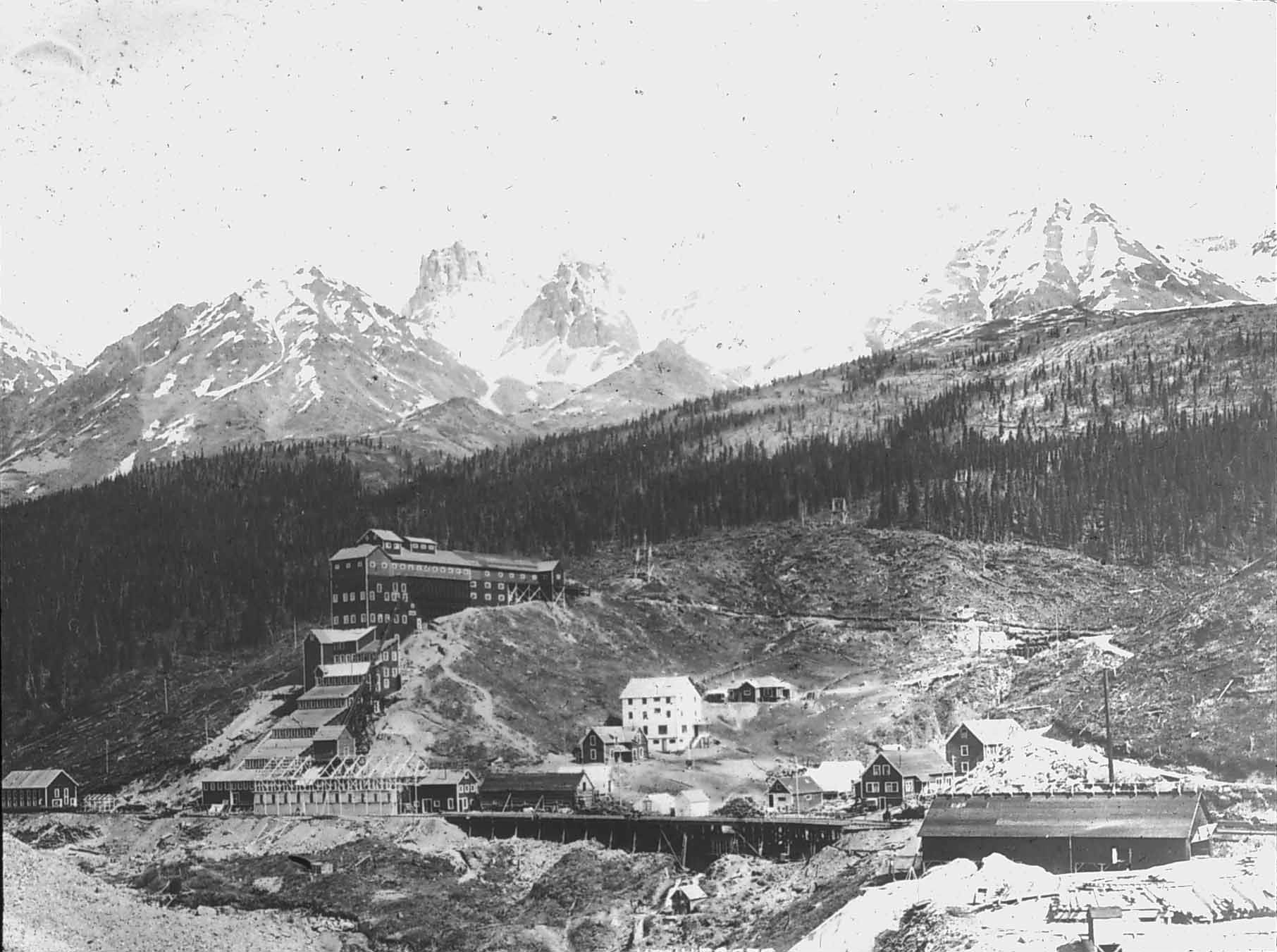
At its height in the early 1920s, roughly 700 people lived in the combined McCarthy–Kennecott area. The workforce split between two worlds. High on Bonanza Mountain, somewhere between 200 and 300 miners lived in multi-story bunkhouses built right at the mine portals — the Bonanza, Jumbo, Mother Lode, and Erie workings — sending ore down to the valley on aerial tramways. On the valley floor, about 300 more people staffed the mill town beside the glacier’s lateral moraine.
The mill town’s social geography was rigidly ranked. Single laborers bunked together in the valley, while managers, engineers, and administrators lived with their families in single-family houses along a residential terrace nicknamed Silk Stocking Row. Kennecott was a fully planned, company-owned settlement designed to keep labor stable in a brutal climate: it had a modern hospital with early X-ray equipment, a general store, a post office, a two-room school, a recreation hall, a tennis court, a skating rink, and even a dairy barn for fresh milk.
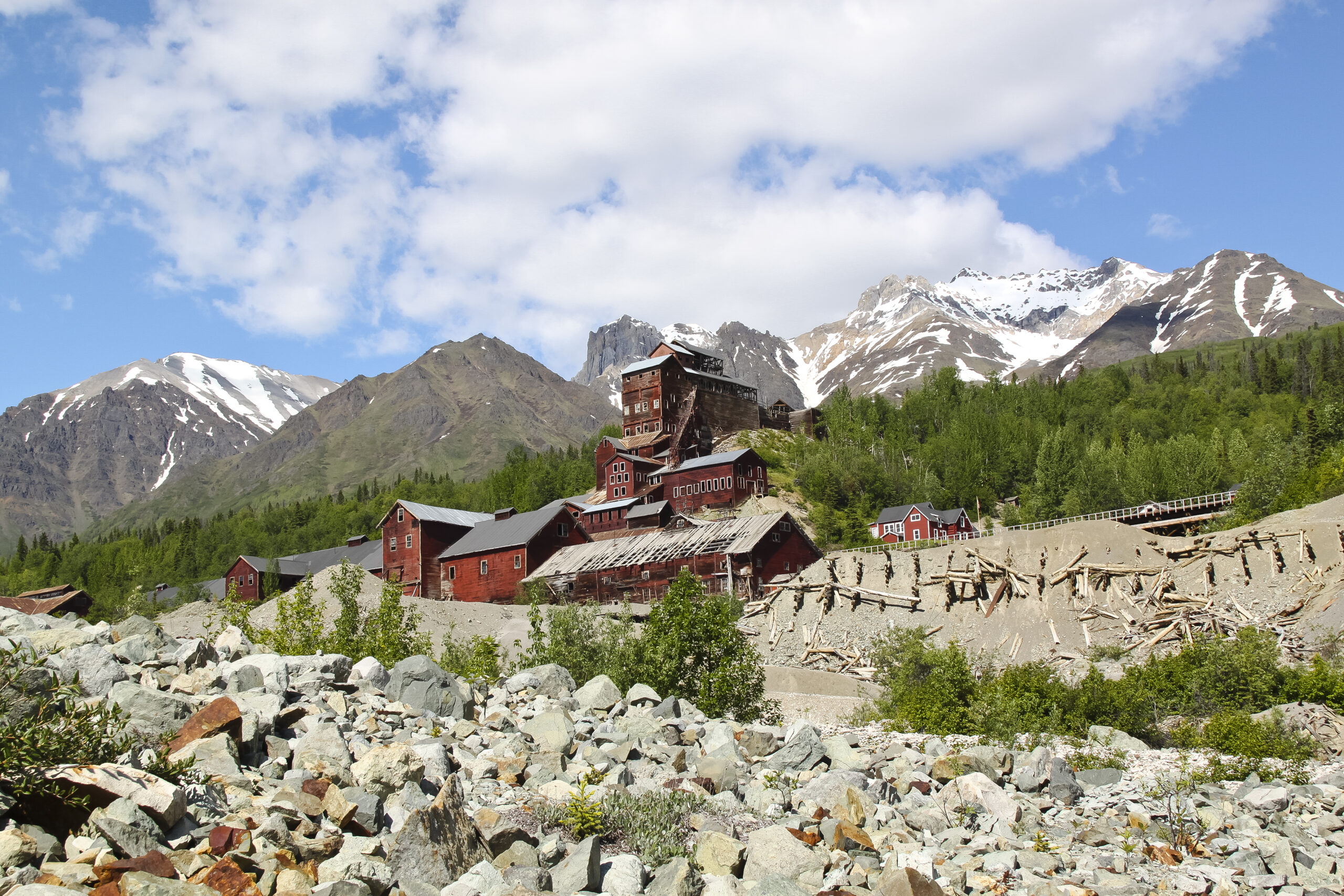
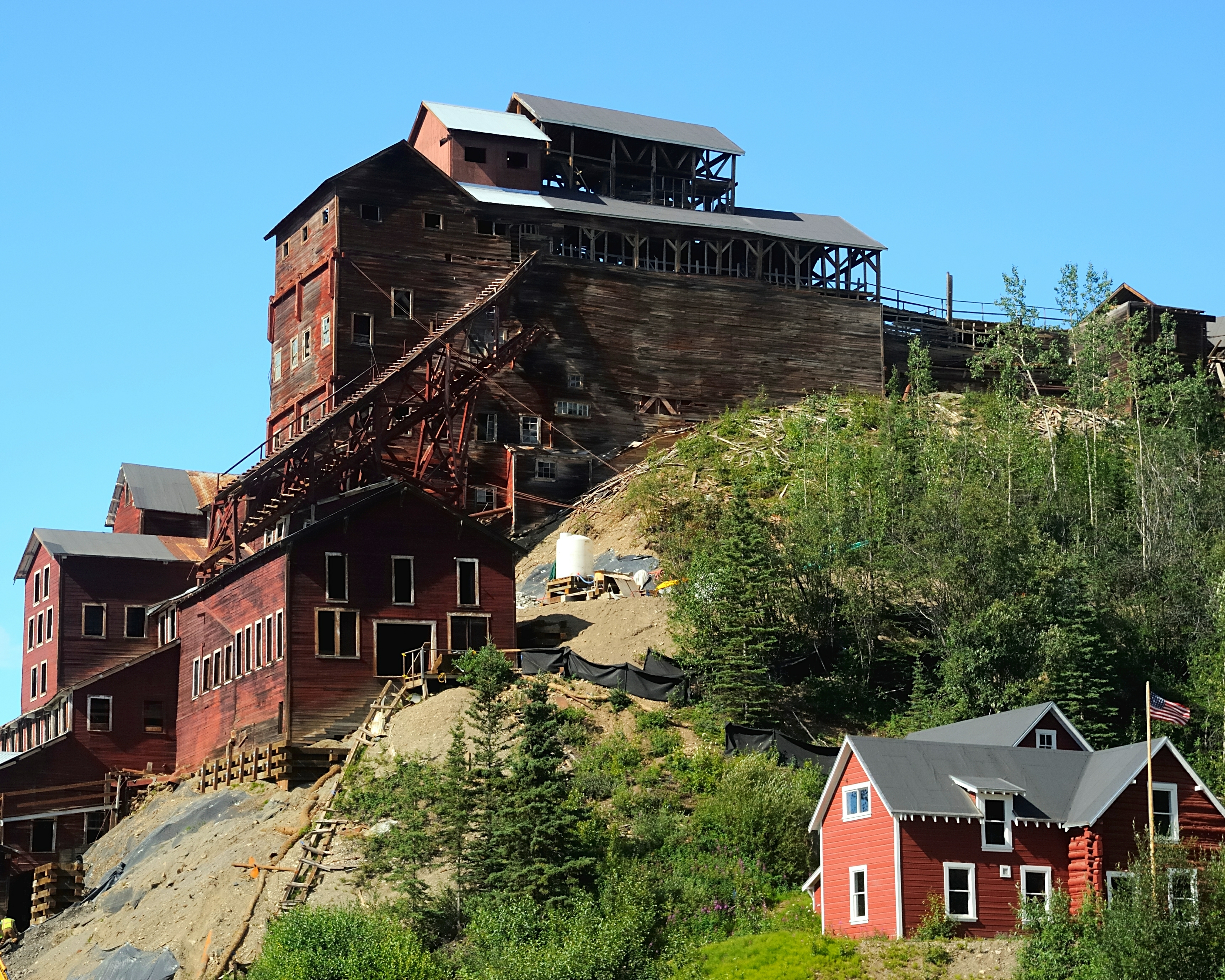
The heart of the operation was the 14-story Concentration Mill, built against the slope so gravity could carry ore downward through crushing, screening, and jigging stages. Because the chalcocite was locked in dense limestone, the plant added ammonia-leaching and flotation circuits to pull out copper concentrate before it was loaded onto rail cars. In its single best year, 1916 — with copper prices inflated by the First World War — Kennecott shipped ore worth $32.4 million. The profits ultimately bankrolled the parent company’s expansion into mines across North and South America.
The Last Train Out
Kennecott’s decline was driven by simple geology and corporate math. By the late 1920s the high-grade chalcocite veins were largely mined out, and costs climbed as the workings went deeper. At the same time the parent corporation was shifting its capital into lower-cost open-pit porphyry copper mines elsewhere. Chief among them was the vast Bingham Canyon operation in Utah, whose smelter supported its own planned company town, Garfield. The Great Depression flattened global metal demand, and mining at Kennecott was suspended entirely in 1933–34.
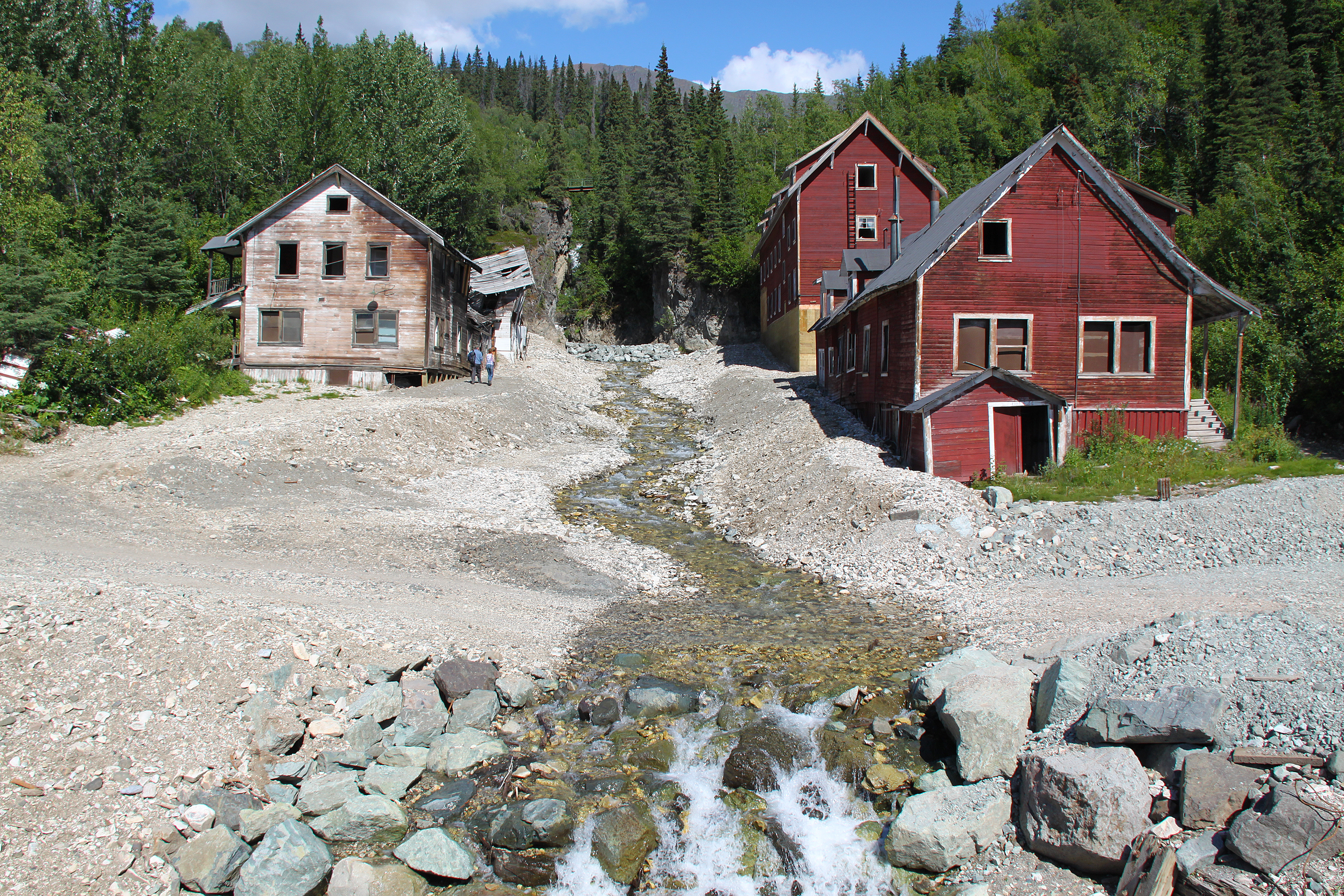
Operations briefly resumed, but the remaining reserves could not justify the cost of keeping the railway open through the Copper River canyon. By late 1938 the accessible ore was gone. The final commercial ore train left Kennecott on November 11, 1938, and within weeks the Copper River & Northwestern Railway shut down for good. The collapse rippled down the whole transportation corridor, gutting rail towns like Chitina. Neighboring McCarthy lost most of its population but never emptied out completely, so it never quite became a ghost town.
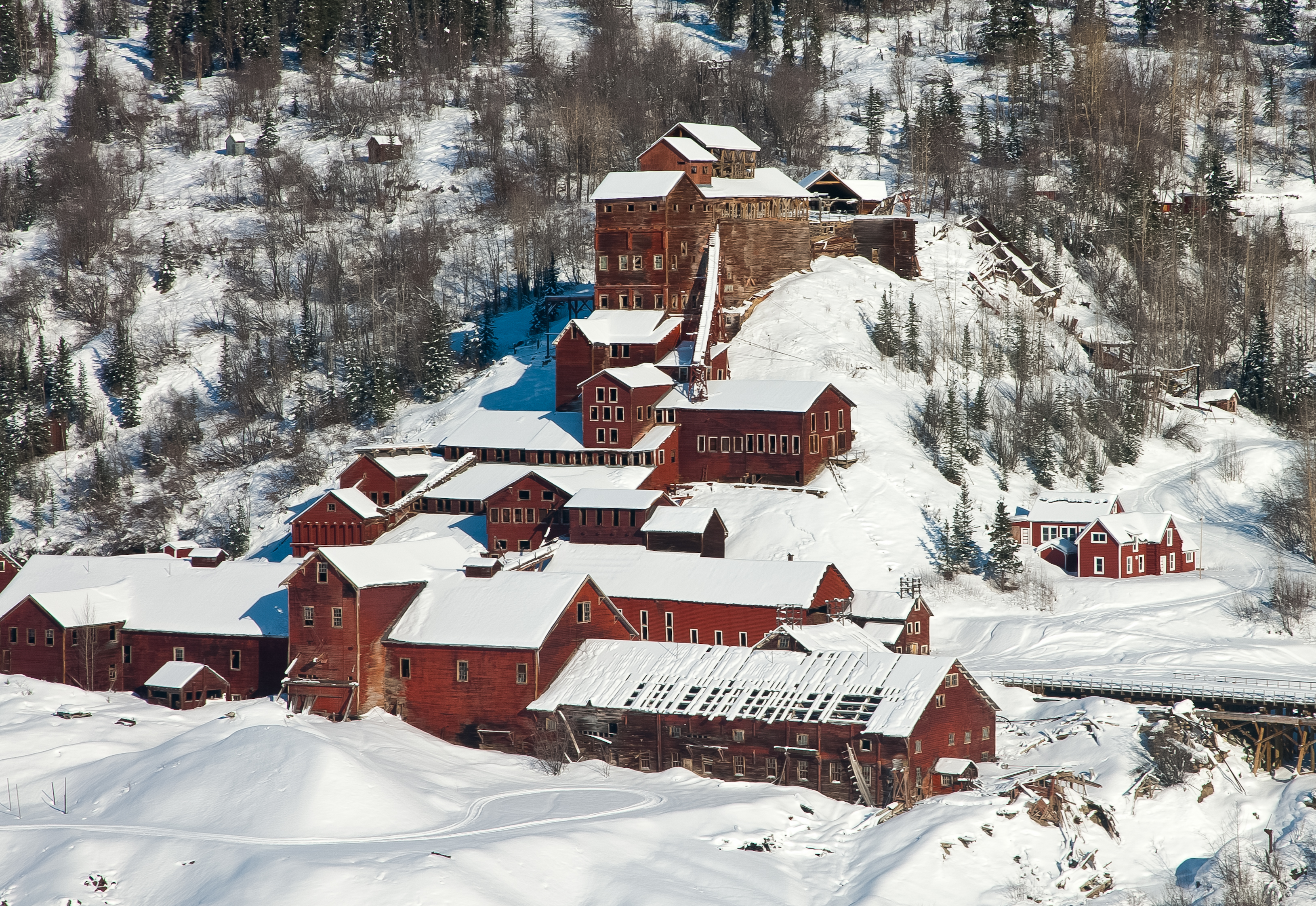
For decades the abandoned mill town sat almost untouched, weathering the subarctic climate and the slow shifting of the ground beside the moving glacier. Its industrial architecture was recognized as the Kennecott Mines National Historic Landmark in 1986, and in 1998 the National Park Service acquired the core structures within Wrangell–St. Elias National Park and Preserve. Working with local residents and groups such as the Friends of Kennicott, the Park Service has since carried out long-term stabilization, hazardous-material cleanup, and preservation work to keep the buildings from collapsing.
Phantom Whistles and the “Abandoned Overnight” Myth
Kennecott’s isolation and eerily intact buildings have made it a favorite of paranormal podcasts and television, and a small body of folklore has grown up around it — phantom train whistles echoing up the valley, disembodied voices in the old hospital, and shadowy figures along the high tramway lines. Park historians file all of this firmly under atmosphere: the natural effect of decaying industrial buildings standing alone in a vast wilderness.
Two other popular stories deserve a fact-check. The romantic version of the discovery has Smith and Warner hunting for horse pasture and mistaking the copper stain for a green meadow. In reality both men were experienced prospectors deliberately working the contact zones between limestone and greenstone where such deposits form.
Kennecott Timeline
Getting There
From Anchorage, the drive runs east on the Glenn Highway, south on the Richardson Highway, and east on the Edgerton Highway to Chitina, where the pavement ends. From there the McCarthy Road — about 59 miles of unimproved gravel following the old railroad grade — leads to the Kennicott River footbridge. Plan on roughly 7 to 8 hours total. Cross the footbridge on foot, then take a shuttle van, bike, or walk the final 5 miles up to Kennecott; private vehicles are not allowed into the mill town.
Nearby Historic Mining Sites
Kennecott anchors a whole landscape of early-twentieth-century mining ruins. Several sites within about 50 miles share its history — though most are far harder to reach than the mill town itself.
Hawley, A Kennecott Story (1997) · Wilson, “Kennecott: Alaskan Origins of a Copper Empire, 1900–1938,” Western Historical Quarterly · Olson & Shaine, Community & Copper in a Wild Land · National Park Service, Kennecott Mines National Historic Landmark and Wrangell–St. Elias interpretive materials · National Park Service, At Work in the Wrangells (photographic history) · St. Elias Alpine Guides visitor and tour information · Photos: Michael F. Wacht (CC BY-SA 4.0); W. Smith (CC BY-SA 3.0); Wrangell–St. Elias National Park / NPS, incl. Bryan Petrtyl (CC BY-SA 2.0); and a public-domain historic image, all via Wikimedia Commons