Piedmont Ghost Town, Wyoming: Charcoal Kilns, Butch Cassidy, and the Town That Helped Build a Railroad
In the summer of 1869, just days before one of the most celebrated moments in American history, a mob of 400 unpaid railroad workers stopped a train in its tracks in a remote corner of southwestern Wyoming — and held its passengers hostage until they got their money. The passengers included Thomas C. Durant, one of the most powerful figures in the Union Pacific Railroad. The town was Piedmont. And it never got the credit it deserved.
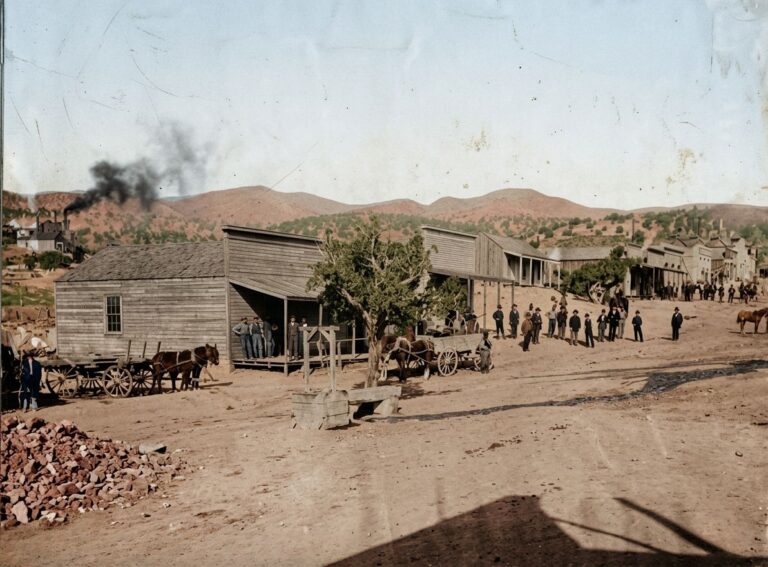
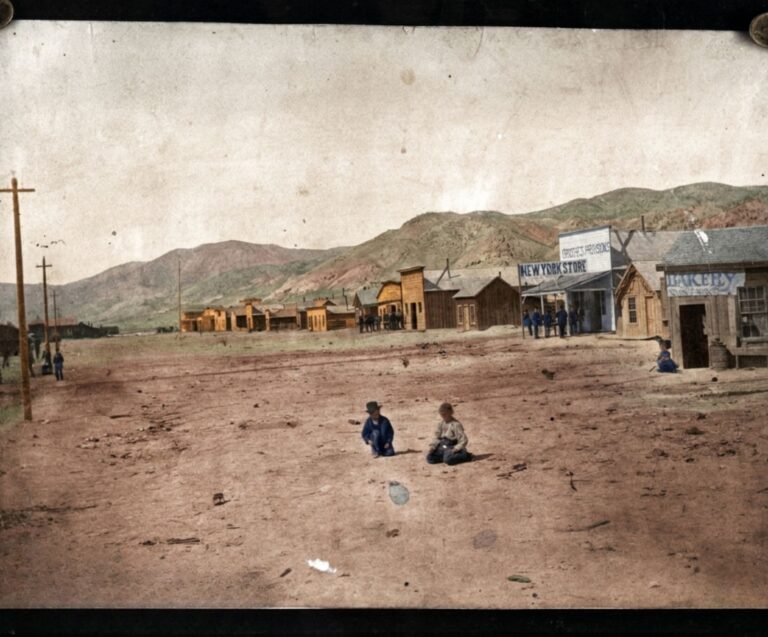
Today Piedmont sits quietly off Interstate 80 in Uinta County, its three surviving limestone charcoal kilns rising like stone chimneys from the sagebrush. A dozen weathered cabins still stand along what was once the main street. The cemetery hill overlooks it all. Getting there takes about ten minutes from the highway, costs nothing, and offers one of the most historically dense ghost town experiences in Wyoming — a place where the construction of the transcontinental railroad, an outlaw gang’s legal defense fund, and the economics of industrial charcoal all intersect on the same gravel road.
Born from the railroad grade: the founding of Piedmont (1867–1869)
Settlement at Piedmont began around 1867, driven not by gold or silver but by the Union Pacific’s westward push through the high terrain of southwestern Wyoming. The problem was topographical: the mountain grade toward Aspen Station was steep enough that 19th-century steam locomotives couldn’t summit it alone. Heavy freight trains needed helper engines — additional locomotives attached at the rear to push them over the top. That operational requirement needed a fixed base: a roundhouse to maintain the engines, a water tank to refill their boilers, a telegraph office to coordinate traffic. Piedmont was where those things got built.
During the winter and spring of 1868–1869, the camp functioned as a classic “Hell on Wheels” settlement — a dense, transient tent town of graders, laborers, Civil War veterans, and immigrants that followed the advancing end-of-track. Precise population counts are elusive, but historical evidence suggests that only about twenty permanent homes were established during this phase, even as the population surged into the hundreds or higher during peak construction.
The town was formally founded by two Mormon pioneers: Moses Byrne, an entrepreneur who arrived in 1869 and immediately set about building charcoal kilns, and Charles Guild, who established one of the earliest ranches in Wyoming Territory. The settlement was initially called Byrne in honor of its founder — but was later renamed Piedmont, likely derived from the Italian Piemonte (“foot of the mountain”), to prevent telegraph operators from confusing it with Byron Station on the same line.
The charcoal kilns: an industrial marvel in limestone
Moses Byrne’s most enduring contribution to Piedmont was not the town itself but the kilns. He recognized a gap in the regional industrial economy: the iron and silver smelters of the Salt Lake Valley needed charcoal — a high-energy, low-smoke fuel that burned hotter and cleaner than raw wood — and they needed it in quantity. The Union Pacific provided the transport. The Uinta Mountains to the south provided the timber. Byrne provided the infrastructure.
In 1869, he built the first five kilns. By 1873, the operation had grown to approximately 35 to 40 kilns, with monthly output reaching an estimated 100,000 bushels of charcoal. The product was shipped primarily to Utah smelters, with a portion going to nearby Fort Bridger for heating and blacksmith work.
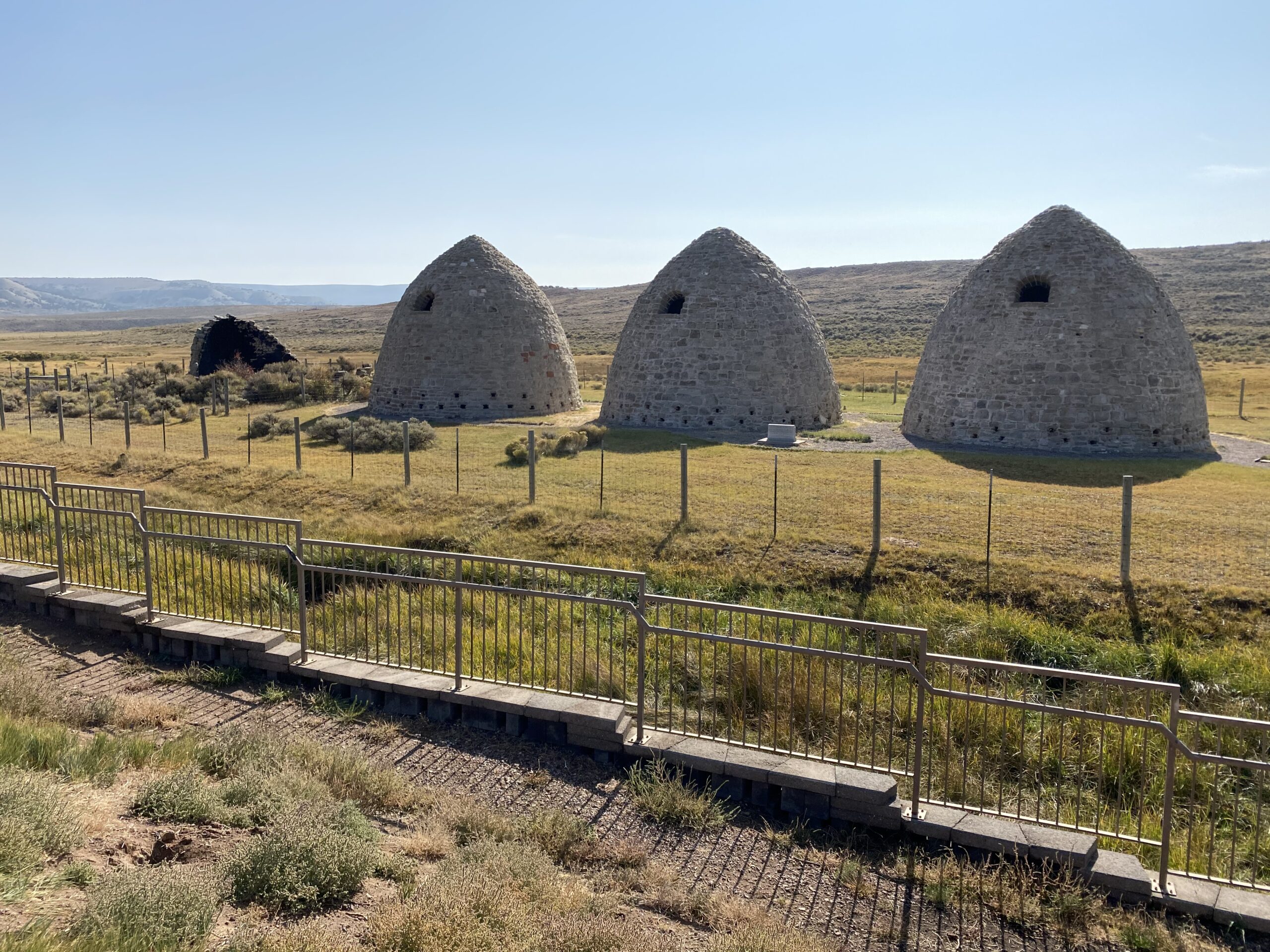
The kilns themselves are architectural objects worth studying up close. Each was built of native limestone in a conical, beehive shape — approximately 30 feet tall with a 30-foot base diameter — an architecture specifically engineered for the process of pyrolysis: the conversion of wood to carbon in a low-oxygen environment.
Of the original 35 to 40 kilns, three survive in near-perfect condition; a fourth is partially collapsed. They are now managed by Wyoming State Parks, Historic Sites and Trails, and were listed on the National Register of Historic Places on June 3, 1971 — among the earliest such recognitions for a Wyoming industrial site.
The hostage that almost delayed the Golden Spike
The Durant Standoff: 400 workers, one railroad baron, and $200,000 in unpaid wages
In early May 1869, just days before the scheduled completion of the transcontinental railroad at Promontory Summit, a mob of approximately 400 angry laborers in Piedmont physically blocked the tracks and refused to let a special train pass. On board were Thomas C. Durant — one of the most powerful executives in the Union Pacific — and other company dignitaries traveling toward Utah for the “Golden Spike” ceremony.
The workers were owed back wages totaling approximately $200,000. The Union Pacific, already mired in the financial misconduct that would eventually become the Crédit Mobilier scandal, had simply not paid them. The laborers had leverage, a train, and a telegraph office. They used all three.
Durant and his party were forced off the train and held in Piedmont for approximately 36 to 48 hours. Durant used the town’s telegraph to contact the railroad’s board of directors. The standoff was only resolved when financier Oliver Ames arranged for a partial payment of $50,000 to be sent to the workers — not the full amount owed, but enough to let the train proceed. The Golden Spike ceremony, originally scheduled for May 8, was postponed as a direct result of events in Piedmont.
The workers were never fully paid. But they made their point. And the ceremony happened — on May 10, 1869.
Butch Cassidy, the Wild Bunch, and the Montpelier bank job
In the decades after the railroad construction era, Piedmont’s remote location and rail connectivity made it a useful waypoint for figures operating on the wrong side of the law. The town is most closely associated with Butch Cassidy and members of the Wild Bunch gang, who reportedly used it as a meeting point and staging area in the 1890s.
The most documented connection involves a legal matter rather than a crime — at least directly. In 1896, Cassidy’s associate Matt Warner was arrested for murder in Utah. Cassidy sought to hire a skilled defense attorney and settled on Douglas Preston, a prominent Rock Springs lawyer who later became the Attorney General of Wyoming. According to historical accounts, Cassidy, along with Elzy Lay and Bub Meeks, used Piedmont as a location to meet with Preston and discuss the case.
The problem was funding. To raise the legal fees, the three men robbed the bank in Montpelier, Idaho, on August 13, 1896, taking over $7,000. The proceeds were reportedly delivered to Preston, partially via Piedmont. Preston’s representation was effective: he couldn’t get the charges dismissed entirely, but he succeeded in reducing Warner’s sentence from murder to manslaughter.
The bypass that killed a town: the Aspen Tunnel and the end of Piedmont (1901–1940s)
Piedmont’s death was slower and more ironic than most. The town hadn’t been ruined by a silver crash, a flood, or a fire. It was undone by the very progress it had helped to enable.
Between roughly 1901 and 1910, the Union Pacific completed construction of the Aspen Tunnel — a major engineering project that created a new, lower-grade route through the terrain, entirely bypassing the steep mountainside that had made Piedmont necessary in the first place. Without the grade, there was no need for helper engines. Without the engines, the roundhouse closed. Without the roundhouse crews, the town’s commercial establishments — the general store, the hotel, the saloons — lost their customer base.
The charcoal industry had already been contracting for years. By the early 20th century, smelting technology had shifted to coal and coke, which were more energy-dense and easier to transport in bulk. The price of charcoal had fallen from 27 cents per bushel to 7 cents, squeezing margins until production was no longer viable.
A small community of ranchers and persistent residents kept Piedmont technically alive through the 1940s. When the post office finally closed, it was over. The abandoned Union Pacific grade — now the county road into town — is the most direct physical reminder of what brought Piedmont into existence and what eventually made it obsolete.
Legends and local lore
The Hellhound of Piedmont
A recurring thread in local folklore involves sightings of a “Hellhound” or Black Dog in the vicinity of Piedmont and the nearby settlement of Sage — described as a large, spectral canine with glowing red eyes. In broader Western folk tradition, such creatures are sometimes interpreted as guardians of cemeteries or forgotten treasure. Piedmont’s isolation and the eerie atmosphere of its ruins have made it fertile ground for this kind of story. The legend is best understood as a psychological artifact of the site’s stark emptiness rather than as a documented phenomenon.
Ghost lights and 19th-century figures
Travelers and local residents have occasionally reported paranormal activity at Piedmont — particularly around the Byrne cemetery and the abandoned cabins — including accounts of “ghost lights” and sightings of figures in 19th-century clothing. These accounts circulate in regional treasure-tale literature and oral tradition. They are part of the site’s legendary landscape, not its documented history.
What to see
The charcoal kilns
The three surviving limestone kilns are the centerpiece of any visit. Their beehive shape is striking enough to read clearly from the county road, and up close the craftsmanship of the native limestone construction is remarkable — these are not rough frontier shelters but precision-built industrial structures that have stood for over 150 years. Interpretive signage on-site explains the production process. Allow time to walk around all three and examine the vent openings at the base.
Main street and the surviving cabins
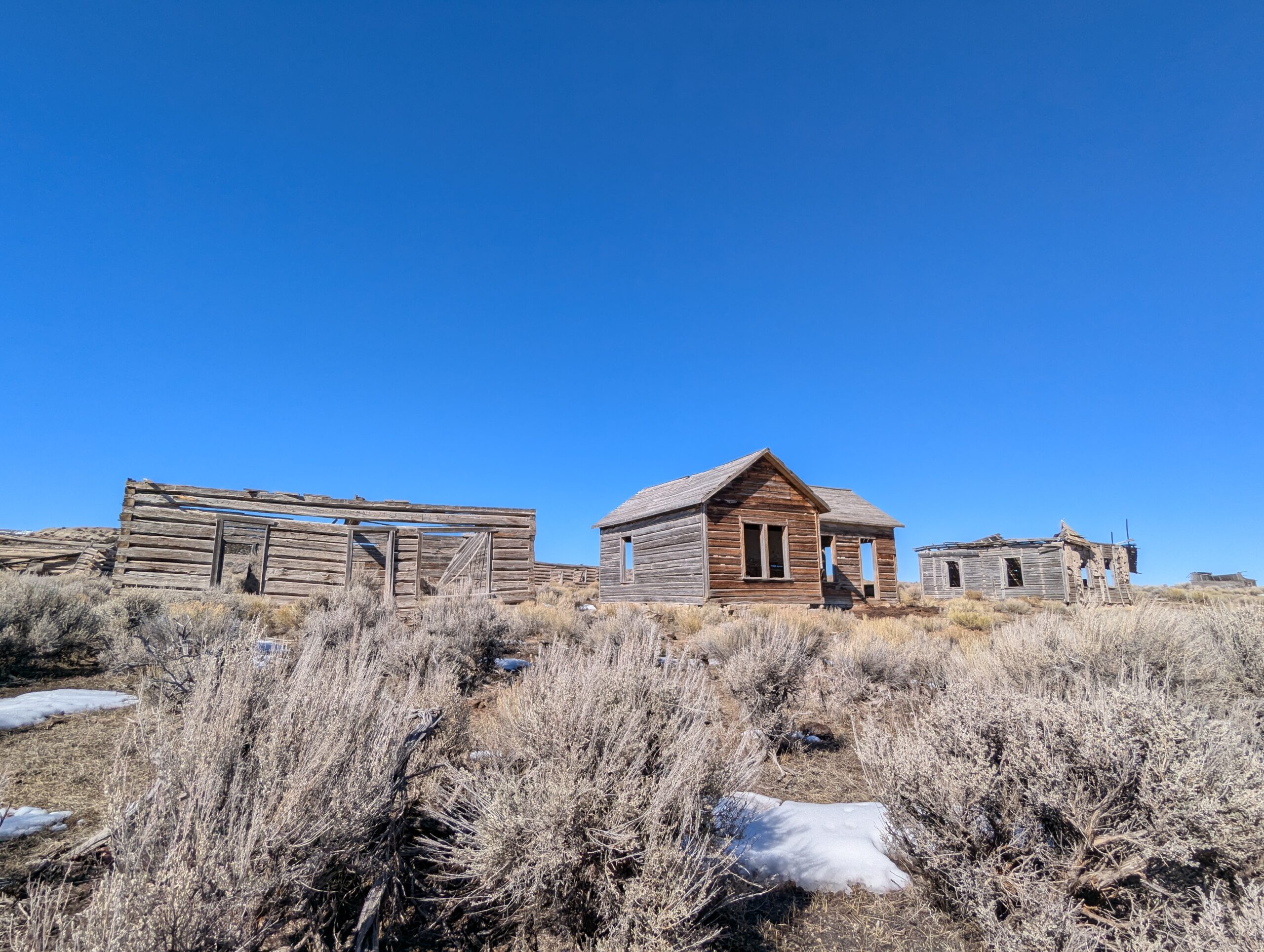
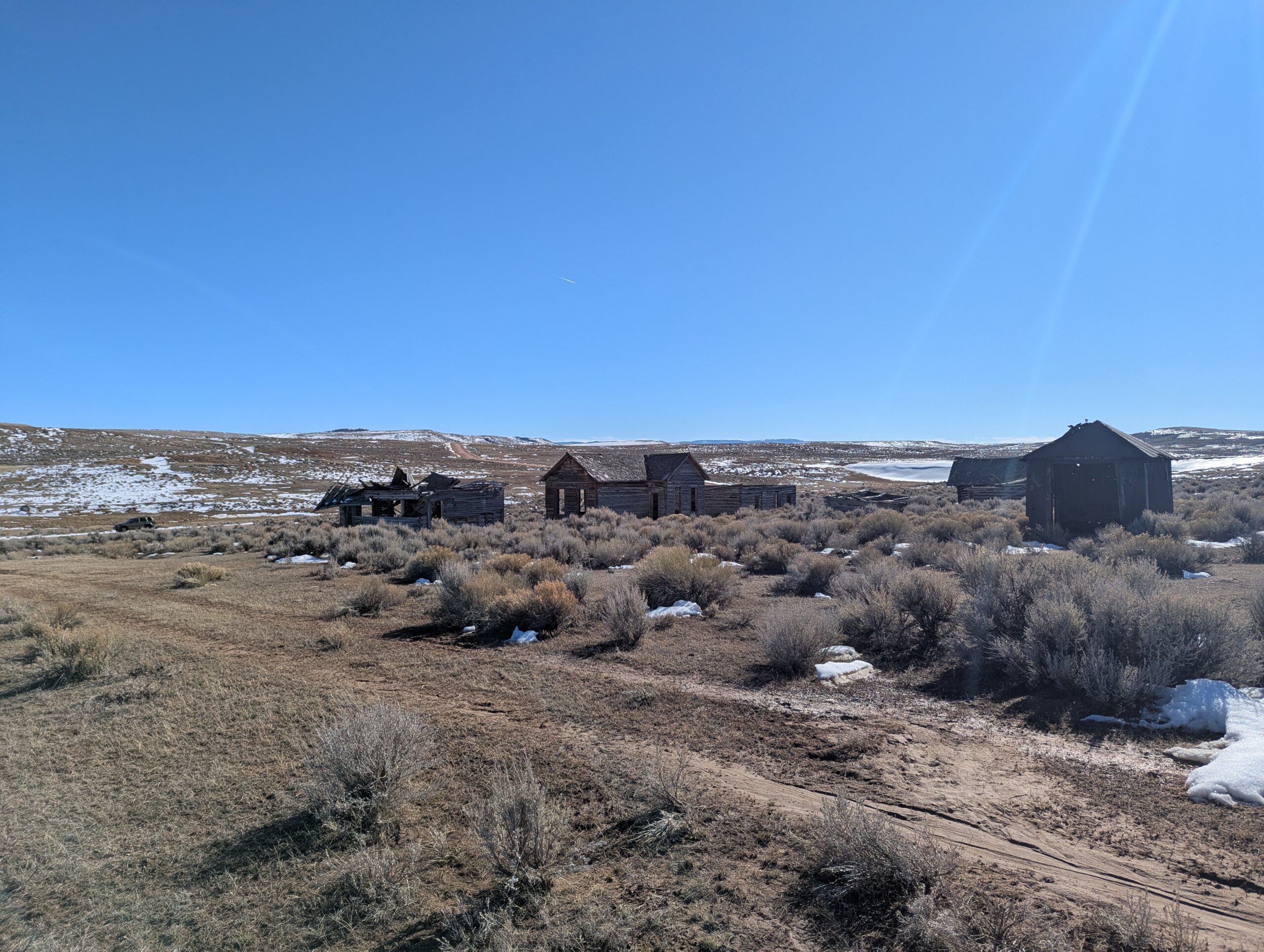
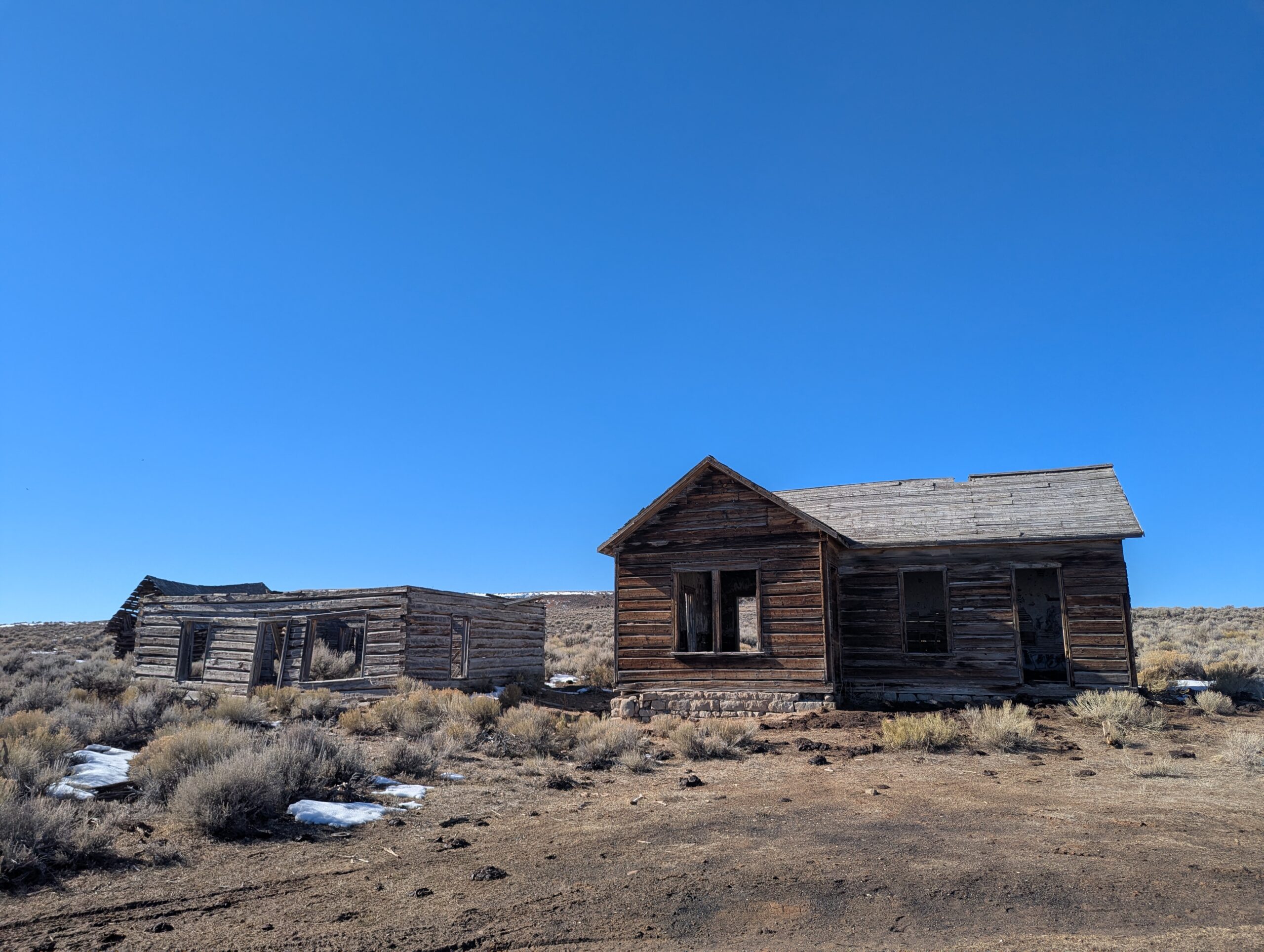
About a dozen wood-framed cabins still stand in varying states of decay along what was once Piedmont’s main street. Some retain their original flooring; some have adobe siding still partially intact. This is as close to an unrestored, unmanaged 19th-century Wyoming residential streetscape as you are likely to find anywhere in the state. Do not enter the buildings, but the exteriors repay careful observation.
The schoolhouse foundations
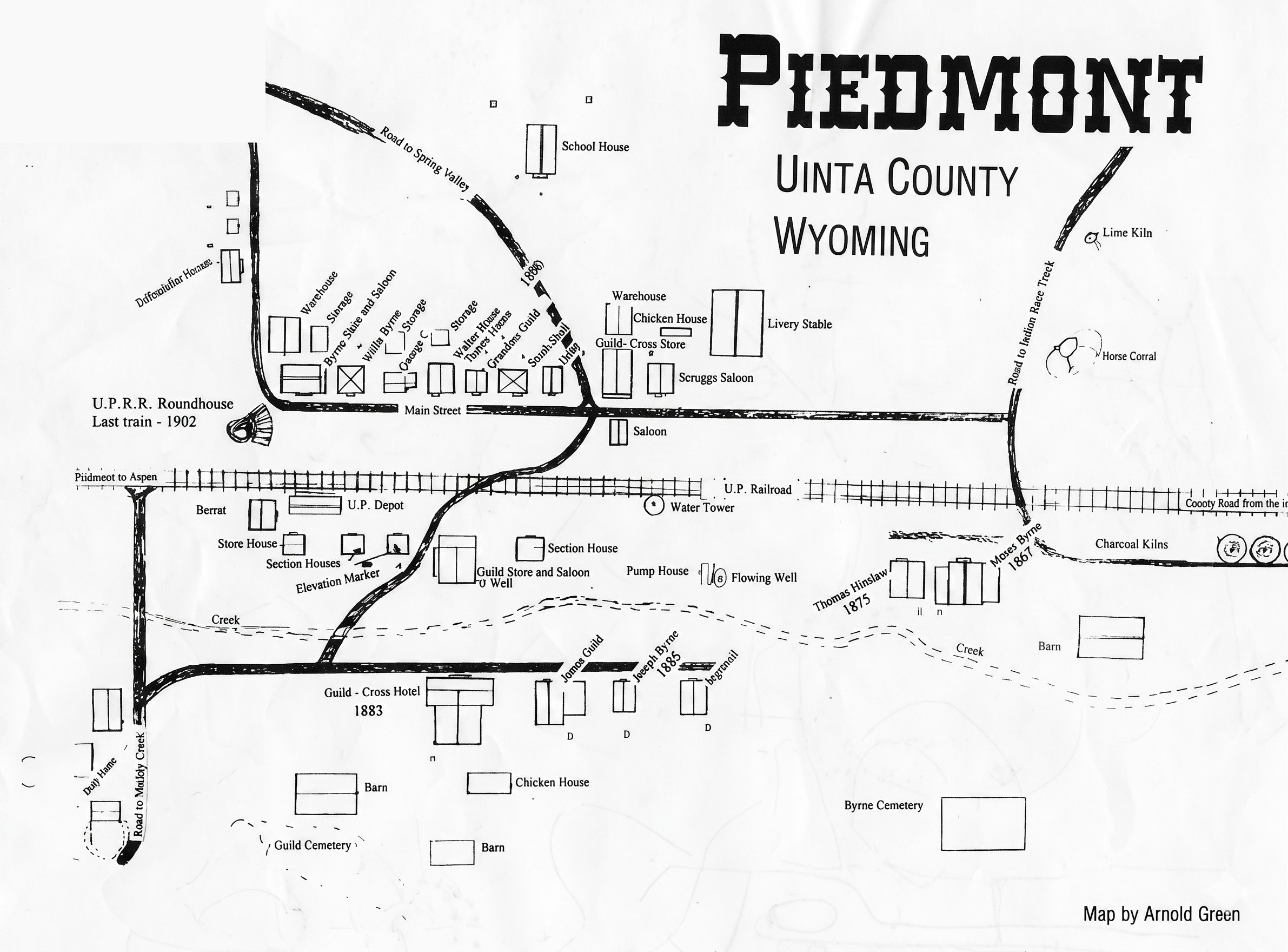
The elevated foundations of the old schoolhouse offer the best vantage point over the town — a perspective that makes Piedmont’s original footprint legible in a way that ground-level exploration doesn’t. From here the relationship between the residential core, the industrial kilns, and the railroad grade all comes into focus.
The Byrne family cemetery
Located on the hill east of the town, the cemetery is the most intimate part of the site. The grave of Moses Byrne — the town’s founder — is the largest and most identifiable marker. Treat it with appropriate respect. This is an active historic site, not a tourist attraction.
The abandoned railroad grade
The original Union Pacific grade that Piedmont existed to serve is now the county road into town. Walking a section of it makes the town’s entire story concrete: this is the line that brought the construction workers, the charcoal market, the helper engines, and the outlaw traffic — and whose rerouting through the Aspen Tunnel made all of it obsolete.
Historical sites nearby
Further reading
Sources
Wyoming State Parks — Piedmont Charcoal Kilns
WyoHistory.org — Piedmont Charcoal Kilns Field Trip
Wikipedia — Piedmont, Wyoming
Union Pacific Railroad Museum — Hidden Histories of the Transcontinental Railroad
Cowboy State Daily — The 1896 Montpelier Bank Robbery
WyoHistory.org — Uinta County, Wyoming
Utah’s Adventure Family — Piedmont Charcoal Kilns & Ghost Town
Map courtesy RootsWeb / Arnold Green
More ghost towns in Wyoming: South Pass City