Ashcroft, Colorado: The Silver Camp in Aspen’s Backyard
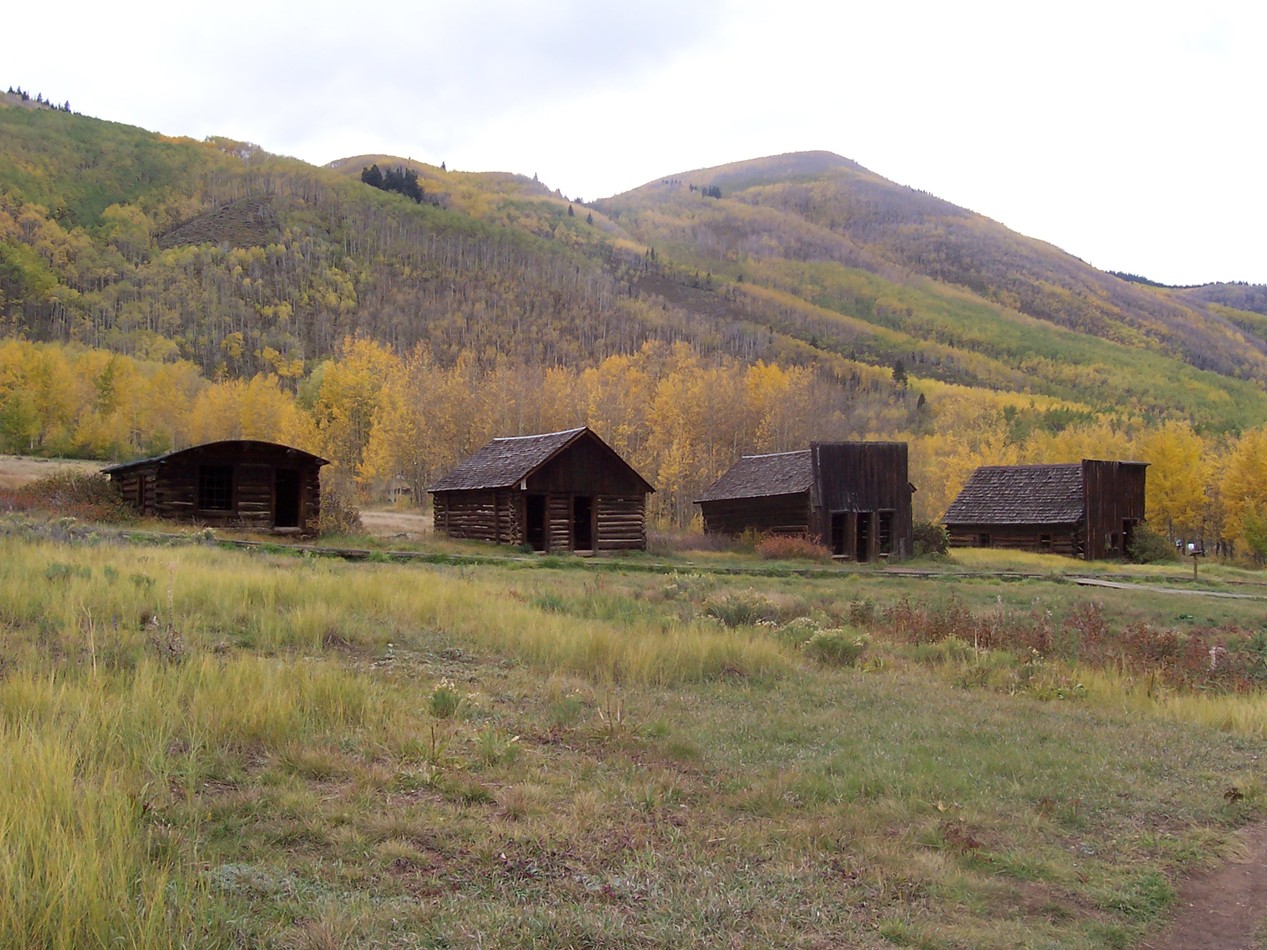
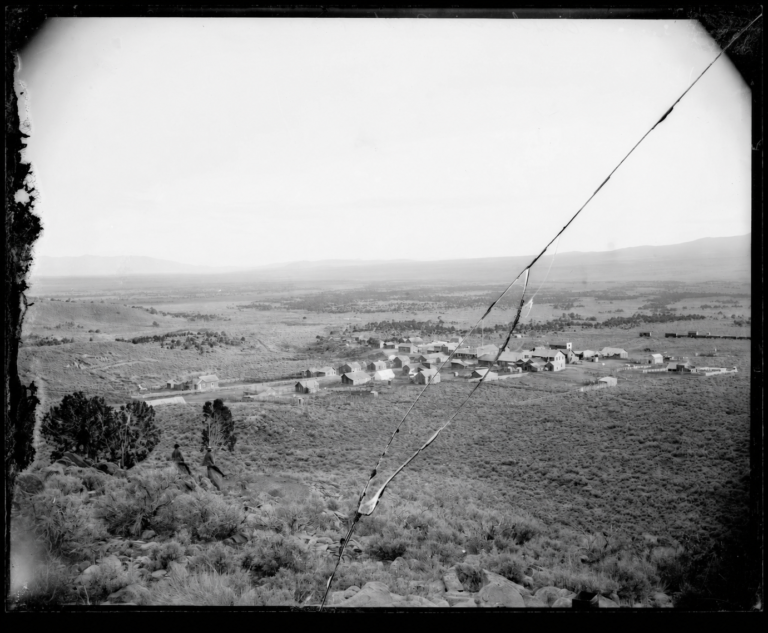
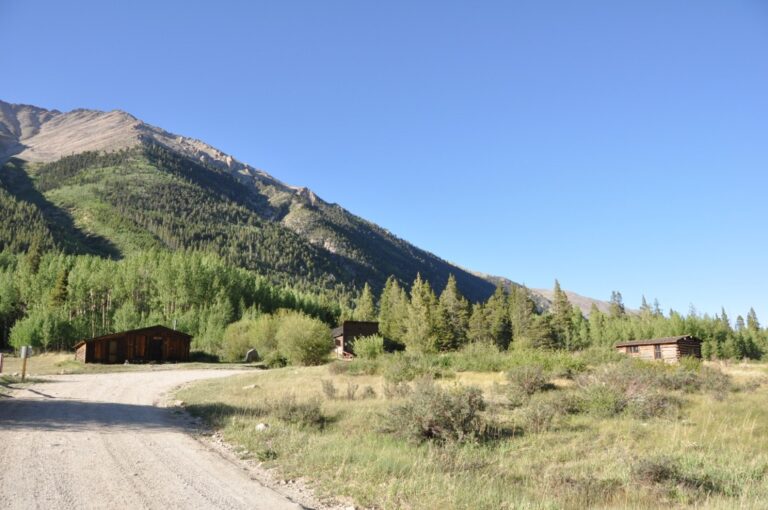
Ashcroft is a silver-mining ghost town about 11 miles up Castle Creek Road from Aspen, sitting in a high meadow at roughly 9,500 feet below the peaks of the Elk Mountains. Prospectors from Leadville founded it in 1880, and for a few years it was the bigger, busier camp in the valley, with hotels, saloons, two newspapers and a population that may have topped 2,000. Its silver lay in shallow surface pockets, and when Aspen’s far richer mines and two railroads arrived down the valley, Ashcroft emptied almost as fast as it had filled. A ski-resort dream in the 1930s, Army mountain training in World War II and a 1950s television western all passed through before the Aspen Historical Society took over the townsite in 1974. Today it is one of the easiest Colorado ghost towns to visit, with a cluster of weathered log buildings on a paved road.
Castle Forks City
The Castle Creek Valley was Ute country long before any miners arrived. Bands of the Ute people hunted and camped in these mountains in summer, and they were forced out of western Colorado by treaties and removals that were complete by 1881, just as the mining rush reached the valley.
In the spring of 1880, Charles B. Culver and W. F. Coxhead crossed the mountains from Leadville, which was then the center of Colorado’s silver boom, and found silver ore near the forks of Castle Creek. Culver, remembered as “Crazy” Culver, stayed to hold the ground while Coxhead went back for supplies. When Coxhead returned, other prospectors had joined Culver at a camp called Castle Forks City. They formed a Miner’s Protective Association, laid out streets and built a courthouse within weeks.
By August 1880 a town company was selling lots, and a post office opened under the name Ashcroft. The name came from T. E. Ashcraft, a promoter who bought into the town company in 1881. The post office was briefly renamed Chloride, then changed back to Ashcroft on January 3, 1882, the name that stuck.
The boom years
For a few years Ashcroft had the better position in the valley. Freight and passengers came in over Taylor Pass and Pearl Pass from the railheads at Buena Vista and Crested Butte, steep routes that were often snowbound but shorter than the early trails into Aspen. At its height the town had six hotels, as many as 20 saloons, two grocery stores, a meat market, a school, sawmills, a small smelter and even a bowling alley. Two newspapers, among them the Ashcroft Journal, printed claim notices and boosted the camp to distant investors.
The most famous investor was Horace A. W. Tabor, Leadville’s “Silver King.” He bought a half interest in the Tam O’Shanter mine, high on the slopes above town, reportedly for $100,000, and had a stake in the neighboring Montezuma. Ore from mines high on the slopes had to come down by pack train and, according to some accounts, by aerial tramway.
Tabor’s night on the town. A favorite Ashcroft story says that Tabor and his new wife, Elizabeth “Baby Doe” Tabor, visited in 1883, threw a banquet and a ball, and bought a round of drinks for everyone in every saloon in town.
Shallow silver and the railroad that never came
Ashcroft’s ore was rich near the surface but did not go deep. The veins turned out to be shallow pockets, and as they played out in the mid-1880s there was nothing below them to keep the mines running. At the same moment, Aspen’s mines, such as the Smuggler and the Mollie Gibson, were proving to be among the richest silver producers in the country.
Transportation settled it. The Denver & Rio Grande reached Aspen in 1887 and the Colorado Midland in 1888, and neither built up Castle Creek. A planned line toward Crested Butte never happened. Without a railroad, low-grade ore could not be shipped from Ashcroft at a profit, and people followed the work down the valley. Residents were already leaving for Aspen by 1883, and some took their buildings with them. The silver crash of 1893 finished off what mining was left.
Ashcroft never quite died. A few miners and old-timers stayed on, and by 1912 fewer than 50 people remained. The post office closed in November of that year.
The last resident
Through the 1920s and 1930s, the town belonged to a handful of holdouts. The best known was Jack Leahy, a miner who stayed on in the empty town, kept up a claim, and by local accounts entertained the occasional visitor with stories and styled himself its mayor. When Leahy died in 1939, Ashcroft had no year-round residents left.
A ski resort that almost was
In 1936 the valley got a new kind of prospector. Billy Fiske, an American bobsledder who had won Olympic gold in 1928 and 1932, and his partner Ted Ryan saw in the peaks above Ashcroft a chance to build an American St. Moritz. With local mining man T. J. Flynn, they formed the Highland Bavarian Corporation and built the Highland Bavarian Lodge near the meeting of Castle and Conundrum creeks, north of the townsite, which opened in December 1936. The Swiss mountaineer and avalanche expert André Roch surveyed the area and picked out the slopes of Hayden Peak, which he called Ski Hayden, for a European-style resort with a long aerial tramway from Ashcroft.
The war ended the plan. Fiske joined Britain’s Royal Air Force in 1939, claiming to be Canadian to get around American neutrality. He was badly burned when his Hurricane was hit on August 16, 1940, during the Battle of Britain, and died the next day. A plaque in St Paul’s Cathedral in London honors him. Ryan leased Ashcroft to the U.S. Army for a dollar a year, and soldiers of the 10th Mountain Division trained in the surrounding mountains, mostly in the summer of 1942. After the war the skiing went to Aspen Mountain instead, and the Hayden tramway was never built.
Sled dogs and Sergeant Preston
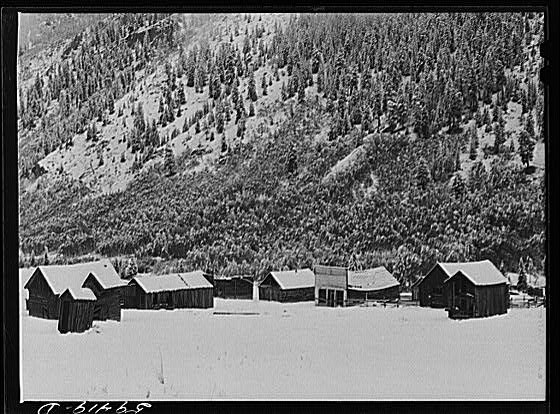
In 1948 Stuart Mace, a 10th Mountain Division veteran who had worked with Army sled dogs, settled across Castle Creek Road from the townsite with his family and built Toklat Lodge. He ran dog-sled trips with his huskies and became the unofficial caretaker of the old town.
His dogs brought Ashcroft a brief turn in show business. In the mid to late 1950s, Mace’s huskies and the townsite appeared in the television series Sergeant Preston of the Yukon, with Ashcroft standing in for a Canadian gold-rush town. The film crews added false fronts to some buildings, so a few of the fronts you see today may date from the 1950s rather than the 1880s.
Saving what was left
By the early 1970s the remaining buildings were sagging under decades of heavy snow. In 1974 the U.S. Forest Service gave the Aspen Historical Society a permit to manage the townsite, an early example of a local historical society taking charge of a ghost town on federal land. The preservationist Ramona Markalunas led the effort, and Ashcroft was listed on the National Register of Historic Places on May 12, 1975.
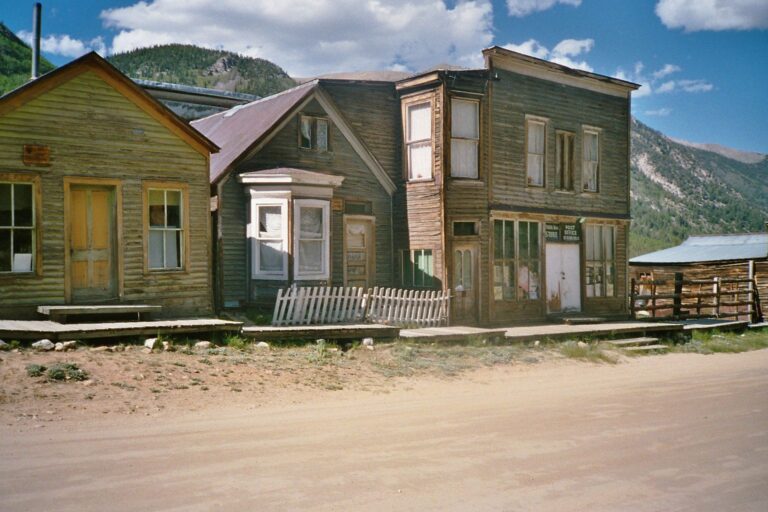
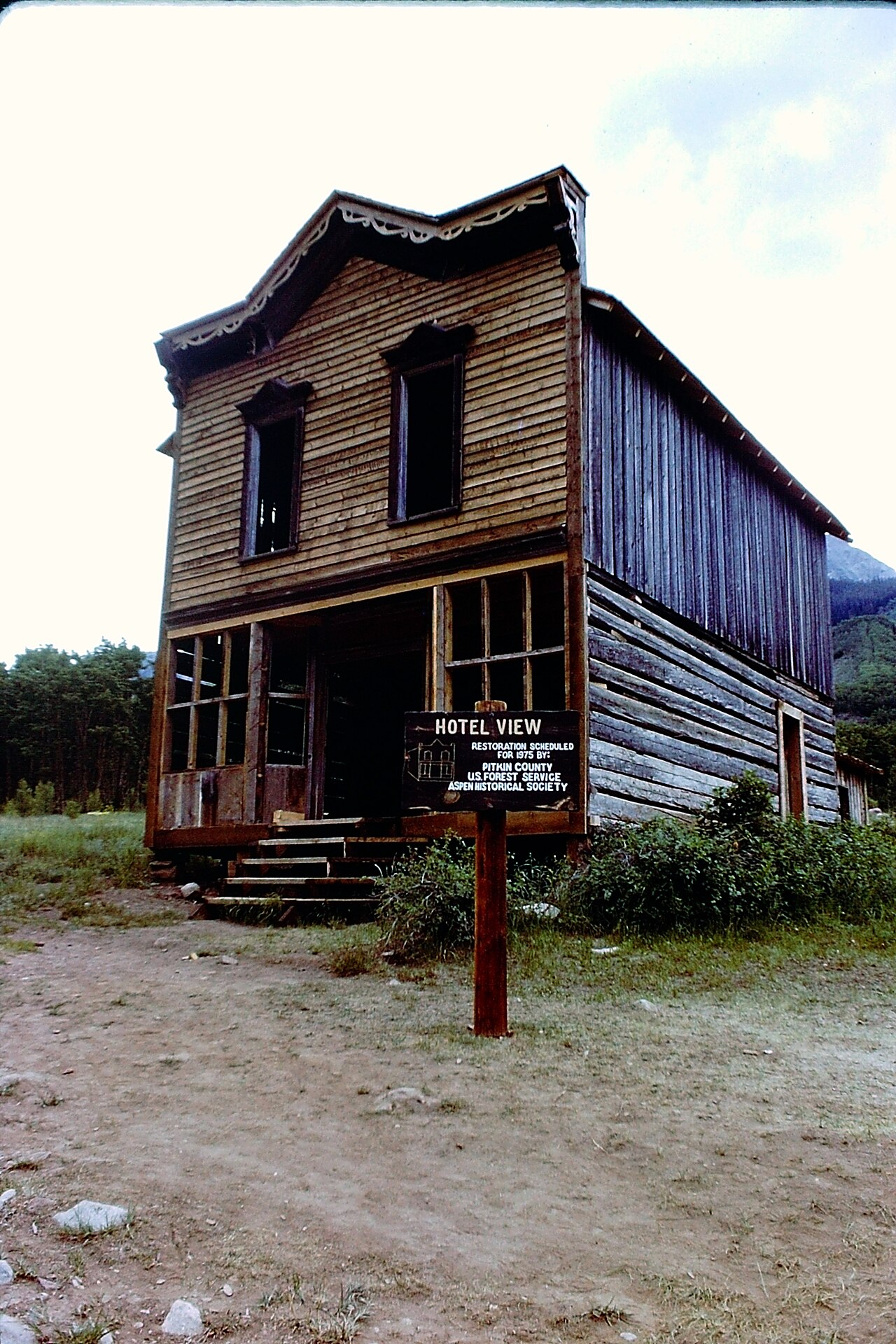
The society’s approach is stabilization rather than rebuilding: keep the surviving buildings standing and weathered, and repair only what is needed to save them. The two-story Hotel View, the town’s most recognizable building, was restored as part of that work.
What remains
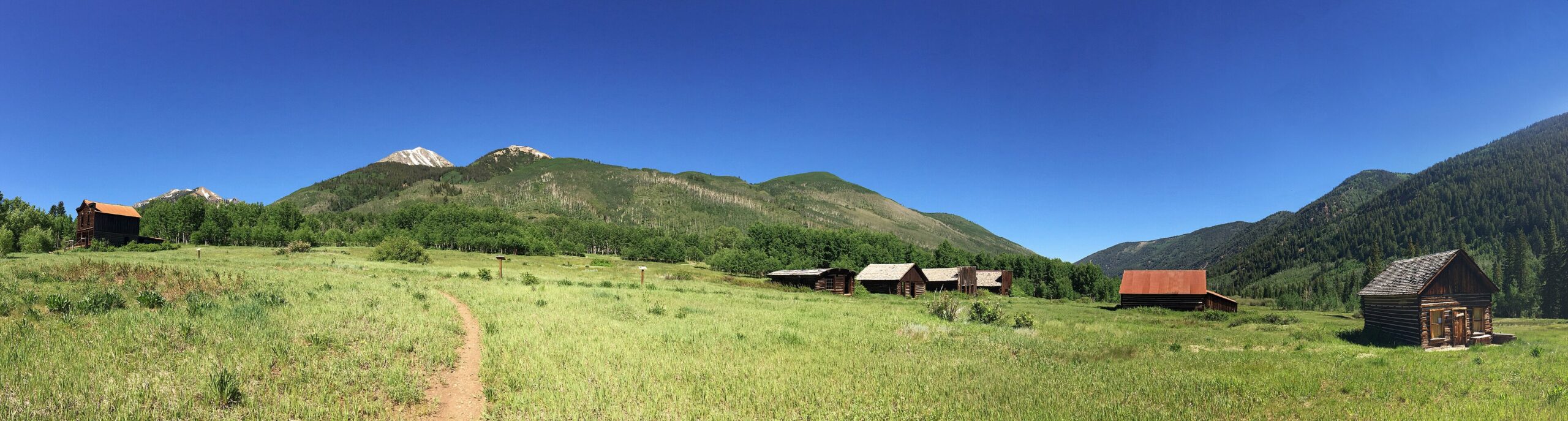
About a dozen buildings stand along the old main street and around the meadow. One history counts 13, about half of them original to the town; others were moved in or rebuilt. Among them are the Hotel View, the small post office, the Kinney Mercantile and the Ashcroft Journal building. The post office stands in its original spot but is not the town’s first one; as Ashcroft shrank, the postmaster moved into a smaller building that was easier to heat. A footpath with interpretive signs connects the buildings, and in summer a gift shop operates in one of the cabins.
Ashcroft in winter
In winter the valley belongs to cross-country skiers. Ted Ryan, the ski-resort partner from the 1930s, opened a Nordic ski area here in 1971, and Ashcroft Ski Touring still grooms more than 35 kilometers of trails on National Forest land around the townsite, for a fee. The trails lead past the snowed-in buildings to the Pine Creek Cookhouse, a mountain restaurant farther up the valley that winter visitors reach on skis, snowshoes or a horse-drawn sleigh. Castle Creek Road is open in winter as far as the ski area gate.
The old wagon road over Pearl Pass, which once linked Ashcroft to Crested Butte, has its own place in sports history. In 1976 a group of Crested Butte riders took heavy old “klunker” bicycles over the pass and down past Ashcroft to Aspen, a ride often counted as one of the first organized mountain-bike tours.
Timeline
Historic sites nearby
Further reading
Sources
Aspen Historical Society — Ashcroft Ghost Town — history, visitor hours, admission and rules
HistoryNet — Ghost Town: Ashcroft, Colorado — founding, Tabor, surviving buildings
The Aspen Times — Ashcroft: An American St. Moritz? — the Highland Bavarian Lodge and the Hayden plan
U.S. Forest Service — Ashcroft Nordic Ski Area — winter access
National Park Service — National Register listing for Ashcroft
Wikipedia — Ashcroft, Colorado and Billy Fiske
Photos: John Holm, CC BY 2.0; Marion Post Wolcott, Farm Security Administration, Library of Congress, public domain; Robert W. McLeod, CC BY-SA 4.0; Lorie Shaull, CC BY-SA 2.0. Licenses: CC BY 2.0, CC BY-SA 2.0, CC BY-SA 4.0.